

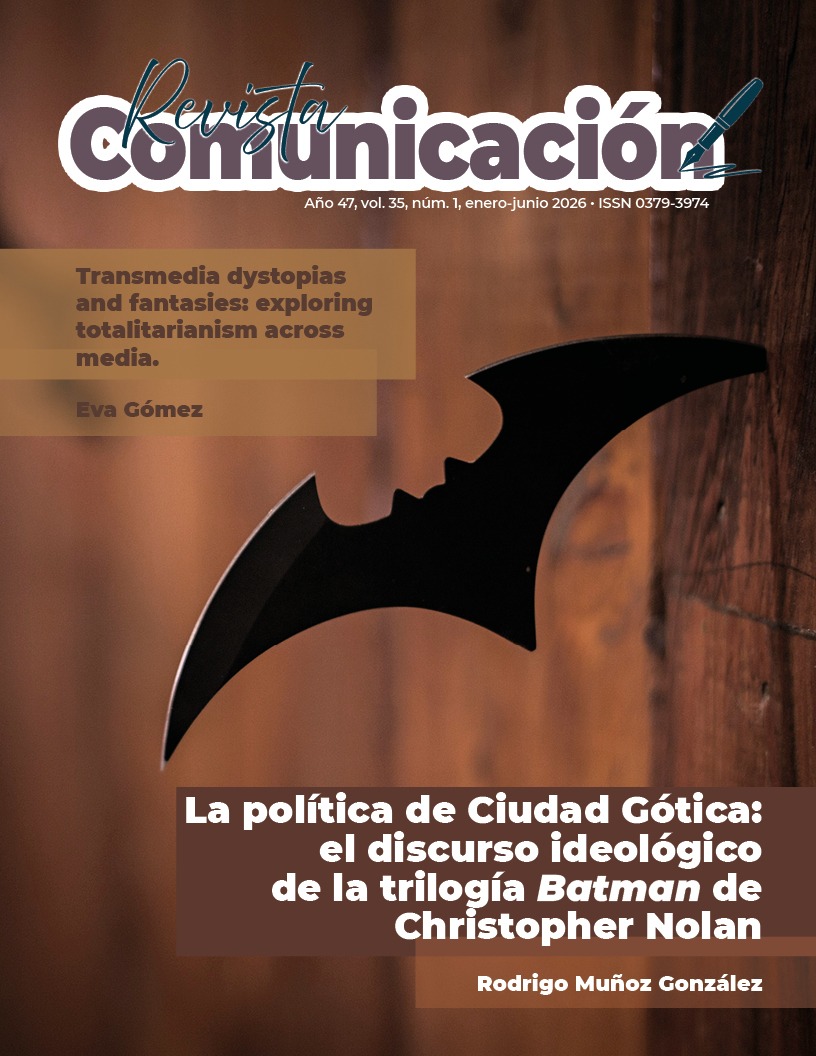
La política de Ciudad Gótica: el discurso ideológico de la trilogía Batman de Christopher Nolan
Barra lateral del artículo
Contenido principal del artículo
Resumen
Este artículo estudia la trilogía de Batman de Christopher Nolan (2005-2012) desde el análisis crítico del discurso para desentrañar su operación ideológica. Con una matriz cualitativa, examinamos identidad, objetivos y acciones tanto de Batman como de sus antagonistas, al articular los ideologemas que estructuran el relato. Los hallazgos muestran una defensa del statu quo: Batman, héroe filantrópico de origen oligárquico, restaura orden y propiedad mediante excepciones autoritarias y producción de símbolos. Los villanos condensan críticas al orden, al capital y al sistema político, refigurados como amenaza “externa” y caos. Se dibuja una geografía moral de clase virtud descendente, criminalidad ascendente–, así como una metáfora de invasión que personaliza el mal y oculta causas estructurales. Se concluye que la trilogía promueve conciencia cívica, no política, también, proponemos ampliar el análisis hacia producción, consumo y materialidad para futuras investigaciones.
Detalles del artículo

Esta obra está bajo una licencia internacional Creative Commons Atribución-NoComercial-SinDerivadas 4.0.
This work is licensed under a Deed - Atribución/Reconocimiento-NoComercial-SinDerivados 4.0 Internacional - Creative Commons.
Política de acceso abierto
Esta revista provee acceso libre inmediato a su contenido bajo el principio de que hacer disponible gratuitamente investigación al público apoya a un mayor intercambio de conocimiento global.
Ser una revista de acceso abierto, implica que todo el contenido es de libre acceso y sin costo alguno para el usuario o usuaria, o institución. Las personas usuarias pueden leer, descargar, copiar, distribuir, imprimir y buscar los artículos en esta revista sin pedir permiso previo del editor o el autor con fines educativos y no de lucro.
La única limitación de la reproducción y la distribución, y el único papel de los derechos de autor en este ámbito, debe ser dar a los autores el control sobre la integridad de su trabajo y el derecho a ser debidamente reconocidos y citados. (Budapest Open Access Iniciative)
LICENCIAMIENTO Y PROTECCIÓN INTELECTUAL
Todos los artículos publicados, están protegidos con una licencia Creative Commons 4.0 (Deed - Atribución/Reconocimiento-NoComercial-SinDerivados 4.0 Internacional - Creative Commons) de Costa Rica. Consulte esta licencia en: https://creativecommons.org/licenses/by-nc-nd/4.0/deed.es
Las licencias constituyen un complemento al derecho de autor tradicional, en los siguientes términos:
- Se impide la obra derivada (es decir, no se puede alterar, transformar ni ampliar el documento).
b. Siempre debe reconocerse la autoría del documento referido.
c. Ningún documento publicado en la Revista Comunicación, puede tener fines comerciales de ninguna naturaleza.
Mediante estas licencias, la revista garantiza al autor que su obra está protegida legalmente, tanto bajo la legislación nacional como internacional. Por tal motivo, cuando sea demostrada la alteración, la modificación o el plagio parcial o total de una de las publicaciones de esta revista, la infracción será sometida a arbitraje internacional en tanto que se están violentando las normas de publicación de quienes participan en la Revista y la Revista misma. La institución afiliada a Creative Commons para la verificación en caso de daños y para la protección de dichos productos es el Instituto Tecnológico de Costa Rica, mediante la Editorial Tecnológica y la Vicerrectoría de Investigación.
Citas
Abril, G. (1997). Teoría general de la información. Madrid: Cátedra.
Acu, A. (2016). Time to Work for a Living: The Marvel Cinematic Universe and the Organized Superhero. Journal of Popular Film and Television, 44(4), 195205. Recuperado de https://doi.org/10.1080/01956051.2016.1174666
Albarrán-Torres, C. y Burke, L. (2025). Postcolonial Superheroes: Unmasking Black Panther: Wakanda Forever and Namor, Its Mesoamerican Antihero. Quarterly Review of Film and Video, 42(3), 872-898. Recuperado de https://doi.org/10.1080/10509208.2023.2245319
Althusser, L. (1988). Ideología y aparatos ideológicos del estado. Buenos Aires: Nueva Visión.
AlAwadhi, D. y Dittmer, J. (2022). The figure of the refugee in superhero cinema. Geopolitics, 27(2), 604-628. Recuperado de https://doi.org/10.1080/14650045.2020.1820484
Alejandro, A. y Zhao, L. (2024). Multi-method qualitative text and discourse analysis: A methodological framework. Qualitative inquiry, 30(6), 461-473. Recuperado de https://doi.org/10.1177/10778004231184421
Andrews, S. Skoczylis, J. (2022). Prevent, ideology and Ideological State Apparatus: Analysing terrorism prevention policies using Althusser’s framework. Millennium, 50(2), 405-429. Recuperado de https://doi.org/10.1177/03058298211063929
Bagger, C. (2020). Superheroes or Group of Heroes? The Avengers as Multiple Protagonist Superhero Cinema. Academic Quarter| Akademisk kvarter, 20, 37-60. Recuperado de https://doi.org/10.5278/ojs.academicquarter.vi20.5847
Bennett, T. J. (2024). Kristeva as semiotician today. Acta Nova Humanistica: A Journal of Humanities Published by New Bulgarian University, 1(1), 83-100. Recuperado dehttps://doi.org/10.33919/ANHNBU.24.1.6
Boczkowski, P. J. y Siles, I. (2014). Steps toward Cosmopolitanism in the Study of Media Technologies: Integrating Scholarship on Production, Consumption, Meteriality, and Content. En T. Gillespie, P.J., Boczkowski y K.A. Foot (Eds.), Media Technologies: Essays on Communication, Materiality and Society. Massachusetts: MIT Press.
Brown, J. A. (2018). Batman and the Multiplicity of Identity: The Contemporary Comic Book Superhero as Cultural Nexus. Recuperado dehttps://doi.org/10.4324/9780203731666
Butler, J. (2024). Who’s afraid of Gender? New York: Farrar, Straus and Giroux.
Caballero-Mengíbar, A. (2015). Critical discourse analysis in the study of representation, identity politics and power relations: a multimethod approach. Communication & Society, 28(2), 39-54. Recuperado de https://doi.org/10.15581/003.28.35957
Campbell, J. (1972). El héroe de las mil caras: psicoanálisis del mito. México: Fondo de Cultura Económica.
Campos, A. y Tristán, L. (2009). Nicaragüenses en las noticias: textos, contextos y audiencias. San José: Editorial de la Universidad de Costa Rica.
Chan, T. T. (2025). The making of an Oceanic superhero: Dwayne Johnson, mixed identity, and non-conforming heroism in Black Adam (2022). Celebrity Studies, 1-17. Recuperado de https://doi.org/10.1080/19392397.2025.2540769
Chouliaraki, L. (2024). Wronged: The weaponization of victimhood. New York: Columbia University Press.
Chouliaraki, L. (2025). Discourse and Mediation: A Historical Overview of Theoretical Narratives and Research Agendas. The Greek Review of Social Research, 165, 75-94. Recuperado de https://doi.org/10.12681/grsr.42208
Chouliaraki, L. y Fairclough, N. (2010). Critical discourse analysis in organizational studies: Towards an integrationist methodology. Journal of management studies, 47(6), 1213-1218. Recuperado de https://doi.org/10.1111/j.14676486.2009.00883.x
Coogan, P. (2006). Superhero: the secret origin of a genre.Austin : MonkeyBrain Books.
Couldry, N. (2003). Media Rituals: A Critical Approach.London & New York: Routledge.
Couldry, N. (2024). Hermeneutics for an anti-hermeneutic age: What the legacy of Jesús Martín-Barbero means today. Media, Culture & Society, 46(3), 659-667. Recuperado de https://doi.org/10.1177/01634437231217176
Couldry, N. y Hepp, A. (2017) The Mediated Construction of Reality.United Kingdom: Polity.
Curtis, N. (2021). Superheroes and the mythic imagination: order, agency and politics. Journal of Graphic Novels and Comics, 12(5), 360-374. Recuperado de https://doi.org/10.1080/21504857.2019.1690015
Dittmer, J. (2013). Captain America and the Nationalist Superhero. Pennsylvania: Temple University Press.
Eco, U. (1965/2011). Apocalípticos e Integrados.España: Debolsillo.
Eco, U. (1978/2005). El superhombre de masas. España: Debolsillo.
Fairclough, N., Mulderrig, J. y Wodak, R. (2011). Critical Discourse Analysis. En T. van Dijk (Ed.), Discourse Studies: a multidisciplinary introduction (pp. 357378). London: Sage.
Foucault, M. (1976). Vigilar y castigar: nacimiento de la prisión. México: Siglo XXI Editores.
Freeden, M. (2021). Ideology studies: New advances and interpretations. London & New York: Routledge. Recuperado de https://doi.org/10.4324/9781003186151
Freire-Sánchez, A. y Lopera-Mármol, M. (2025). Deconstruction of the superhero subgenre in The Boys: A social satire through characters with mental disorders. Critical Studies in Television, 1-19. Recuperado de https://doi.org/10.1177/17496020251360014
Glenzer, K. (2021). Toward equity: Power, cultural hegemony, and organizations. Action Research, 19(4), 609-613. Recuperado de https://doi.org/10.1177/14767503211060558
Greimas, A.J. (1976). Semántica Estructural. Madrid: Editorial Gredos.
Hall, S. (1980). Encoding/Decoding. En S. Hall, D. Hobson, A. Lowe, y P. Willis (Eds.), Culture, Media, Language (pp. 128-138).: Hutchinson.
Hassler-Forest, D. (2012). Capitalist superheroes: Caped crusaders in the neo liberal age. United Kingdom: Zero Books.
He, W. (2025). The spirit of sports as ideology: a theoretical framework. Sport, Ethics and Philosophy, 19(1), 79-94. Recuperado de https://doi.org/10.1080/17511321.2024.2402687
Hébert, L. (2019). An Introduction to Applied Semiotics: Tools for Text and Image Analysis. London & New York:Routedge. Recuperado de https://doi.org/10.4324/9780429329807
Iedema, R. (2003). Multimodality, resemiotization: extending the analysis of discourse as multi-semiotic practice. Visual Communication, 2 (1), 29-57. Recuperado de https://doi.org/10.1177/1470357203002001751
Iyer, S. (2024). From Film to Franchise: The Rise of Cinematic Universes andTheir Impact on Global Cinema. Shodh Sagar Journal of Language,
Arts, Culture and Film, 1(2), 14-20. Recuperado de https://doi.org/10.36676/jlacf.v1.i2.14
Jäger, S. (2008). Entre las culturas: caminos fronterizos en el análisis del discurso. Discurso & Sociedad, 2 (3), 503-532.
Jameson, F. (1981). The Political Unconscious: Narrative as a Socially Symbolic Act. New York: Cornell University Press.
Kahler, J. (2021). The many masks of Dr Henry Pym: Alter ego, identity, disability and personality of a founding Avenger. Film, Fashion & Consumption, 10(1), 299-311. Recuperado de https://doi.org/10.1386/ffc_00026_1
Kristeva, J. (1974). El texto de la novela. Barcelona: Editorial Lumen.
McKoy, M. (2024). Great power and great responsibility: Exploring the politics of the superhero genre. New Political Science, 46(1), 101-106. Recuperado de https://doi.org/10.1080/07393148.2024.2306743
Meyfian, R. E. (2024). Through superheroes, America spreading religious propaganda. Journal of Religion and Linguistics, 1(2), 94-104. Recuperado de https://doi.org/10.31763/jorel.v1i2.10
Miller, C. R. (2016). Genre innovation: Evolution, emergence, or something else? The journal of media innovations, 3(2), 4-19. Recuperado de http://dx.doi.org/10.5617/jmi.v3i2.2432
Mills, A. (2013). American theology, superhero comics, and cinema: The Marvel of Stan Lee and the revolution of a genre. London & New York: Routledge. Recuperado de https://doi.org/10.4324/978020375404
Morley, D. (1996). Televisión, audiencias y estudios culturales. Buenos Aires: Amorrortu.
Muñoz-González, R. (2017). Masked thinkers? Politics and ideology in the contemporary superhero film. Kome −An International Journal of Pure Communication Inquiry, 5(1), 65-79. doi: 10.17646/KOME.2017.14
Muñoz-González, R. (2024). Young People, Media, and Nostalgia: An Ethnography of How Youth Imagine Their Lives. London & New York: Routledge. https://doi.org/10.4324/9781003514817
O’Neill, R. (2018). Seduction: Men, Masculinity and Mediated Intimacy. United Kingdom: Polity.
Plotz, B. (2024). “Why is your body a different shape?” fatness and masculinity in the superhero film. Fat studies, 13(1), 66-78. Recuperado de https://doi.org/10.1080/21604851.2023.2170551
Posada, T. (2025). Cinematic Rupture: The Growing Pains of Superhero Comics Remediation. Journal of Popular Film and Television, 1-16. Recuperado de https://doi.org/10.1080/01956051.2025.2509875
Philips, M. (2022). Violence in the American imaginary: Gender, race, and the politics of superheroes. American Political Science Review, 116(2), 470-483. Recuperado de https://doi.org/10.1017/S0003055421000952
Propp, V. (2011). Morfología del Cuento. Madrid: Akal.
Reynolds, R. (1994). Superheros, a modern mythology. United States: University Press of Mississippi.
Roderick, I. (2018). Multimodal critical discourse analysis as ethical praxis. Critical Discourse Studies, 15(2), 154-168. Recuperado de https://doi.org/10.1080/17405904.2017.1418401
Romero-Rodriguez, L. M., Civila, S. y Aguaded, I. (2021). Otherness as a form of intersubjective social exclusion: Conceptual discussion from the current communicative scenario. Journal of Information, Communication and Ethics in Society, 19(1), 20-37. Recuperado de https://doi.org/10.1108/JICES-11-2019-0130
Sandoval, C. (2002). Otros amenazantes: los nicaragüenses y la formación de identidades nacionales en Costa Rica. San José: Editorial de la Universidad de Costa Rica.
Slemon, A. (2025). Absences and Silences in Critical Discourse Analysis: Methodological Reflections. International Journal of Qualitative Methods, 24, 1-10. Recuperado de https://doi.org/10.1177/16094069251321250
Statham, S. (2022). Critical discourse analysis: A practical introduction to power in language. London & New York: Routledge. Recuperado de https://doi.org/10.4324/9780429026133
Taylor, J. C. (2025). The Superhero Blockbuster: Adaptation, Style, and Meaning. United States: The University Press of Mississippi. Recuperado de https://doi.org/10.2307/jj.25465118
Terrill, R. E. (2025). Tricksters of Gotham: The Joker, the Batman, and the Christopher Nolan Trilogy. London & New York: Routledge. Recuperado de https://doi.org/10.4324/9781003615552
Tomabechi, N. (2025). Supervillains: The Significance of Evil in Superhero Comics. United States: Rutgers University Press.
Ural, H. (2023). Rethinking affective publics as media rituals through temporality, performativity and liminality. Media, Culture & Society, 45(5), 1036-1049. Recuperado de https://doi.org/10.1177/01634437231155557
Van De Mieroop, D. (2021). The Narrative Dimensions Model and an exploration of various narrative genres. Narrative Inquiry, 31(1), 4-27. Recuperado de https://doi.org/10.1075/ni.19069.van
van Dijk, T. (1990). La noticia como discurso: comprensión, estructura y producción de la información. Barcelona: Paidós.
van Dijk, T. (1999). El análisis crítico del discurso. Anthopos, 186, 23-36.
van Dijk, T. (2005). Política, ideología y discurso. Quórum Académico, 2(2), 1547.
van Dijk, T. (2008). Ideología y Discurso. Barcelona: Ariel.
Vergara, A. (2010). El discurso alarmista en la televisión en Costa Rica: el discurso sobre la criminalidad en los textos informativos (Tesis para optar al grado de doctorado). Alemania: Universidad de Bremen.
Voloshinov, V.N. (1973). Marxism and the philosophy of the language. New York: Seminar Press.
Wildfeuer, J. (2014). Film discourse interpretation: Towards a new paradigm for multimodal film analysis. London & New York: Routledge. Recuperado de https://doi.org/10.4324/978020376620
Williams, R. (1977). Marxism and Literature. Gran Bretaña: Oxford University Press.
Zaborowski, R. y Hovden, J. F. (2024). The space of immigrant discourse in the European press: Lessons from the “refugee crisis”. MedieKultur: Journal of media and communication research, 40(77), 031-053. Recuperado de https://doi.org/10.7146/mk.v40i77.141528
Zappelli, G. (2010). Guión: escritura activa. Costa Rica: Editorial de la Universidad de Costa Rica.
Žižek, S. (2003). El espectro de la ideología. En S. Žižek (Comp.), Ideología: un mapa de la cuestión. Buenos Aires: Fondo de Cultura Económica.
Žižek, S. (2012). The Politics of Batman. New Statesman. Recuperado de http://www.newstatesman.com/culture/culture/2012/08/slavoj%C5%BEi%C5%BEek-politics-batman
Zornado, J. y Reilly, S. (2021). The Cinematic Superhero as Social Practice. Cham Switzerland: Palgrave Macmillan