

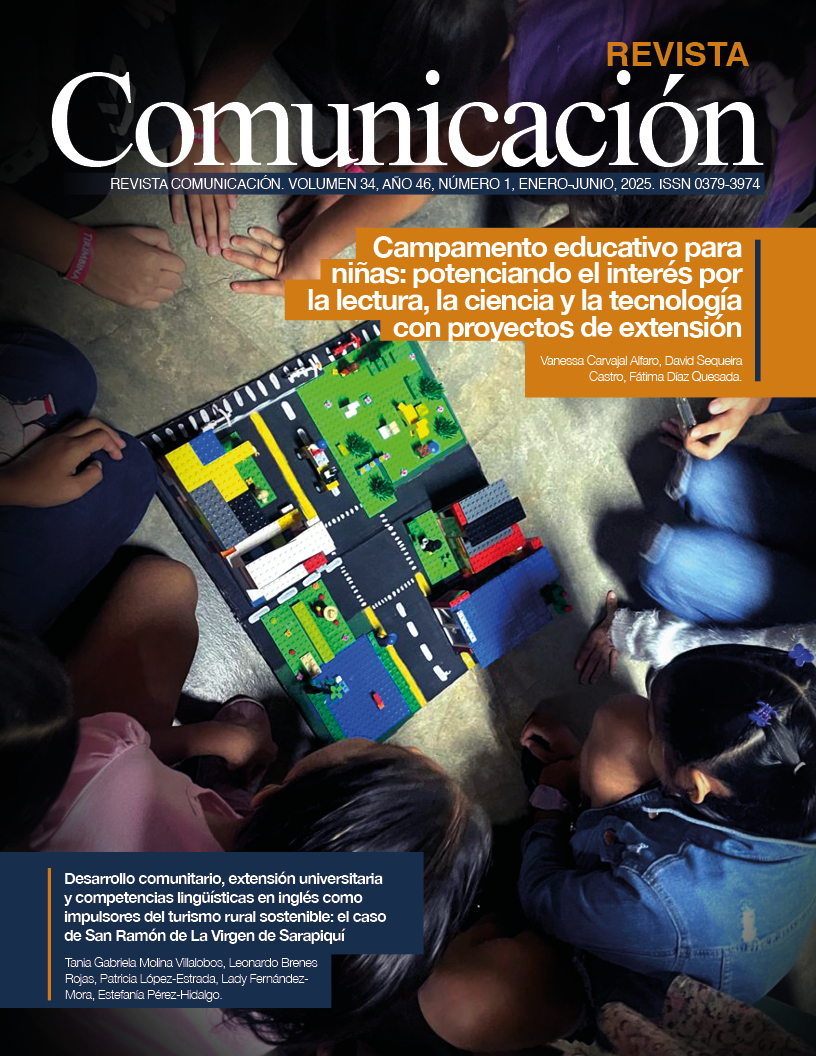
Educational Camp for Girls: Fostering Interest in Reading, Science and Technology with Extension Projects
Article Sidebar
Main Article Content
Abstract
This study addresses the issue of gender inequality in areas such as science, technology, and education, where girls, especially in rural areas of Costa Rica, are poorly represented. The main objective was to promote interest in reading, science, and technology among girls in the community of Sarapiquí, helping to reduce gender gaps in these fields. To achieve this, an educational camp was designed and executed, including workshops on reading, optics, and robotics. The methodology used combined a constructivist approach and the STEAM pedagogical model, which advocates the integration of the disciplines of science, technology, engineering, arts, and mathematics. The 90-minute workshops encouraged active learning, experimentation, and group reflection. The results show an increase in the participation of girls in scientific and technological activities, strengthening their skills in robotics, optics, and reading comprehension. Furthermore, the activities enhanced the development of teamwork and critical thinking skills. A positive impact on the self-esteem and empowerment of the girls was highlighted, as they showed greater confidence in their scientific and technological abilities. In addition, the importance of an inclusive approach that challenges gender stereotypes and promotes equity in education was stressed. Conclusions show that educational projects like this one are fundamental for reducing gender gaps in science and technology, as they promote meaningful and transformative learning for young participants
Article Details
This work is licensed under a Deed - Atribución/Reconocimiento-NoComercial-SinDerivados 4.0 Internacional - Creative Commons.
Política de acceso abierto
Esta revista provee acceso libre inmediato a su contenido bajo el principio de que hacer disponible gratuitamente investigación al público apoya a un mayor intercambio de conocimiento global.
Ser una revista de acceso abierto, implica que todo el contenido es de libre acceso y sin costo alguno para el usuario o usuaria, o institución. Las personas usuarias pueden leer, descargar, copiar, distribuir, imprimir y buscar los artículos en esta revista sin pedir permiso previo del editor o el autor con fines educativos y no de lucro.
La única limitación de la reproducción y la distribución, y el único papel de los derechos de autor en este ámbito, debe ser dar a los autores el control sobre la integridad de su trabajo y el derecho a ser debidamente reconocidos y citados. (Budapest Open Access Iniciative)
LICENCIAMIENTO Y PROTECCIÓN INTELECTUAL
Todos los artículos publicados, están protegidos con una licencia Creative Commons 4.0 (Deed - Atribución/Reconocimiento-NoComercial-SinDerivados 4.0 Internacional - Creative Commons) de Costa Rica. Consulte esta licencia en: https://creativecommons.org/licenses/by-nc-nd/4.0/deed.es
Las licencias constituyen un complemento al derecho de autor tradicional, en los siguientes términos:
- Se impide la obra derivada (es decir, no se puede alterar, transformar ni ampliar el documento).
b. Siempre debe reconocerse la autoría del documento referido.
c. Ningún documento publicado en la Revista Comunicación, puede tener fines comerciales de ninguna naturaleza.
Mediante estas licencias, la revista garantiza al autor que su obra está protegida legalmente, tanto bajo la legislación nacional como internacional. Por tal motivo, cuando sea demostrada la alteración, la modificación o el plagio parcial o total de una de las publicaciones de esta revista, la infracción será sometida a arbitraje internacional en tanto que se están violentando las normas de publicación de quienes participan en la Revista y la Revista misma. La institución afiliada a Creative Commons para la verificación en caso de daños y para la protección de dichos productos es el Instituto Tecnológico de Costa Rica, mediante la Editorial Tecnológica y la Vicerrectoría de Investigación.
References
Comisión Interamericana de Derechos Humanos. (2017). Las mujeres indígenas y sus derechos humanos en las Américas. Organización de los Estados Americanos. https://www.oas.org/es/cidh/informes/pdfs/MujeresIndigenas.pdf
Guerra, J. (2020). El constructivismo en la educación y el aporte de la teoría sociocultural de Vygotsky para comprenderla construcción del conocimiento en el ser humano. Revista Dilemas Contemporáneos: Educación, Política y Valores., VII(2). Recuperado de: https://doi.org/10.46377/dilemas.v32i1.2033
Instituto Nacional de Mujeres. (2018). Política Nacional para la igualdad efectiva entre hombres y mujeres PIEG 2018-2030. Recuperado de: https://oig.cepal.org/sites/default/files/politica_nacional_para_la_igualdad_efectiva_entre_hombres_y_mujeres_-_pieg_2018-2030.pdf
Jackson, P. (Ed.). (2009). Currículum oculto, dominación y libertad. Paulo Freire, Revista de pedagogía crítica, 7. Recuperado de: https://revistas.academia.cl/index.php/pfr/article/view/470/610
Luján, M. y Rodríguez, K. (2011). El campamento como programa didáctico: hacia una propuesta teórico-metodológica para su implementación en los museos. Actualidades investigativas en educación,11(1). Recuperado de: https://revistas.ucr.ac.cr/index. php/aie/article/download/10184/18042/37817
Ministerio de Planificación Nacional y Política Económica (Mideplan). (2015). Objetivos de desarrollo del milenio, III informe País 2015. Recuperado de: https://documentos.mideplan.go.cr/share/s/PXmgOSF7T3e-Qh6EZNZTzg
Morales, H. y Irigoyen, A. (2016). El paradigma conductista y constructivista de la educación a través del decálogo del estudiante. Archivos en medicina familiar, 18(2), 27-30. Recuperado de: https://www.medigraphic.com/cgi-bin/new/resumen.cgi?IDARTICULO=72082
Organización para la Cooperación y el Desarrollo Económicos (OECD). (2024). Igualdad de género en Costa Rica: Hacia una mejor distribución del trabajo remunerado y no remunerado. Recuperado de: https://www.oecd.org/content/dam/oecd/es/publications/ reports/2024/07/gender-equality-in-costarica_06ebece0/9a6523a7-es.pdf
Organización de la Naciones Unidas para la Educación, la Ciencia y la Cultura (Unesco). (2007). Ciencia Tecnología y Género. Informe internacional. Recuperado de: http://www.unesco.org/fileadmin/MULTIMEDIA/HQ/SC/pdf/sc_stg_executive_summary-es.pdf