


The link between neoliberalism, State and necropolitics
Article Sidebar
Main Article Content
Abstract
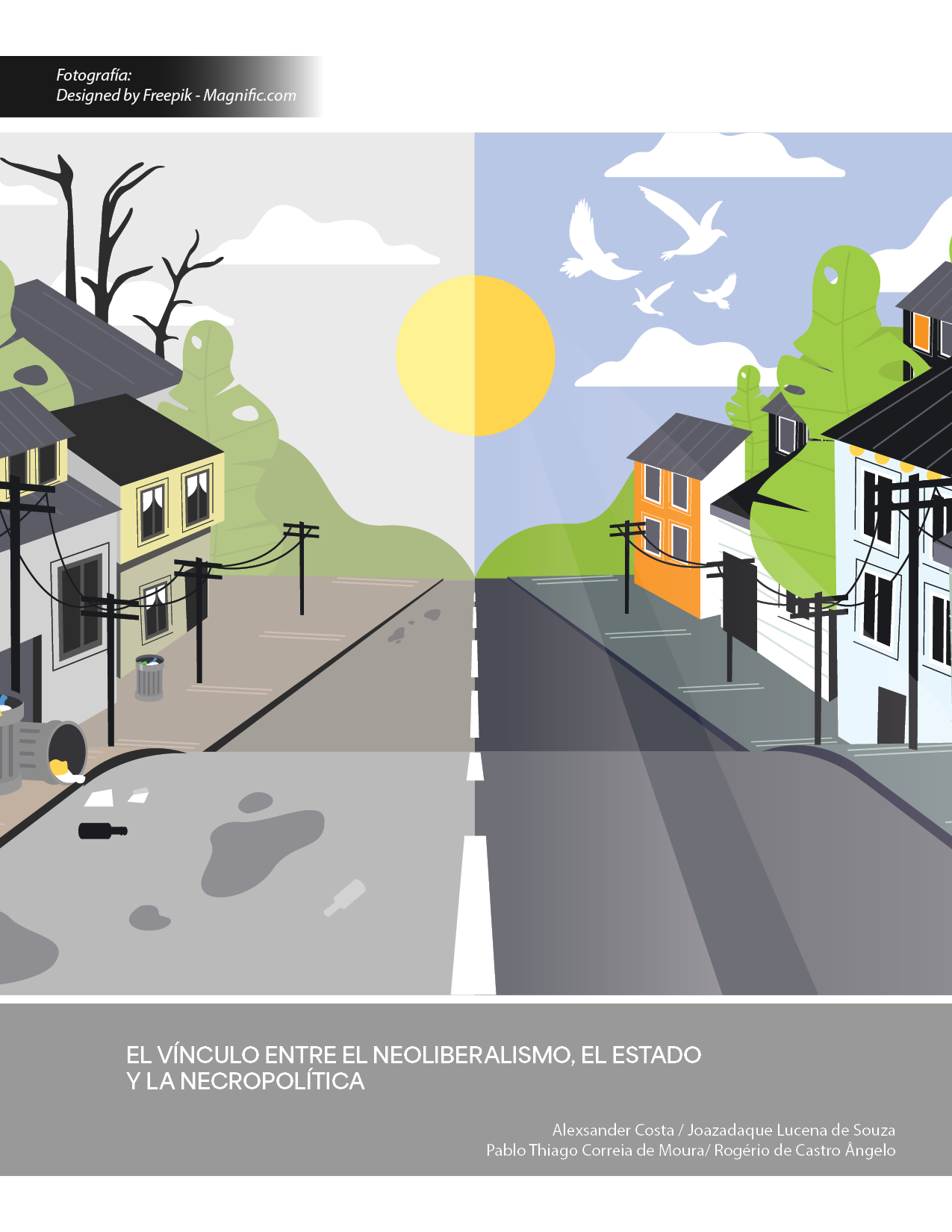
From an Aristotelian perspective, politics has been understood as a rational device capable of harmonizing, organizing, and promoting the common good of the social body. However, given social occurrences, would this initial understanding be open to discussion? The perspective presented by Mbembe allows us to glimpse an understanding that is different from that initially presented by Aristotle. In this sense, the purpose of this article is to present Achile Mbembe’s critique of the historical consensus, crystallized in the modern period, that politics is the rational instrument of cohesion and balance of the multiplicity of human desire, therefore, the manifestation of the rational order. The investigative process undertaken in this article was guided by the investigation of bibliographical works, mediated by qualitative research on the themes: necropolitics, neoliberalism, urbanicide, and demilitarization, using authors such as Mbembe, Foucault, Almeida, and Graham. In this process, we seek to highlight the argumentative nuances that support this conceptual and structuring category of the notion of Necropolitics, which is based on the notion of biopolitics developed by Michael Foucault, as Almeida reminds us in his article “Necropolitics and Neoliberalism”. Necropolitics is a conceptual analytical category developed by Mbembe, which, in addition to being an abstract parameter to decode the social political engendering, the Cameroonian philosopher finds in Foucauldian bases, especially in the notion of biopolitics, the key to understanding the political dynamics that affect social reality and which, in our understanding, are revealing and essential for understanding the Brazilian scenario regarding the governmentality devices of social architecture, especially in communities considered peripheral.
Article Details
Section

This work is licensed under a Creative Commons Attribution-NonCommercial-NoDerivatives 4.0 International License.

This work is licensed under a Creative Commons Attribution-NonCommercial-NoDerivs 3.0 Unported License.