


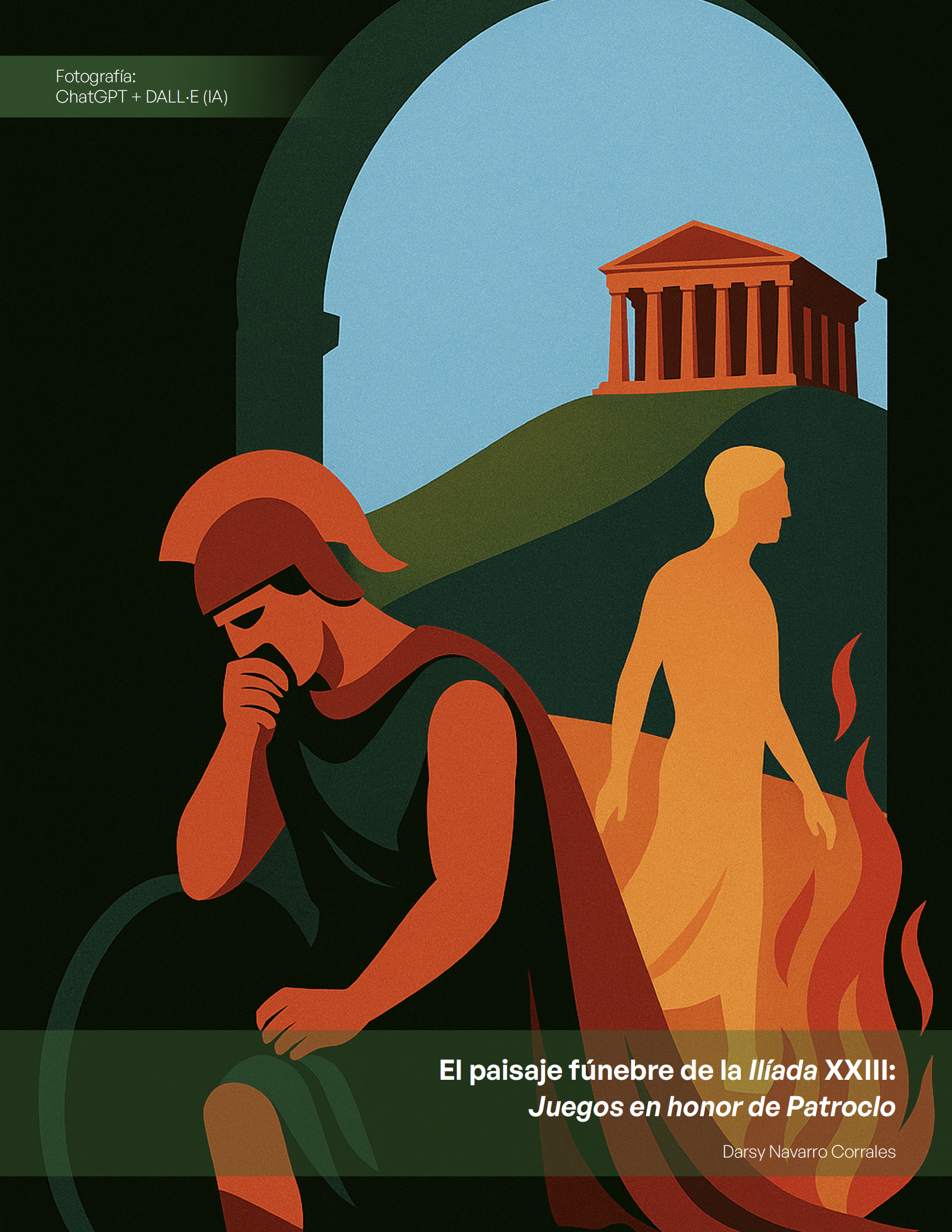
The Funereal Landscape of the Iliad XXIII: Games in Honor of Patroclus
Article Sidebar
Main Article Content
Abstract
This article examines the various landscapes depicted in Iliad XXIII, focusing on the funeral rites of the hero Patroclus. Following the approach proposed by Ma. Cardete (2020), the analysis conceives of landscapes as cultural constructions, exploring the interplay between the natural and the cultural dimensions of space.
The study also draws upon S. Guettel’s (2000) typology of ancient Greek landscapes, namely, the natural, the human, and the imagined landscape.
Methodologically, the research adopts a literary-hermeneutic perspective, compiling, systematizing, and interpreting evidence from classical Greek literature in order to situate the cultural landscape and elucidate its multiple literary meanings. From this inquiry emerges a conceptualization of the “funerary landscape” in Homeric poetry.
In conclusion, Iliad XXIII articulates a funerary theme intrinsically linked to physical space, in reciprocal correspondence with: (1) the natural landscape, which frames the actions of the Achaean leaders before the walls of Troy; (2) the human landscape, which portrays the funerary, martial, and ludic ceremonies surrounding Patroclus’s body; and (3) the imagined landscape, which evokes transcendent elements rooted in the collective imagination of Ancient Greece and associated with the afterlife.
Article Details

This work is licensed under a Creative Commons Attribution-NonCommercial-NoDerivatives 4.0 International License.

This work is licensed under a Creative Commons Attribution-NonCommercial-NoDerivs 3.0 Unported License.