


Los efectos de los procesos de digitalización y las competencias digitales en los resultados de las pymes
Barra lateral del artículo
Contenido principal del artículo
Resumen
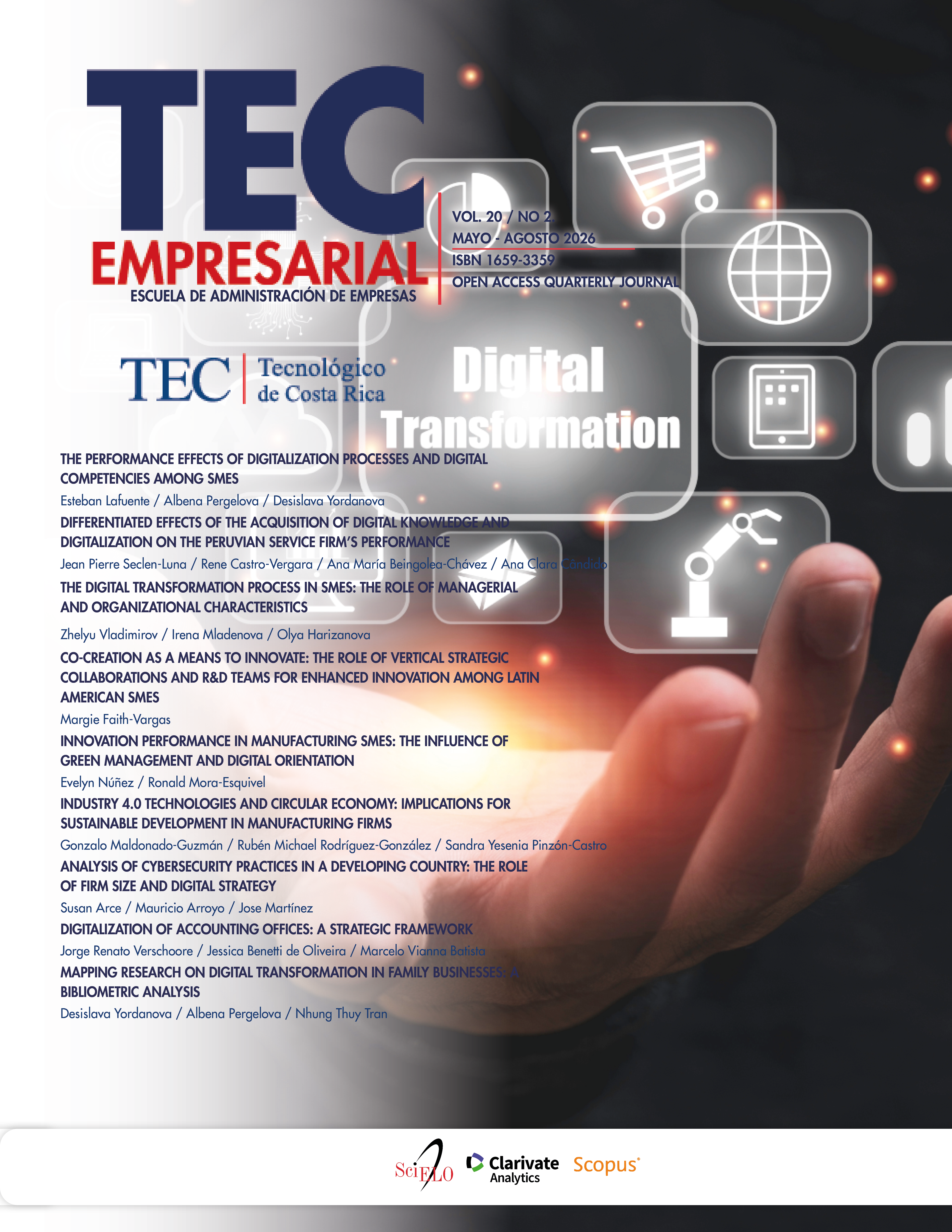
La digitalización está transformando la competitividad de las pymes; sin embargo, los resultados de diversas investigaciones muestran que los efectos de los procesos de digitalización en el rendimiento empresarial distan de ser claros. Las tecnologías digitales generan valor mediante el desarrollo de capacidades y la orquestación estratégica, y este editorial presenta los ocho artículos incluidos en el volumen especial, los cuales adoptan diversas perspectivas para analizar la conexión entre digitalización y rendimiento empresarial. Los artículos incluidos en este volumen especial integran diferentes perspectivas teóricas y enfoques metodológicos para explicar los resultados heterogéneos resultantes de los procesos de digitalización. Los trabajos destacan mecanismos operativos (p. ej., la integración de la tecnología digital y las rutinas de innovación) y estratégicos (p. ej., el desarrollo de la estrategia digital, los factores gerenciales y contextuales) que configuran las dimensiones de rendimiento financiero, de innovación, orientado a la sostenibilidad, y estratégico. El volumen especial refuerza la visión de que la digitalización es un proceso organizacional complejo. El editorial concluye identificando direcciones prometedoras para futuras investigaciones sobre las
complementariedades de las capacidades digitales y los riesgos de la transformación digital.
Detalles del artículo

La versión digital de la revista se encuentra registrada bajo la licencia Creative Commons BY-NC-ND 4.0. Por lo tanto, esta obra se puede reproducir, distribuir y comunicar públicamente sin propósitos comerciales, siempre que: 1. Se reconozca el nombre de los autores y la revista Tec Empresarial, y 2. No remezcle, transforme o haga una creación a partir del original.
Los autores conservan los derechos de autor y ceden a la revista el derecho de la primera publicación y de que pueda editarlo, reproducirlo, distribuirlo, exhibirlo y comunicarlo en el país y en el extranjero mediante medios impresos y electrónicos. Por otra parte, el autor declara asumir el compromiso sobre cualquier litigio o reclamación relacionada con derechos de propiedad intelectual, exonerando de responsabilidad a la Escuela de Administración de Empresas del Tecnológico de Costa Rica.
Citas
Acs, Z. J., Lafuente, E., & Szerb, L. (2022). A note on the configuration of the digital ecosystem in Latin America. TEC Empresarial, 16(1), 1-15. https://doi.org/10.18845/te.v16i1.5926
Appio, F. P., Frattini, F., Petruzzelli, A. M., & Neirotti, P. (2021). Digital transformation and innovation management: A synthesis of existing research and an agenda for future studies. Journal of Product Innovation Management, 38(1), 4-20. https://doi.org/10.1111/jpim.12562
Arce, S., Arroyo, M., & Martinez, J. (2026). Analysis of cybersecurity practices in a developing country: The role of firm size and digital strategy. TEC Empresarial, 20(2) 107-127. https://doi.org/10.18845/te.v20i2.8634
Berente, N., Gu, B., Recker, J., & Santhanam, R. (2021). Managing artificial intelligence. MIS Quarterly, 45(3), 1433-1450. https://doi.org/10.25300/MISQ/2021/16274
Björkdahl, J. (2020). Strategies for digitalization in manufacturing firms. California Management Review, 62(4), 17-36. https://doi.org/10.1177/0008125620920349
Blichfeldt, H., & Faullant, R. (2021). Performance effects of digital technology adoption and product & service innovation–A process-industry perspective. Technovation, 105, 102275. https://doi.org/10.1016/j.technovation.2021.102275
Cennamo, C. (2021). Competing in digital markets: A platform-based perspective. Academy of Management Perspectives, 35(2), 265-291. https://doi.org/10.5465/amp.2016.0048
Dalenogare, L. S., Benitez, G. B., Ayala, N. F., & Frank, A. G. (2018). The expected contribution of Industry 4.0 technologies for industrial performance. International Journal of Production Economics, 204, 383-394. https://doi.org/10.1016/j.ijpe.2018.08.019
Faith-Vargas, M. (2026). Co-creation as a means to innovate: The role of vertical strategic collaborations and R&D teams for enhanced innovation among Latin American SMEs. TEC Empresarial, 20(2) 47-63. https://doi.org/10.18845/te.v20i2.8631
Goldfarb, A., & Tucker, C. (2019). Digital economics. Journal of Economic Literature, 57(1), 3-43. https://doi.org/10.1257/jel.20171452
Hu, L., Filipescu, D., & Pergelova, A. (2024). Understanding SMEs’ internationalization through digital platforms: The role of knowledge sharing and consumer education. International Marketing Review, 41(5), 1044-1073. https://doi.org/10.1108/IMR-09-2023-0252
Lafuente, E., & Sallan, J. M. (2024). Digitally powered solution delivery: The use of IoT and AI for transitioning towards a solution business model. International Journal of Production Economics, 277, 109383. https://doi.org/10.1016/j.ijpe.2024.109383
Lafuente, E., & Vaillant, Y. (2023). Greater co-innovation and innovation efficiency through greening. Journal of Cleaner Production, 428, 139516. https://doi.org/10.1016/j.jclepro.2023.139516
Lafuente, E., Acs, Z. J., & Szerb, L. (2023a). Digital inequality and the signature of digital technologies and the digital ecosystem: Analysis of deviations in the rank-size rule of internet access data. In Acs, Z., Lafuente, E., Szerb, L. (Eds.), The Entrepreneurial Ecosystem: A Global Perspective, Springer Nature, pp. 247-276.
Lafuente, E., Acs, Z. J., & Szerb, L. (2024). Analysis of the digital platform economy around the world: A network DEA model for identifying policy priorities. Journal of Small Business Management, 62(2), 847-891. https://doi.org/10.1080/00472778.2022.2100895
Lafuente, E., Alonso-Ubieta, S., Leiva, J. C., & Mora-Esquivel, R. (2021). Strategic priorities and competitiveness of businesses operating in different entrepreneurial ecosystems: a benefit of the doubt (BOD) analysis. International Journal of Entrepreneurial Behavior & Research, 27(5), 1351-1377. https://doi.org/10.1108/IJEBR-06-2020-0425
Lafuente, E., Araya, M., & Leiva, J. C. (2022). Assessment of local competitiveness: A composite indicator analysis of Costa Rican counties using the ‘Benefit of the Doubt’ model. Socio-Economic Planning Sciences, 81, 100864. https://doi.org/10.1016/j.seps.2020.100864
Lafuente, E., Bayo-Moriones, A., & García-Cestona, M. (2010). ISO-9000 certification and ownership structure: Effects upon firm performance. British Journal of Management, 21(3), 649-665. https://doi.org/10.1111/j.1467551.2009.00660.x
Lafuente, E., Szerb, L., & Rideg, A. (2020). A system dynamics approach for assessing SMEs’ competitiveness. Journal of Small Business and Enterprise Development, 27(4), 555-578. https://doi.org/10.1108/JSBED-06-2019-0204
Lafuente, E., Vaillant, Y., & Rabetino, R. (2023b). Digital disruption of optimal co-innovation configurations. Technovation, 125, 102772. https://doi.org/10.1016/j.technovation.2023.102772
Li, L., Su, F., Zhang, W., & Mao, J. Y. (2018). Digital transformation by SME entrepreneurs: A capability perspective. Information Systems Journal, 28(6), 1129-1157. https://doi.org/10.1111/isj.12153
Maldonado-Guzmán, G., Rodríguez-González, R.M., & Pinzón-Castro, S.Y. (2026). Industry 4.0 technologies and circular economy: Implications for sustainable development in manufacturing firms. TEC Empresarial, 20(2) 82-106. https://doi.org/10.18845/te.v20i2.8633
Meier, A. (2021). Systematic review of the literature on SME digitalization: multi-sided pressure on existing SMEs. In Schallmo, D.R.A. and Tidd, J. (Eds.), Digitalization. Management for Professionals, Springer Nature, pp. 257-276. https://doi.org/10.1007/978-3-030-69380-0_14
Núñez, E. & Mora-Esquivel, R. (2026). Innovation performance in manufacturing SMEs: The influence of green management and digital orientation. TEC Empresarial, 20(2) 64-81. https://doi.org/10.18845/te.v20i2.8632
Pergelova, A., & Yordanova, D. (2025). The human element in digital transformation: The role of talent management for SMEs. Journal of the International Council for Small Business, 6(2), 269-283. https://doi.org/10.1080/26437015.2024.2404177
Pergelova, A., Manolova, T., Simeonova-Ganeva, R., & Yordanova, D. (2019). Democratizing entrepreneurship? Digital technologies and the internationalization of female-led SMEs. Journal of Small Business Management, 57(1), 14-39. https://doi.org/10.1111/jsbm.12494
Seclen-Luna, J.P., Castro-Vergara, R., Beingolea Chávez, A.M., & Candido, A.C. (2026). Differentiated effects of the acquisition of digital knowledge and digitalization on the Peruvian service firm’s performance. TEC Empresarial, 20(2)10-29. https://doi.org/10.18845/te.v20i2.8629
Usai, A., Fiano, F., Petruzzelli, A. M., Paoloni, P., Briamonte, M. F., & Orlando, B. (2021). Unveiling the impact of the adoption of digital technologies on firms’ innovation performance. Journal of Business Research, 133, 327-336. https://doi.org/10.1016/j.jbusres.2021.04.035
Vaillant, Y., & Lafuente, E. (2024). Digital versus non-digital servitization for environmental and non-financial performance benefits. Journal of Cleaner Production, 450, 142078. https://doi.org/10.1016/j.jclepro.2024.142078
Vaillant, Y., Lafuente, E., & Vendrell-Herrero, F. (2025). AI platforms as cooperation enablers favoring the development of strategic situating capabilities within solution delivery ecosystems. Journal of Product Innovation Management. https://doi.org/10.1111/jpim.12807
Verschoore, J.R., Benetti de Oliveira, J., & Batista, M.V. (2026). Digitalization of accounting offices: A strategic framework. TEC Empresarial, 20(2)128-148. https://doi.org/10.18845/te.v20i2.8635
Vladimirov, Z., Mladenova, I., & Harizanova, O. (2026). The digital transformation process in SMEs—the role of manager and firm characteristics. TEC Empresarial, 20(2)30-46. https://doi.org/10.18845/te.v20i2.8630
Yordanova, D., Pergelova, A., & Thuy-Tran, N. (2026). Mapping research on digital transformation in family businesses: A bibliometric analysis. TEC Empresarial, 20(2)149-173. https://doi.org/10.18845/te.v20i2.8636