
Artículo de Investigación
DOI:
https://doi.org/10.18845/te.v20i2.8636
Mapping research on digital transformation in family businesses: A bibliometric analysis
Estructura y evolución de la investigación sobre la transformación digital en la empresa familiar: Un análisis bibliométrico
Tec Empresarial, Vol. 20, n°. 2, (May - Aug 2026), 149 - 173, ISSN: 1659-2395, e-ISSN: 1659-3359
AUTHORS
Desislava Yordanova 
Faculty of Economics and Business Administration. Sofia University “St. Kliment
Ohridski”. Bulgaria. yordanova@feb.uni-sofia.bg.

Albena Pergelova
Department of International Business. MacEwan University. Canada. pergelovaA@macewan.ca.
Nhung Thuy Tran
Faculty of Economics and Business Administration. Sofia University “St. Kliment
Ohridski”. Bulgaria. thuynhung.tr@gmail.com.
Corresponding Author: Desislava Yordanova
ABSTRACT
Abstract:
This paper presents a bibliometric study of the research on digital
transformation in family business based on a dataset of 196 peer-reviewed articles extracted
from Web of Science which aims to map the existing research on this topic. We integrate
several different bibliometric methods to provide more comprehensive picture of the field.
The study outlines trends in scientific production, providing information about most
productive authors, institutions, countries, and journals. We show that the research
interest in this topic has increased significantly during the last five years, and existing
literature examines a great variety of research topics and employs diverse theoretical
perspectives. The co-citation analysis of cited references describes the intellectual
foundations of the research on digital transformation in family business, while the
bibliographic coupling analysis of articles shed light on emerging research trends in this
field. Based on co-occurrence analysis of author keywords, the main research topics in the
field are outlined and their evolution during the last five years is discussed. A conceptual
framework of the main thematic focuses and theoretical pillars in the research on digital
transformation in family business is presented that can inform both academic research and
practical applications. The paper highlights several directions for future research.
Keywords: Family business; digital transformation; bibliometric; bibliographic coupling; co-citation analysis
Resumen:
Este artículo presenta un estudio bibliométrico de la investigación
sobre la transformación digital en la empresa familiar. El mapeo de la investigación
existente sobre este tema se fundamenta en el análisis de 196 artículos revisados por pares
extraídos de Web of Science. El trabajo integra diversos métodos bibliométricos con el fin
de ofrecer una visión más completa del campo. El estudio identifica las principales
tendencias en la producción científica y proporciona información sobre los autores,
instituciones, países y revistas más productivas. Los resultados muestran que el interés por
investigar en este ámbito ha aumentado significativamente durante los últimos cinco años, y
la literatura existente examina una amplia variedad de temas de investigación y emplea
diversas perspectivas teóricas. El análisis de co-citación de referencias describe los
fundamentos intelectuales de la investigación sobre la transformación digital en la empresa
familiar, mientras que el análisis de acoplamiento bibliográfico de los artículos permite
identificar las tendencias emergentes en este campo. A partir del análisis de co-ocurrencia
de las palabras clave de los estudios analizados, se delimitan los principales temas de
investigación en el área y se discute su evolución durante los últimos cinco años. Asimismo,
se presenta un marco conceptual que sintetiza los principales enfoques temáticos y pilares
teóricos de la investigación sobre la transformación digital en la empresa familiar, el cual
puede orientar tanto la investigación académica como las aplicaciones prácticas. Finalmente,
el artículo destaca diversas líneas para futuras investigaciones.
Palabras clave: Empresa familiar; transformación digital; bibliometría; acoplamiento bibliográfico; análisis de co-citación
1. Introduction
1. Introduction
The rapid development of a diverse set of digital technologies, digital platforms, and digital infrastructures has accelerated digital transformation (DT) in organizations (Liu et al., 2023). New digital technologies are transforming traditional business environments into digital ecosystems in which companies need to embrace DT to remain competitive (Subramaniam et al., 2019; Lafuente et al., 2023; Lafuente et al., 2024). DT was defined as "a fundamental change process, enabled by the innovative use of digital technologies accompanied by the strategic leverage of key resources and capabilities, aiming to radically improve an entity and redefine its value proposition for its stakeholders" (Gong & Ribiere, 2021, p.12). It is described as a three-stage process in which digitization (conversion of analog information into digital format) and digitalization (use of digital technologies to enable process improvements) are the two more incremental stages preceding the more pervasive stage of DT (Verhoef et al., 2021; Vaillant et al., 2025).
DT is associated with significant benefits leading to better firm performance that may include changes in value creation paths (Vial, 2019), increased entrepreneurial innovations (Galindo-Martín et al., 2019), improved total factor productivity (Guo et al., 2023), social network updates and training in digital tools (Ribeiro-Navarrete et al., 2021), lower cost, better operating efficiency, better innovation success (Zhai et al., 2022), greater profits, productivity, and competitiveness (Llopis-Albert et al., 2021). However, despite these benefits, organizations may face diverse challenges to their DT (Petzolt et al., 2022) and they must successfully overcome them to maintain their competitiveness (Soluk & Kammerlander, 2021).
In this article, we focus on DT in family businesses. Family business is "a business governed and/or managed with the intention to shape and pursue the vision of the business held by a dominant coalition controlled by members of the same family or a small number of families in a manner that is potentially sustainable across generations of the family or families" (Chua et al., 1999, p.25). In contrast to non-family firms, family firms are characterized by family involvement in the ownership and management, unique bundle of resources (familiness), socioemotional wealth, and vision and the transgenerational intention of the controlling family (Dawson & Mussolino, 2014). These distinctive characteristics of family business may present both opportunities and challenges for DT. Empirical research reveals that digitalization and DT lead to positive outcomes in family businesses (Lasio et al., 2024; Bürgel et al., 2023; Chatterjee et al., 2023; Nieto et al., 2023) . Family businesses are under pressure to undertake DT to meet market expectations (Mikusová & Stanovská, 2025), but the transition toward DT is not straightforward in family firms (Ceipek et al., 2021). They may lack commitment and readiness for DT (Xie et al., 2023) and can be reluctant to digitize (Mikusová & Stanovská, 2025).
Although the research on DT and the research on family firms have grown consistently during the last decades (Kraus et al., 2021; Chrisman et al., 2024), the research at the intersection of these two areas is still scarce (Soluk & Kammerlander, 2021; Canjun et al., 2025) and there is a need for greater research attention on this topic. DT and family business have been predominantly studied in isolation. DT research is focused on specific domains and is highly specialized (Kraus et al., 2022). For example, some authors have studied DT in companies of different sizes (Marino-Romero et al., 2024) or in different industries (Hagberg et al., 2016; Lafuente et al., 2023). At the same time, various bibliometric analyses on various research topics in family business were published during the last decade including AI adoption within the context of family businesses (Atienza-Barba et al., 2025), entrepreneurship in family firms (Anwar et al., 2024), family business research published between 2011 and 2020 (Aparicio et al., 2021), family firm internationalization research (Casprini et al., 2020) conflict management in family businesses (Caputo et al., 2018), sustainability in family business (Ferreira et al., 2021), research on family business in tourism and hospitality (Shekhar et al., 2022), family businesses adaptation to the rapid pace of globalization (Wu et al., 2022). However, no study has focused on mapping the research on DT in family business. To address this research gap, this study conducts a bibliometric analysis on DT in family business. We describe the intellectual foundations of the research on DT in family business via co-citation analysis. We also outline the current research trends in the literature on DT in family business through bibliographic coupling analysis. Finally, we provide a conceptual framework of the main thematic focuses in the research on DT in family business, and we offer future research directions. The following research questions were addressed in this study:
RQ1: Which authors, articles, journals, institutions, and countries are the most influential in the field of DT in family business?
RQ2: What current research trends stand out in the literature of DT in family business?
RQ3: What are the intellectual foundations of the research on DT in family business?
RQ4: What is the knowledge structure of the field of DT of family business?
Building upon existing research on DT in family business, our work offers several contributions to literature. The study provides a higher understanding of the field of DT in family business by identifying the current research trajectories and trends in this field that can inform future research agendas. By uncovering the knowledge structure, intellectual foundations, and current research trends in the literature of DT in the context of family business, this study may foster new research opportunities. The study provides value to both academic and practitioner audiences by presenting a conceptual framework of the main thematic focuses and theoretical pillars in the research on DT in family business. The remainder of the article is structured as follows. The next section describes the steps in the literature review process adopted in this study. The following section presents the results of the bibliometric analysis. The final section concludes, discusses the limitations of the study, and suggests directions for future research on DT in family business.
2. Methodology
2. Methodology
Bibliometric analysis is a quantitative research method, using mathematical and statistical techniques to evaluate scholarly literature and publication patterns (Donthu et al., 2021). This method allows for examining performance in a knowledge domain (Wallace et al., 2011) and investigating implicit behaviors in knowledge dissemination (González-Valiente, 2016), thus facilitating the identification of research outputs and emerging trends (Merigó et al., 2018). According to the research of Wolfswinkel et al. (2013), the literature review process requires the following sequential stages: (1) defining the scope of the review; (2) sourcing relevant literature; (3) finalizing sample selection; (4) analyzing the corpus; and (5) presentation of the findings (Vial, 2019). Therefore, the bibliometric analysis for this article was conducted following the procedural framework described in Figure 1.

The methodology began with data retrieval from the Web of Science (WOS) database, a comprehensive repository for peer-reviewed literature (Crossan & Apaydin, 2010). We searched for articles published up to March 20, 2025, without a lower boundary for the time frame. The data extraction incorporated terms related to "family firms/family business/ family controlled enterprise" and terms related to "digital*/digitization/digitalization/ICT", which needed to appear in the title, abstract, or keywords of the articles. The selection process yielded 338 articles. We carefully read the titles, abstracts, introductions, or full texts of these articles to identify the relevant ones. The exclusion criteria for selecting relevant articles were: 1/ the selected publications should only include articles from peer-reviewed scientific journals, indexed in Web of Science, as they provide objective and reliable knowledge; 2/ only articles in English were selected, because English has become the most important language used in scientific communication; 3/ we did not fix a lower boundary for the time frame because we wanted to identify all published articles examining DT in family business; 4/ the selected articles must provide a clear relationship with the subject of DT in family business. This resulted in a final sample of 196 articles. The resulting dataset included article titles, author names, year of publication, journal of publication, abstract, number of citations, and related references. This dataset facilitated subsequent descriptive analysis and cartographic representation. VOSviewer software was used to systematize the relationships between articles, allowing for a comprehensive exploration of co-authorship networks and the identification of featured topics (Herrera-Barriga & Escandon-Barbosa, 2024), while also distinguishing influential publications and journals (Van Eck & Waltman, 2017). The number of citations are the primary metric for assessing scholarly impact (Mustafa et al., 2023). A manual keyword normalization and pre-screening process was performed before synthesis. We then conducted bibliographic coupling and co-citation analyses. This process allowed for the construction of detailed network maps of related research clusters and the identification of overarching thematic connections within the research domain (Kirby, 2023).
3. Results
3. Results
3.1 Descriptive analysis
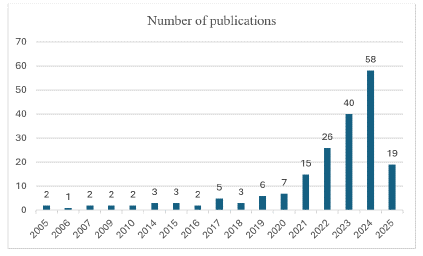
The 196 articles on DT in family business included in this analysis were published in 107 journals. The first 2 articles on this topic appeared in 2005, but the number of documents per year was under 10 until 2020 (see Figure 2). After 2020 the number of publications on DT in family business per year has increased continuously which indicates the growing research interest of the scientific community in this topic. This is not surprising as the outbreak of Covid-19 pandemic at the end of 2019 showed that DT is important for family businesses of all sizes and sectors.
Only 9 journals have published 3 or more articles in the field of DT in family business, and 16 journals have published 2 articles, while 82 journals have published only 1 article. The majority of the journals with more than 2 publications are in the field of business and management and are positioned in Q1 or Q2 (see Table 1). The top 10 journals with the highest number of citations are also in the field of business and management (see Table 1). They include International Journal of Entrepreneurial Behavior & Research (522 citations), Journal of Family Business Management (255 citations), Technovation (194 citations), European Journal of Information Systems (169 citations), Research in International Business and Finance (156 citations), Entrepreneurship Theory and Practice (153 citations), Technological Forecasting and Social Change (147 citations), Journal of Retailing and Consumer Services (137 citations), Research Policy (132 citations), and Journal of Business Research (106 citations).
Table 1:. Top journals ranked by the number of publications.
| Journal | Number of publications | Impact factor | Position |
|---|---|---|---|
| Journal of Family Business Management | 34 | 3.6 | Q2 |
| Sustainability | 10 | 3.3 | Q2 |
| Technological Forecasting and Social Change | 7 | 12.9 | Q1 |
| Journal of Business Research | 7 | 10.5 | Q1 |
| IEEE Transactions on Engineering Management | 7 | 4.6 | Q1 |
| International Journal of Entrepreneurial Behavior & Research | 6 | 4.5 | Q1 |
| International Entrepreneurship and Management Journal | 4 | 6.2 | Q1 |
| European Journal of Innovation Management | 4 | 5 | Q1 |
| Journal of Enterprising Communities-People and Places in the | 3 | 2.4 | Q3 |
| Global Economy |
In total 564 authors from 390 institutions in 66 countries contributed to the research on DT in family business. Interestingly, all of the top institutions ranked by the number of publications are located in Europe (see Table 2).
The country with the highest number of published articles in the field of DT in family business is China (see Table 3). Half of the top 10 countries ranked by the number of publications are on the European continent.
Table 2:. Top 10 institutions ranked by the number of publications.
| Rank | Institutions | Documents | Citations | Total Link Strength |
|---|---|---|---|---|
| 1 | WHU - Otto Beisheim School of Management | 8 | 458 | 316 |
| 2 | University of Bern | 5 | 283 | 218 |
| 3 | IPAG Business School | 5 | 32 | 48 |
| 4 | Free University of Bozen-Bolzano | 4 | 135 | 98 |
| 5 | University of Nicosia | 4 | 87 | 44 |
| 6 | Witten/Herdecke University | 3 | 446 | 98 |
| 7 | University of Bergamo | 3 | 148 | 39 |
| 8 | University of Valencia | 3 | 99 | 47 |
| 9 | University of Siegen | 3 | 74 | 65 |
| 10 | University of Turin | 3 | 38 | 28 |
Table 3:. Top 10 countries ranked by the number of publications.
| Rank | Country | Documents | Citations | Total Link Strength |
|---|---|---|---|---|
| 1 | China | 35 | 333 | 186 |
| 2 | Italy | 29 | 1100 | 310 |
| 3 | Germany | 22 | 1152 | 354 |
| 4 | Spain | 20 | 483 | 234 |
| 5 | USA | 18 | 624 | 112 |
| 6 | India | 18 | 298 | 56 |
| 7 | England | 16 | 962 | 190 |
| 8 | France | 13 | 534 | 114 |
| 9 | Malaysia | 11 | 182 | 44 |
| 10 | Australia | 9 | 178 | 51 |
Only 8 authors published 3 or more articles in the field of DT in family business (see Table 4). Nadine Kammerlander, with 6 articles, Jonas Soluk, with 5 articles, and Demetris Vrontis, with 4 articles were the most productive authors. The most cited authors are Sascha Kraus (482 citations), Jonas Soluk (437 citations), and Thomas Clauss (435 citations).
Table 4:. Top 8 authors ranked by the number of publications.
| Rank | Author | Documents | Citations | Total Link Strength |
|---|---|---|---|---|
| 1 | Kammerlander, Nadine | 6 | 413 | 82 |
| 2 | Soluk, Jonas | 5 | 437 | 93 |
| 3 | Vrontis, Demetris | 4 | 87 | 5 |
| 4 | Bargoni, Augusto | 3 | 37 | 0 |
| 5 | Chatterjee, Sheshadri | 3 | 74 | 5 |
| 6 | Chaudhuri, Ranjan | 3 | 74 | 5 |
| 7 | De massis, Alfredo | 3 | 225 | 49 |
| 8 | Hiebl, Martin R. W. | 3 | 74 | 27 |
The analysis of the number of citations of the articles in our dataset provides an overview of the most influential research. There are 196 articles in the dataset published in the period 2005 - 2025 with a total of 3558 citations which indicates an average of 18.06 citations per article. However, 38 articles have no citations, 18 articles have a minimum of one citation, 63 articles have between 2 and 9 citations, and 67 articles have between 10 and 70 citations. The top ranked articles in the field of DT in family business in terms of the highest number of citations received in WoS have 72 or more citations (see citation analysis column in Table 5). In this regard, the article on DT in family business with the highest number of citations (429 citations) is by Kraus, Clauss, Breier, Gast, Zardini and Tiberius (2020).
Table 5:. The top ranked articles in the field of DT in family business in terms of total citations in WoS and total link strength.
| Citation analysis | Bibliographic coupling | ||
|---|---|---|---|
| Article | Total citations | Articles | Total Link Strength |
| Kraus, Clauss, Breier, Gast, Zardini, and Tiberius (2020) | 429 | Soluk, Miroshnychenko, Kammerlander, and De Massis (2021) | 528 |
| Bruque and Moyano (2007) | 183 | Ardito and Capolupo (2024) | 495 |
| Soluk and Kammerlander (2021) | 169 | Bornhausen and Wulf (2024) | 461 |
| Caballero-Morales (2021) | 156 | Basly and Hammouda (2020) | 401 |
| Soluk, Miroshnychenko, Kammerlander, and De Massis (2021) | 151 | Cucculelli, Dileo, and Pini (2022) | 393 |
| Orth and Green (2009) | 137 | Pini (2019) | 386 |
| Cumming, Meoli, and Vismara (2019) | 132 | Soluk (2022) | 377 |
| Cooper, Upton, and Seaman (2005) | 104 | Bürgel, Hiebl, and Pielsticker (2023) | 370 |
| Škare and Soriano (2021) | 97 | Costa, Presenza, and Abbate (2023) | 350 |
| Soluk, Kammerlander, and De Massis (2021c) | 72 | Soluk and Kammerlander (2021) | 347 |
3.2 Co-citation analysis
The co-citation analysis of the references cited in the articles in the dataset reveals the theoretical foundations and structure of the literature on DT in family business. Following Ferreira (2018), a threshold of 5 citations for each co-cited reference was used to reduce the complexity of visualization. Of the 11506 cited references, 264 were cited 5 times. The 10 references with the highest total link strength which can be considered the main theoretical pillars of the field are presented in Table 6. The co-citation analysis of the cited references sheds light on the main theoretical perspectives and highly influential contributions constituting the intellectual structure of the field (see Figure 3).
Table 6:. The ten most connected references.
| Rank | Reference | Citations | Total Link Strength |
|---|---|---|---|
| 1 | Gómez-Mejía et al. (2007), ASQ | 47 | 1494 |
| 2 | Berrone at al. (2012), FBR | 41 | 1255 |
| 3 | Duran et al. (2016), AMJ | 34 | 1230 |
| 4 | Ceipek et al. (2021), JPIM | 30 | 1084 |
| 5 | Soluk and Kammerlander (2021), EJIS | 33 | 1036 |
| 6 | Soluk et al. (2021), ETP | 31 | 967 |
| 7 | Chrisman et al. (2015), JPIM | 28 | 938 |
| 8 | König et al. (2013), AMR | 23 | 925 |
| 9 | Calabrò et al. (2019), IJMR | 30 | 897 |
| 10 | Chua et al. (1999), ETP | 23 | 756 |
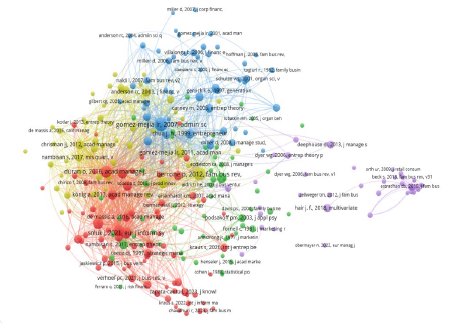
The identified 5 different clusters (red with 75 documents, blue with 49 articles, yellow with 49 articles, green with 55 articles, and lilac with 36 documents) highlight the following five main theoretical approaches: 1/ family influence and family involvement; 2/ entrepreneurship and innovation; 3/ behavioral approach; 4/ socioemotional wealth; and 5/ heterogeneity among family businesses and between family and non-family businesses. The studies in the first cluster (red) emphasize the role of family involvement and family influence on innovation and digitalization in family firms. Duran et al. (2016), Ceipek et al. (2021), Soluk and Kammerlander (2021), Soluk et al. (2021), Chrisman et al. (2015), and König et al. (2013) are the main authors in this cluster. Duran et al. (2016) demonstrate that family control is related to lower innovation input but with increased conversion rate of innovation input into output. Ceipek et al (2021) find that higher family involvement in the top management team decreases the development of exploratory Internet of Things (IoT) innovations relative to exploitative IoT innovations. Soluk and Kammerlander (2021) identify family firm paternalism i.e. decision-making power concentrated in a senior family member (i.e., a patriarch) as a major barrier to developing the dynamic capabilities required in the DT process. Soluk et al (2021) find a positive effect of family influence on digital business model innovation and this effect is mediated by dynamic capabilities. Chrisman et al (2015) provide a framework of the influence of family involvement on ability and willingness for innovation management. To summarize, family involvement and family influence are relevant theoretical constructs for understanding DT in family business.
The second cluster (green) is centered on entrepreneurship and innovation in family firms. Nambisan (2017) and Zahra et al (2004) are the articles with the highest total link strength in this cluster. Nambisan (2017) explains the importance of digital entrepreneurship as a new research area and discusses pathways for future research in this area. Zahra et al (2004) find a relationship between several dimensions of organizational culture and entrepreneurship in family and non-family businesses. Furthermore, they demonstrate that the relationship with entrepreneurship for most of these dimensions of organizational culture is stronger in family firms than in non-family firms. Sciascia et al (2015) identify a link between family ownership and R&D intensity in SMEs. Leppäaho and Ritala (2022) find evidence that risk-averse family firms can use a crisis to productively engage in innovation efforts. Overall, the literature in this cluster reveals that entrepreneurship and innovation is another major theoretical underpinning of family firms' DT.
Documents in the third cluster (blue) draw upon the behavioral approach and behavioral agency model perspective to examine the characteristics, determinants and results of the behavior of family firms. Gómez-Mejía et al. (2007), Chua et al. (1999), and Nieto et al. (2023) are the publications with the highest total link strength in this cluster. Using behavioral theory, Gómez-Mejía et al. (2007) investigate the behavior of family firms in response to venturing risks and find that the predictions of behavioral theory differ depending on family ownership. Chue at al. (1999) propose a definition of family business based on the vision, intentions and behavior that distinguish them from non-family business. Nieto et al. (2023) shed light on innovation behavior of family firms by analyzing their innovation efforts, sources, and results. Their findings reveal that family firms are less likely to use external sources (contracting mechanisms and collaboration agreements), exhibit fewer innovation efforts, and are less likely to achieve radical innovations than incremental innovations than non-family firms. Kotlar et al. (2013) adopt a behavioral agency model perspective to gain greater understanding of the effects of behavioral factors on external technology acquisition. Based on the documents in this cluster, we conclude that DT in family business is significantly influenced by idiosyncratic behaviors of family firms.
The fourth cluster (yellow) emphasizes socioemotional wealth (SEW) preservation and its implications in family business. Berrone et al. (2012) are the main authors in this cluster. They argue that SEW approach can be a dominant paradigm in family business research as it can help to differentiate the family business as a unique entity. Berrone et al. (2012) discuss its origins, advantages, dimensions, and different approaches to measuring this concept. Calabrò et al. (2019) highlights the SEW approach is one of the key theoretical perspectives in the family firm innovation research. Chrisman and Patel (2012) examine how family goals that create socioemotional wealth influence R&D investments of family firms. Gómez-Mejía et al. (2011) demonstrate that SEW preservation is a predictor of managerial choices in family firms (management processes, strategic choices, organizational governance, stakeholder relations, and business venturing) and identify several contingency variables (hazards faced by the firm, family stage, firm size, and the presence of nonfamily shareholders) that moderate the influence of SEW on managerial choices in family firms. To summarize, the literature in this cluster reveals that SEW approach is another major theoretical perspective used in research on DT in family business.
The fifth cluster (lilac) focuses on heterogeneity in performance and success among family firms and between family and non-family firms stemming from family firm identity, familiness, family members' identification with the family firm, family structures, etc. For example, De Massis et al. (2018) discuss different sources of family firm heterogeneity to understand the determinants, processes, and outcomes of family business internationalization. Deephouse and Jaskiewicz (2013) identify reputational differences among family and non-family firms associated with differences in family ownership, presence of family members on the governing board, and the presence of the family's name in the firm's name. Dyer Jr. and Whetten (2006) demonstrate that family firms exhibit better corporate social performance along several dimensions in comparison with non-family firms which is explained by family concerns among image and reputation and a desire to protect family assets. Arregle et al (2019) use the structure of the family institution to shed light on family businesses' internationalization heterogeneity. Zellweger et al (2010) propose a multi-dimensional model of family influence in the family firm, which demonstrates the heterogeneity among families and can help to better understand differences among family firms and differences between family and non-family firms. Based on the documents in this cluster, we suggest that heterogeneity in performance and success among family firms and between family and non-family firms is a valuable theoretical basis for researching DT in family business.
3.3 Bibliographic coupling analysis
The bibliographic coupling analysis of the 196 articles in our dataset "is suitable for detecting current trends and future priorities as they are reflected at the forefront of research" (Vogel & Güttel, 2013, p.429). We use a threshold of 5 minimum citations of a document in Web of Science to identify core sets of articles for the bibliographic coupling analysis (Baier-Fuentes et al., 2019). The bibliographic coupling of the 196 articles in our dataset shows that the largest set of connected documents contains 100 publications (50.07% of the dataset). The top 5 articles in terms of total link strength are published during the last 5 years (see Table 5). The network visualization for bibliographic coupling documents is presented in Figure 4. The identified 8 research clusters (red, green, blue, olive, lilac, turquoise, orange, brown) represent the major research streams on DT in family firms and consist of articles that may be extensively cited in the future. Two clusters contain only 2 documents (orange and brown) and therefore they were excluded from the analysis. Publications in the red cluster (29 documents) examine the adoption of digital technologies in family businesses. Cucculelli et al. (2022) discuss the influence of family ownership and family management on the adoption of Industry 4.0 business models including activities aimed to influence value generation through the adoption of digital technology. Pini (2019) emphasizes that the effects of external management on digital innovation related to investments in Industry 4.0 in family firms depends on the areas' development levels. Dutot (2022) stress that IT governance and strategy can mediate positively the relationship between family harmony and firm performance in family SMEs. Gargallo Castel and Galve Gorriz (2017) highlight the moderating effect of family involvement on the influence of ICT on firm performance. Amato et al. (2024) report that the degree of process digitalization negatively moderates the relationship between family firm status and the maturity level of management control systems. Meroño-Cerdán (2017) find that although family firms perceive higher barriers to the adoption of teleworking than non-family firms, they adopt teleworking evaluating only the perceived benefits. Kathuria et al. (2023) discuss that professional executive may decrease the negative effect of family ownership on IT investment.
Studies in the green cluster (22 documents) focus on DT and its outcomes in family firms. Costa et al. (2023) highlight the influence of familiness on DT of family-owned SMEs. Drawing upon a multiple case study of 15 family-owned SMEs, Soluk and Kammerlander (2021) outline three stages of the process of DT in these firms (process digitalization, product and service digitalization, and business model digitalization), their internal and external triggers, the developed capabilities throughout this process, as well as specific enablers and barriers that can accelerate or impede the advancement through the stages of the DT process. Heider et al. (2022) identify the effects of family willingness and family ability on process digitalization, product digitalization, as well as DT. Liu et al. (2023) examine factors affecting digital investments and disclosure of symbolic cues about DT in family firms. Tuncalp (2025) emphasizes strategic, operational and cultural factors driving artificial intelligence adoption in family firms. Putritamara et al (2023) find that dynamic capabilities affect DT which improves firm resilience in family firms. Barile et al. (2024) describes the reconfiguration of the traditional business model of a family firm into a digital business model through the adoption of digital tools.
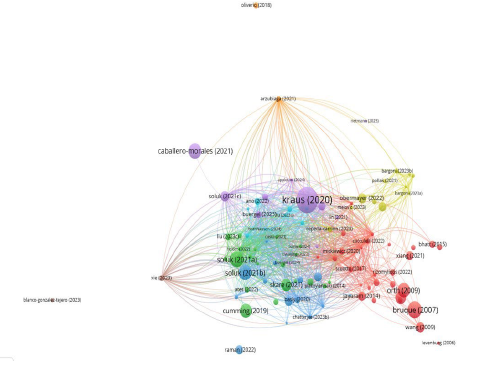
Articles part of the blue cluster (14 documents) shed light on the interrelationships among family influence, entrepreneurship, DT and internationalization in family firms. Soluk et al. (2021) find that the positive effect of family influence on digital business model innovation is mediated by dynamic capabilities. Basly and Hammouda (2020) provide a conceptual model revealing the factors impacting digital entrepreneurship adoption in family firms and the moderating influence of family involvement on digital entrepreneurship adoption in family firms. Lasio et al. (2024) demonstrate that entrepreneurial orientation significantly enhances the effect of DT of family firm performance. Chatterjee et al. (2023) describe digitalization and international networking capability as moderators for the successful internationalization and performance of family firms. De Groote et al. (2023) reveal how family-owned SMEs can use historical, venture, and collaborative capital to master digitalization. Upadhyay et al. (2023) shed light on the role of digital entrepreneurship and entrepreneurial orientation on the intention of family businesses to adopt artificial intelligence.
Researchers in the olive cluster (12 documents) address the use of social media, digital marketing and consumer behavior in family firm context. Bargoni et al. (2023a) examine the influence of family firms' characteristics on millennials' consumer behavior and the moderating role of millennials' digital savviness. Cepeda-Carrion et al. (2023) investigate the relationship between social media use and open innovation in family firms. Zanon et al. (2019) demonstrate that family firm image promotion affects positively perceived brand authenticity, which in turn leads to higher level of customer-company-identification. This in turn is associated with increased intention to engage in social media. Bargoni et al. (2022) explore the role of brand authenticity dimensions on consumer engagement in the context of social media in family and non-family firms. Bargoni et al. (2023b) find that family firms' characteristics are important antecedents of consumers' willingness to pay for family firms' products in an online environment. Ibáñez et al. (2022) explore the effect of visual attention to visual stimuli on a website affects consumers' recognition of the family firm identity and its influence on consumer behavior.
Studies published in the lilac cluster (11 documents) focus on DT and strategic behavior of family businesses in different contexts including during Covid-19 pandemic. Soluk (2021) presents a theoretical framework of family firms' motives, resource allocation and entrepreneurial action leading to digital innovation (digital process innovation, digital product innovation, and digital business model innovation) in response to external shocks. Bürgel and Hiebl (2023) examine the influence of conflict management strategies on the level of family business digitalization and the moderation effect of generational ownership dispersion during the global pandemic of Covid-19. Zapata-Cantu et al. (2023) discuss the role of knowledge management processes that could provide avenues of innovation and adaptation of family firms in turbulent and uncertain times. Soluk et al. (2021c) provide a framework of a family firm adaptation to an exogenous shock. Bürgel et al. (2023) discuss the role of digitalization for firms' resilience to pandemic crises in a sample of family and non-family firms. Kraus et al. (2020) examine the strategies used by family firms to adapt to the Covid-19 crisis. Their findings reveal that as a result of the crisis family businesses tend to make strategic changes in their business models, use digital tools in operations, and develop culture of digitalization.
Scholars in the turquoise cluster (8 publications) explore the interrelationships between the role of human factor and DT in family firms. Ardito and Capolupo (2024) find that the presence of family owners negatively impacts exploratory innovation intensity, but this relationship is positively moderated by digital search (i.e. digital technologies related to knowledge components during the innovation process). Bornhausen and Wulf (2024) report that the share of non-family managers in the top management team positively affects digital innovativeness in family firms and transgenerational control intentions play a moderating role in this relationship. De Groote et al. (2021) discover that the presence of a family member who drives the adoption of new technologies may lead to successful coping with disruptive change (e.g., the Internet and with it the advent of ecommerce). Nieto et al. (2023) reveal that there is a positive link between digitalization and the breadth of technological collaboration, and this effect is higher among family firms, i.e. when one or more members of the owner family hold managerial positions, than in their non-family counterparts.
3.4 Keywords co-occurrence analysis
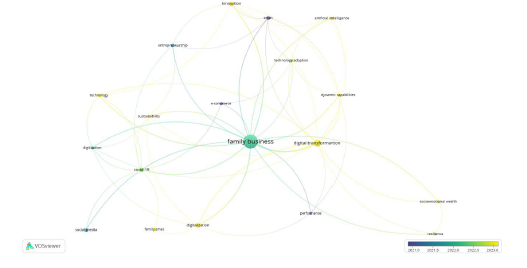
A network visualization map of author keywords was used to understand the knowledge structure of the field of DT of family business (see Figure 5). This resulted in 19 out of 655 keywords. The co-occurrence analysis of author keywords yielded six clusters (Table 7). The twelve most occurring keywords are: Family Business (123), Digital Transformation (33), Digitalization (14), Innovation (13), SMEs (11), Covid-19 (11), Social Media (9), Entrepreneurship (8), Dynamic Capabilities (7), Technology (7), Sustainability (7), E-Commerce (7).
The temporal co-occurrence map of author keywords illustrates the changes in research interests in the field of DT of family business over time (see Figure 6). Since 2021, the hot topics in this research field have shifted from e-commerce, entrepreneurship, performance, and SMEs towards digital transformation, digitalization, innovation, dynamic capabilities, technology, artificial intelligence, family SMEs, sustainability. This change is related to global crises like Covid-19 (Plekhanov et al., 2023), remarkable developments in artificial intelligence in recent years (Minh et al., 2022; Lafuente & Sallan, 2024), and the 2030 Agenda for Sustainable Development, adopted by the United Nations (UN) General Assembly in 2015.
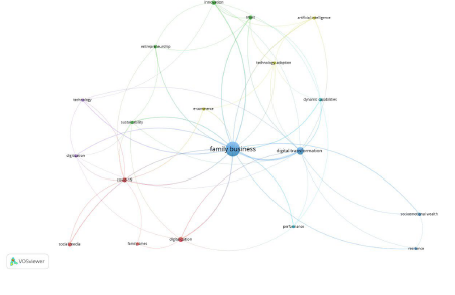
Table 7:. Author keywords in the six co-occurrence clusters.
| Cluster 1 | Cluster 2 | Cluster 3 | Cluster 4 | Cluster 5 | Cluster 6 |
|---|---|---|---|---|---|
| Digitalization | Innovation | Family business | E-commerce | Technology | Dynamic capabilities |
| Covid-19 | SMEs | Digital transformation | Artificial intelligence | Digitalization | Performance |
| Social media | Entrepreneurship | Socioemotional wealth | Technology adoption | ||
| Family SMEs | Sustainability | Resilience |
3.5 Integrated framework
Based on co-citation and bibliographic coupling analyses and a content analysis of the set of 100 coupled articles aimed at identifying the utilized dependent variables, we propose an integrated framework to organize thematic focuses and theoretical approaches and to provide guidance for future research on DT in family business. Figure 7 depicts drivers, outcomes, and dimensions of DT examined in the literature on DT in family business. Drivers are variables that influence DT in family businesses, while outcomes are effects of DT on the family businesses.
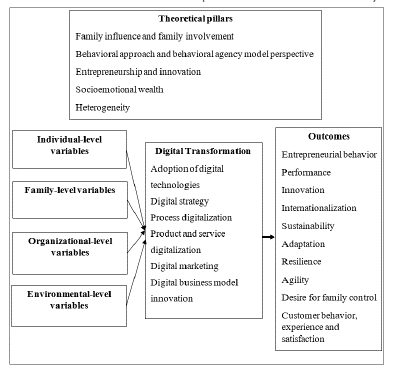
The studied drivers belong to the following four levels of analysis: the individual, the organization, the family, and the environment. Research on DT in family business considers various dimensions and aspects of this phenomenon including adoption of digital technologies, digital strategy, process digitalization, product and service digitalization, digital marketing, and digital business model innovation. Diverse outcome (dependent) variables are used in empirical research on family firms and DT: performance-related (e.g., financial performance, internationalization, innovation); capability-related (e.g., agility, resilience, adaptation), consumer-related (consumer experience, consumer satisfaction) and family-related (desire for family control). By integrating the drivers, dimensions, and outcomes of DT in family business, we offer a framework which scholars and practitioners can use to pinpoint and test specific paths towards DT and performance outcomes, interactions among different elements (e.g., how do individual, family, organization, and environmental drivers interact to drive DT), as well as challenges and opportunities in the process.
Concluding
4. Discussion and conclusions
4.1 Discussion
This article presents a bibliometric study of previous research on DT in family business based on a dataset of 196 peer-reviewed articles extracted from Web of Science which aims to map and integrate existing research on this topic. The study outlines trends in scientific production, providing information about most productive authors, institutions, countries, and journals. Although the first 2 publications on DT in family business appear in 2005, the research interest in this topic started growing after 2020, most likely due to the outburst of Covid-19 pandemic. The most productive authors are Nadine Kammerlander, Jonas Soluk, and Demetris Vrontis, while the authors with the highest numbers of citations are Sascha Kraus, Jonas Soluk, and Thomas Clauss. China is the country with the highest total number of publications. The analysis of the 10 most influential institutions and the 10 most influential countries in terms of total number of publications shed light on the leading role of European countries, especially Italy, Germany and Spain, and European higher education institutions. In relation to the sources generating knowledge about DT in family business, Journal of Family Business Management stands out for the highest number of publications, while International Journal of Entrepreneurial Behavior & Research leads the ranking with the highest number of citations. The seminal study on DT in family business is by Kraus, Clauss, Breier, Gast, Zardini, and Tiberius (2020).
The findings of co-citation, bibliographic coupling, and keywords co-occurrence analyses provide novel insights from the intellectual structure of this research field. The field is fragmented across diverse research streams, research topics and theoretical perspectives. The identified theoretical foundations of the research on DT in family business (family influence and family involvement; behavioural approach and behavioral agency model perspective; entrepreneurship and innovation; socioemotional wealth; and heterogeneity among family businesses and between family and non-family businesses) are very similar to those identified in the research on other topics in family business (for example see Anwar et al., 2024; Bagi§ et al., 2023). The proposed integrated framework extends the existing literature by conceiving DT in family business as a multidimensional phenomenon influenced by multiple variables at four levels of analysis and associated with diverse outcomes. This framework is consistent with systems perspective of family business (Davis & Stern, 1981; Tagiuri & Davis, 1996; Habbershon et al., 2003).
4.2 Contributions to scholarship
This study makes relevant scientific contributions. The findings generated by combining different bibliometric methods give an integrated framework for organizing the research on DT in family business. This framework provides novel conceptual insights into the relationships among drivers, dimensions and outcomes of DT studied in the literature on DT in family business as well as the theoretical pillars of this field. The identified main research topics and their evolution during the last five years may advise future research agendas. The outlined theoretical roots established in the field of DT in family business provide useful insights and directions that may facilitate theoretical development and may reveal new research opportunities in this field. The identified research streams in the literature on DT in family business can help researchers better understand the current state and trends in the development of the field and can facilitate the choice of research topics by future researchers. The presented information about scientific production, influential authors, articles, journals, institutions, and countries in the field of DT in family business may inform future research efforts.
4.3 Contribution to practice
The results of this study provide valuable insights about the importance and scope of DT and the need to speed up DT for owners, managers, and members of the controlling family in family businesses, educators, and policy makers. Owners, managers, and members of the controlling family in family businesses can gain greater understanding about drivers, dimensions and outcomes of DT in family firms. The publications identified in the bibliometric analysis can help them to overcome various obstacles and barriers to DT and to cope with diverse challenges in the process of DT. The proposed integrated framework can inform organizational practices and strategic decision-making in family businesses. Being able to categorize the different drivers (as proposed in the framework) can help family firms understand both forces shaping DT and sources of resistance or challenges. Likewise, understanding the variety of possible outcomes from DT, practitioners can prioritize activities that are aligned with their objectives. The framework can also enable the design and implementation of well-informed public policies and measures to support DT in family businesses, especially resource-constrained family SMEs. The findings of this study are also relevant for education and training. The theoretical foundations, thematic areas, and relationships among drivers, dimensions and outcomes of DT family business identified in this study can help to develop or adapt educational and training programs and courses in various fields (Lafuente & Sallan, 2024).
4.4 Limitations and future research
4.4.1 Limitations of the study
This bibliometric analysis has several limitations that should be addressed in future studies. First, this study is focused only on peer-reviewed articles in English published in journals, while books and book chapters, conference proceedings, and reports in English and publications in other languages were not analyzed. Second, it is important to acknowledge that this study was based solely on Web of Science. Third, we performed our analyses solely in VOSwiewer and therefore they are limited by the features and functionalities of this software. Finally, our study provides a map of the field of DT in family business rather than in-depth analysis of the content of the literature in this field.
4.4.2 Future theoretical directions
This study suggests several directions for future research. The findings from the co-citation analyses highlight five main theoretical approaches to researching DT in family business: 1 / family influence and family involvement; 2 / behavioral approach and behavioral agency model perspective; 3/ entrepreneurship and innovation; 4/ socioemotional wealth; and 5/ heterogeneity among family businesses and between family and non-family businesses. Promising pathways for future research to advance understanding of the complex nature of DT in family firms may include dynamic capability perspective, resource-based view, stewardship theory and systems approach. For example, future research may investigate more deeply the influence of unique bundles of resources in family firms (familiness) (Habbershon et al., 2003) on their DT. Stewardship theory could help to explain the role of stewardship governance and steward behaviour (Davis et al., 1997) in the process of DT in family firms.
Previous research has highlighted that DT is associated with profound structural changes in organizational structure, leadership, organizational culture, employee roles and skills in organizations (Vial, 2019; Lafuente et al., 2023; Vaillant & Lafuente, 2024). Future research should examine in greater detail the nature of structural changes taking place in family firms undergoing a process of DT. Furthermore, as family business comprises the overlapping subsystems of the family, the ownership and the firm (Tagiuri & Davis, 1996), future research based on systems approach needs to explore in-depth the changes taking place in the family and ownership subsystems associated with the process of DT in the family business.
4.4.3 Future methodological directions
Our analysis has identified a plethora of different outcome (dependent) variables which have been used in research on family firms and DT. They can be broadly classified into the following groups: (1) performance-related - e.g., financial performance, internationalization, innovation; (2) capability-related - e.g., agility, resilience, adaptation; (3) consumer related - e.g., consumer experience, consumer satisfaction; and (4) family-related. While each of those outcomes is important in their own right, future research can assess the relationships among those various outcome groups. For instance, building on theoretical perspectives such as resource-based view and dynamic capabilities, scholars could investigate more closely the relations between different capability-related outcomes and performance, and the role of digitalization in this process (Lafuente et al., 2010; Lafuente et al., 2018). Another fruitful avenue for future research is the relationship between customer-related outcomes and performance in family firms in a digital world. From a consumer point of view, the "familiness" of a family firm may be key for brand image perceptions; hence, how DT is leveraged by family firms to convert consumer-related outcomes (e.g., consumer experiences) to various firm performance outcomes is of particular importance. Critically important, family-related outcomes were very rarely used in research on DT and family firms. Yet, the way in which DT affects family dynamics and relationships within the family business needs further research attention. Therefore, from a methodological point of view, it is important to build and test mediation models, where digital transformation efforts drive a set of (intermediate) outcomes, which in turn affects a different set of performance variables. Ideally, those models need to be longitudinal to test for mediation and especially considering that DT activities may not manifest quickly and directly into performance outcomes but should be tracked over time.
Furthermore, in the proposed integrative model we offer a classification of DT drivers in family business. While each of those drivers is important for understanding DT adoption, future research needs to build models that test the interactions among those drivers, and the relative importance of each driver for achieving specific outcomes.
4.5 Conclusions
In recent years DT has become an important topic for both research and practice. This bibliometric analysis has mapped the scientific landscape of DT in family business. To address the stated research questions, we utilized descriptive, co-citation, bibliographic coupling, and keywords co-occurrence analyses on a dataset of articles indexed in Web of Science database. The descriptive statistical results reveal not only the top contributors, journals, and articles, but also highlight influential institutions and countries in the field of DT in family business. The topic of DT in family business has received a marked increase in research interest during the last 5 years after the global crisis caused by COVID-19 pandemic and new developments in digital technologies. The majority of the 10 most influential journals publishing research on this topic are in the field of business and management. The most productive authors in terms of number of publications are affiliated with European institutions, while the majority of the 10 most influential countries and institutions are located in Europe.
Our study reveals that DT in family business can be considered as a very recent research field. Moreover, the field is fragmented and is characterized by heterogeneity in both theoretical perspectives employed, and research topics examined. Based on the findings of the performed bibliometric analyses, we propose an integrated framework highlighting thematic focuses and theoretical approaches used in the research on DT in family business. The framework posits that individual-level, family-level, organizational-level, and environmental-level variables influence digital transformation in family business, which can produce diverse performance-related, capability-related, consumer-related, and family-related outcomes. Our bibliometric analysis contributes to better understanding of the field of DT in family business and provides suggestions for future research and valuable insights for practices.
References
References
- Amato, S., Broccardo, L., & Tenucci, A. (2024). Family firms, management control and digitalization effect. Management Decision, 62(5), 1645-1667. https://doi.org/10.1108/MD-03-2023-0347
- Anwar, M., Clauss, T., & Meyer, N. (2024). Entrepreneurship in family firms: an updated bibliometric overview. Review of Managerial Science, 18(2), 539-575. https://doi.org/10.1007/s11846-023-00650-z
- Aparicio, G., Ramosb, E., Casillas, J. C., & Iturralde, T. (2021). Family Business Research in the Last Decade. A Bibliometric Review. European Journal of Family Business, 11(1), 33-44. https://doi.org/10.24310/ejfbejfb.v11i1.12503
- Ardito, L., & Capolupo, P. (2024). Exploratory innovation in family-owned firms: The moderating role of digital search. IEEE Transactions on Engineering Management, 71, 13673-13683. https://doi.org/10.1109/TEM.2022.3231468
- Arregle, J. L., Hitt, M. A., & Mari, I. (2019). A missing link in family firms’ internationalization research: Family structures. Journal of International Business Studies, 50, 809-825. https://doi.org/10.1057/s41267-019-00213-z
- Atienza-Barba, M., Álvarez-García, J., Meseguer-Martínez, Á., & Barba-Sánchez, V. (2025). The family business in the digital era: advancing towards artificial intelligence. Journal of Family Business Management, 15(2), 297-316. https://doi.org/10.1108/JFBM-09-2024-0215
- Baier-Fuentes, H., Merigó, J. M., Amorós, J. E., & Gaviria-Marín, M. (2019). International entrepreneurship: a bibliometric overview. International Entrepreneurship and Management Journal, 15, 385-429. https://doi.org/10.1007/s11365-017-0487-y
- Bargoni, A., Ballerini, J., Vrontis, D., & Ferraris, A. (2022). To be (family) or not to be (family): the familiness effect over Brand authenticity posts on social media and consumer engagement relationship. Journal of Product & Brand Management, 32(5), 713-736. https://doi.org/10.1108/JPBM-11-2021-3722
- Bargoni, A., Giachino, C., Troise, C., Alam, G. M., & Quaglia, R. (2023b). A digital family affair: Do family firms’ characteristics enhance consumers’ willingness to pay?. Technological Forecasting and Social Change, 188, 122289. https://doi.org/10.1016/j.techfore.2022.122289
- Bargoni, A., Kliestik, T., Jabeen, F., & Santoro, G. (2023a). Family firms’ characteristics and consumer behaviour: An enquiry into millennials’ purchase intention in the online channel. Journal of Business Research, 156, 113462. https://doi.org/10.1016/j.jbusres.2022.113462
- Barile, D., Secundo, G., & Del Vecchio, P. (2024). Food 4.0 for competing during the COVID-19 pandemic: experimenting digitalization in family firms. European Journal of Innovation Management, 27(4), 1381-1402. https://doi.org/10.1108/EJIM-07-2022-0373
- Basly, S., & Hammouda, A. (2020). Family businesses and digital entrepreneurship adoption: A conceptual model. The Journal of Entrepreneurship, 29(2), 326-364. https://doi.org/10.1177/0971355720930573
- Berrone, P., Cruz, C., & Gomez-Mejia, L. R. (2012). Socioemotional wealth in family firms: Theoretical dimensions, assessment approaches, and agenda for future research. Family Business Review, 25(3), 258-279. https://doi.org/10.1177/0894486511435355
- Bornhausen, A. M., & Wulf, T. (2024). Digital innovation in family firms: The roles of non-family managers and transgenerational control intentions. Small Business Economics, 62, 1429-1448. https://doi.org/10.1007/s11187-023-00823-w
- Bruque, S., & Moyano, J. (2007). Organisational determinants of information technology adoption and implementation in SMEs: The case of family and cooperative firms. Technovation, 27(5), 241-253. https://doi.org/10.1016/j.technovation.2006.12.003
- Bürgel, T. R., & Hiebl, M. R. (2023). Conflict management strategies and the digitalization of family firms: the moderating role of generational ownership dispersion. IEEE Transactions on Engineering Management, 71, 9555-9574. https://doi.org/10.1109/TEM.2023.3293855
- Bürgel, T. R., Hiebl, M. R., & Pielsticker, D. I. (2023). Digitalization and entrepreneurial firms’ resilience to pandemic crises: Evidence from COVID-19 and the German Mittelstand. Technological Forecasting and Social Change, 186, 122135. https://doi.org/10.1016/j.techfore.2022.122135
- Bağiş, M., Kryeziu, L., Kurutkan, M. N., Krasniqi, B. A., Yazici, O., & Memili, E. (2023). Topics, trends and theories in family business research: 1996-2020. International Entrepreneurship and Management Journal, 19, 1855-1891. https://doi.org/10.1007/s11365-023-00904-y
- Caballero-Morales, S. O. (2021). Innovation as recovery strategy for SMEs in emerging economies during the COVID-19 pandemic. Research in International Business and Finance, 57, 101396. https://doi.org/10.1016/j.ribaf.2021.101396
- Calabrò, A., Vecchiarini, M., Gast, J., Campopiano, G., De Massis, A., & Kraus, S. (2019). Innovation in family firms: A systematic literature review and guidance for future research. International Journal of Management Reviews, 21(3), 317-355. https://doi.org/10.1111/ijmr.12192
- Canjun, C., Lelin, L., & Changxin, X. (2025). Digital transformation and the performance of family firms: a dynamic capabilities perspective. Innovation, 1-29. https://doi.org/10.1080/14479338.2024.2448486
- Caputo, A., Marzi, G., Pellegrini, M. M., & Rialti, R. (2018). Conflict management in family businesses: A bibliometric analysis and systematic literature review. International Journal of Conflict Management, 29(4), 519-542. https://doi.org/10.1108/IJCMA-02-2018-0027
- Casprini, E., Dabic, M., Kotlar, J., & Pucci, T. (2020). A bibliometric analysis of family firm internationalization research: Current themes, theoretical roots, and ways forward. International Business Review, 29(5), 101715. https://doi.org/10.1016/j.ibusrev.2020.101715
- Ceipek, R., Hautz, J., De Massis, A., Matzler, K., & Ardito, L. (2021). Digital transformation through exploratory and exploitative internet of things innovations: The impact of family management and technological diversification. Journal of Product Innovation Management, 38(1), 142-165. https://doi.org/10.1111/jpim.12551
- Cepeda-Carrion, I., Ortega-Gutierrez, J., Garrido-Moreno, A., & Cegarra-Navarro, J. G. (2023). The mediating role of knowledge creation processes in the relationship between social media and open innovation. Journal of the Knowledge Economy, 14, 1275-1297. https://doi.org/10.1007/s13132-022-00949-4
- Chatterjee, S., Chaudhuri, R., Vrontis, D., & Maalaoui, A. (2023). Internationalization of family business and its performance: examining the moderating role of digitalization and international networking capability. Review of Managerial Science, 17, 2443-2470. https://doi.org/10.1007/s11846-022-00585-x
- Chrisman, J. J., & Patel, P. C. (2012). Variations in R&D investments of family and nonfamily firms: Behavioral agency and myopic loss aversion perspectives. Academy of Management Journal, 55(4), 976-997. https://doi.org/10.5465/amj.2011.0211
- Chrisman, J. J., Chua, J. H., De Massis, A., Frattini, F., & Wright, M. (2015). The ability and willingness paradox in family firm innovation. Journal of Product Innovation Management, 32(3), 310-318. https://doi.org/10.1111/jpim.12207
- Chrisman, J. J., Fang, H., Vismara, S., & Wu, Z. (2024). New insights on economic theories of the family firm. Small Business Economics, 63, 697-711. https://doi.org/10.1007/s11187-024-00875-6
- Chua, J. H., Chrisman, J. J., & Sharma, P. (1999). Defining the family business by behavior. Entrepreneurship Theory and Practice, 23(4), 19-39. https://doi.org/10.1177/104225879902300402
- Cooper, M. J., Upton, N., & Seaman, S. (2005). Customer relationship management: A comparative analysis of family and nonfamily business practices. Journal of Small Business Management, 43(3), 242-256. https://doi.org/10.1111/j.1540-627X.2005.00136.x
- Costa, A., Presenza, A., & Abbate, T. (2023). Digital transformation in family-owned winery SMEs: an exploratory analysis in the South-Italian context. European Journal of Innovation Management, 26(7), 527-551. https://doi.org/10.1108/EJIM-02-2023-0108
- Crossan, M. M., & Apaydin, M. (2010). A multi-dimensional framework of organizational innovation: A systematic review of the literature. Journal of Management Studies, 47(6), 1154-1191. https://doi.org/10.1111/j.1467-6486.2009.00880.x
- Cucculelli, M., Dileo, I., & Pini, M. (2022). Filling the void of family leadership: institutional support to business model changes in the Italian Industry 4.0 experience. The Journal of Technology Transfer, 47, 213-241. https://doi.org/10.1007/s10961-021-09847-4
- Cumming, D., Meoli, M., & Vismara, S. (2019). Investors’ choices between cash and voting rights: Evidence from dual-class equity crowdfunding. Research Policy, 48(8), 103740. https://doi.org/10.1016/j.respol.2019.01.014
- Davis, J. H., Schoorman, F. D., & Donaldson, L. (1997). Toward a stewardship theory of management. Academy of Management Review, 22(1), 20-47. https://doi.org/10.5465/amr.1997.9707180258
- Davis, P., & Stern, D. (1981). Adaptation, survival, and growth of the family business: An integrated systems perspective. Human Relations, 34(3), 207-224. https://doi.org/10.1177/001872678103400303
- Dawson, A., & Mussolino, D. (2014). Exploring what makes family firms different: discrete or overlapping constructs in the literature?. Journal of Family Business Strategy, 5(2), 169-183. https://doi.org/10.1016/j.jfbs.2013.11.004
- De Groote, J. K., Conrad, W., & Hack, A. (2021). How can family businesses survive disruptive industry changes? Insights from the traditional mail order industry. Review of Managerial Science, 15, 2239-2273. https://doi.org/10.1007/s11846-020-00424-x
- de Groote, J., Soluk, J., Laue, S. L., Heck, M., & Kammerlander, N. (2023). How can family-owned Mittelstand firms use their unique resources to master the digitalization age? The role of family historical, venture, and collaborative capital. Business Horizons, 66(1), 133-152. https://doi.org/10.1016/j.bushor.2022.04.001
- De Massis, A., Frattini, F., Majocchi, A., & Piscitello, L. (2018). Family firms in the global economy: Toward a deeper understanding of internationalization determinants, processes, and outcomes. Global Strategy Journal, 8(1), 3-21. https://doi.org/10.1002/gsj.1199
- Deephouse, D. L., & Jaskiewicz, P. (2013). Do family firms have better reputations than non-family firms? An integration of socioemotional wealth and social identity theories. Journal of Management Studies, 50(3), 337-360. https://doi.org/10.1111/joms.12015
- Donthu, N., Kumar, S., Mukherjee, D., Pandey, N., & Lim, W. M. (2021). How to conduct a bibliometric analysis: An overview and guidelines. Journal of Business Research, 133, 285-296. https://doi.org/10.1016/j.jbusres.2021.04.070
- Duran, P., Kammerlander, N., Van Essen, M., & Zellweger, T. (2016). Doing more with less: Innovation input and output in family firms. Academy of Management Journal, 59(4), 1224-1264. https://doi.org/10.5465/amj.2014.0424
- Dyer Jr, W. G., & Whetten, D. A. (2006). Family firms and social responsibility: Preliminary evidence from the S&P 500. Entrepreneurship Theory and Practice, 30(6), 785-802. https://doi.org/10.1111/j.1540-6520.2006.00151.x
- Ferreira, F. A. (2018). Mapping the field of arts-based management: Bibliographic coupling and co-citation analyses. Journal of Business Research, 85, 348-357. https://doi.org/10.1016/j.jbusres.2017.03.026
- Ferreira, J. J., Fernandes, C. I., Schiavone, F., & Mahto, R. V. (2021). Sustainability in family business-A bibliometric study and a research agenda. Technological Forecasting and Social Change, 173, 121077. https://doi.org/10.1016/j.techfore.2021.121077
- Galindo-Martín, M. Á., Castaño-Martínez, M. S., & Méndez-Picazo, M. T. (2019). Digital transformation, digital dividends and entrepreneurship: A quantitative analysis. Journal of Business Research, 101, 522-527. https://doi.org/10.1016/j.jbusres.2018.12.014
- Gargallo Castel, A. F., & Galve Gorriz, C. (2017). Family involvement and the impact of information and communication technology on performance. Academia Revista Latinoamericana de Administración, 30(1), 23-39. https://doi.org/10.1108/ARLA-08-2015-0214
- Gomez-Mejia, L. R., Cruz, C., Berrone, P., & De Castro, J. (2011). The bind that ties: Socioemotional wealth preservation in family firms. The Academy of Management Annals, 5(1), 653-707. https://doi.org/10.5465/19416520.2011.593320
- Gómez-Mejía, L. R., Haynes, K. T., Núñez-Nickel, M., Jacobson, K. J., & Moyano-Fuentes, J. (2007). Socioemotional wealth and business risks in family-controlled firms: Evidence from Spanish olive oil mills. Administrative Science Quarterly, 52(1), 106-137. https://doi.org/10.2189/asqu.52.1.106
- Gong, C., & Ribiere, V. (2021). Developing a unified definition of digital transformation. Technovation, 102, 102217. https://doi.org/10.1016/j.technovation.2020.102217
- González-Valiente, C. L. (2016). Investigación sobre bibliotecología, ciencia de la información e inteligencia empresarial a través de las presentaciones a los congresos INFO e IntEmpres: Un análisis bibliométrico (2002-2012). Revista Española de Documentación Científica, 39(4), e154. https://doi.org/10.3989/redc.2016.4.1377
- Guo, X., Li, M., Wang, Y., & Mardani, A. (2023). Does digital transformation improve the firm’s performance? From the perspective of digitalization paradox and managerial myopia. Journal of Business Research, 163, 113868. https://doi.org/10.1016/j.jbusres.2023.113868
- Habbershon, T. G., Williams, M., & MacMillan, I. C. (2003). A unified systems perspective of family firm performance. Journal of Business Venturing, 18(4), 451-465. https://doi.org/10.1016/S0883-9026(03)00053-3
- Hagberg, J., Sundstrom, M., & Egels-Zandén, N. (2016). The digitalization of retailing: an exploratory framework. International Journal of Retail & Distribution Management, 44(7), 694-712. https://doi.org/10.1108/IJRDM-09-2015-0140
- Heider, A. K., Clauss, T., Hülsbeck, M., Gerken, M., & Rüsen, T. A. (2022). Blood is thicker than water: The role of family willingness and family ability in achieving holistic digitalisation in family businesses. International Journal of Innovation Management, 26(3), 2240009. https://doi.org/10.1142/S1363919622400096
- Herrera-Barriga, R. A., & Escandon-Barbosa, D. M. (2024). Board leadership in global ventures: A bibliometric analysis. TEC Empresarial, 18(2), 81-96. https://doi.org/10.18845/te.v18i2.7138
- Ibáñez, M. J., Alonso Dos Santos, M., & Llanos-Contreras, O. (2022). Transmission of family identity and consumer response: do consumers recognize family firms?. International Journal of Entrepreneurial Behavior & Research, 28(1), 6-25. https://doi.org/10.1108/IJEBR-05-2021-0401
- Kathuria, A., Karhade, P. P., Ning, X., & Konsynski, B. R. (2023). Blood and water: information technology investment and control in family-owned businesses. Journal of Management Information Systems, 40(1), 208-238. https://doi.org/10.1080/07421222.2023.2172770
- Kirby, A. (2023). Exploratory bibliometrics: using VOSviewer as a preliminary research tool. Publications, 11(1), 10. https://doi.org/10.3390/publications11010010
- König, A., Kammerlander, N., & Enders, A. (2013). The family innovator’s dilemma: How family influence affects the adoption of discontinuous technologies by incumbent firms. Academy of Management Review, 38(3), 418-441. https://doi.org/10.5465/amr.2011.0162
- Kotlar, J., De Massis, A., Frattini, F., Bianchi, M., & Fang, H. (2013). Technology acquisition in family and nonfamily firms: A longitudinal analysis of Spanish manufacturing firms. Journal of Product Innovation Management, 30(6), 1073-1088. https://doi.org/10.1111/jpim.12046
- Kraus, S., Clauss, T., Breier, M., Gast, J., Zardini, A., & Tiberius, V. (2020). The economics of COVID-19: initial empirical evidence on how family firms in five European countries cope with the corona crisis. International Journal of Entrepreneurial Behavior & Research, 26(5), 1067-1092. https://doi.org/10.1108/IJEBR-04-2020-0214
- Kraus, S., Jones, P., Kailer, N., Weinmann, A., Chaparro-Banegas, N., & Roig-Tierno, N. (2021). Digital transformation: An overview of the current state of the art of research. Sage Open, 11(3), 21582440211047576. https://doi.org/10.1177/21582440211047576
- Kraus, S., Durst, S., Ferreira, J. J., Veiga, P., Kailer, N., & Weinmann, A. (2022). Digital transformation in business and management research: An overview of the current status quo. International Journal of Information Management, 63, 102466. https://doi.org/10.1016/j.ijinfomgt.2021.102466
- Lafuente, E., Acs, Z. J., & Szerb, L. (2024). Analysis of the digital platform economy around the world: A network DEA model for identifying policy priorities. Journal of Small Business Management , 62(2), 847-891. https://doi.org/10.1080/00472778.2022.2100895
- Lafuente, E., Bayo-Moriones, A., & García-Cestona, M. (2010). ISO-9000 certification and ownership structure: Effects upon firm performance. British Journal of Management, 21(3), 649-665. https://doi.org/10.1111/j.1467-8551.2009.00660.x
- Lafuente, E., & Sallan, J. M. (2024). Digitally powered solution delivery: The use of IoT and AI for transitioning towards a solution business model. International Journal of Production Economics, 277, 109383. https://doi.org/10.1016/j.ijpe.2024.109383
- Lafuente, E., Vaillant, Y., & Leiva, J.C. (2018). Sustainable and Traditional Product Innovation without Scale and Experience, but only for KIBS!. Sustainability, 10(4), 1169. https://doi.org/10.3390/su10041169
- Lafuente, E., Vaillant, Y. & Rabetino, R. (2023). Digital disruption of optimal co-innovation configurations. Technovation, 125, 139516. https://doi.org/10.1016/j.technovation.2023.102772
- Lasio, V., Gómez, J. M., Rosso, J., & Sánchez, A. (2024). Entrepreneurial orientation and socioemotional wealth as enablers of the impact of digital transformation in family firms. Journal of Family Business Management, 14(6), 1268-1294. https://doi.org/10.1108/JFBM-11-2023-0282
- Leppäaho, T., & Ritala, P. (2022). Surviving the coronavirus pandemic and beyond: Unlocking family firms’ innovation potential across crises. Journal of Family Business Strategy, 13(1), 100440. https://doi.org/10.1016/j.jfbs.2021.100440
- Liu, Z., Zhou, J., & Li, J. (2023). How do family firms respond strategically to the digital transformation trend: Disclosing symbolic cues or making substantive changes?. Journal of Business Research, 155, 113395. https://doi.org/10.1016/j.jbusres.2022.113395
- Llopis-Albert, C., Rubio, F., & Valero, F. (2021). Impact of digital transformation on the automotive industry. Technological Forecasting and Social Change , 162, 120343. https://doi.org/10.1016/j.techfore.2020.120343
- Marino-Romero, J. A., Palos-Sanchez, P. R., & Velicia-Martín, F. (2024). Evolution of digital transformation in SMEs management through a bibliometric analysis. Technological Forecasting and Social Change , 199, 123014. https://doi.org/10.1016/j.techfore.2023.123014
- Merigó, J. M., Pedrycz, W., Weber, R., & de la Sotta, C. (2018). Fifty years of Information Sciences: A bibliometric overview. Information Sciences, 432, 245-268. https://doi.org/10.1016/j.ins.2017.11.054
- Meroño-Cerdán, A. L. (2017). Perceived benefits of and barriers to the adoption of teleworking: Peculiarities of Spanish family firms. Behaviour & Information Technology, 36(1), 63-74. https://doi.org/10.1080/0144929X.2016.1192684
- Minh, D., Wang, H. X., Li, Y. F., & Nguyen, T. N. (2022). Explainable artificial intelligence: a comprehensive review. Artificial Intelligence Review, 55(5), 3503-3568. https://doi.org/10.1007/s10462-021-10088-y
- Mustafa, G., Rauf, A., Ahmed, B., Afzal, M. T., Akhunzada, A., & Alharthi, S. Z. (2023). Comprehensive evaluation of publication and citation metrics for quantifying scholarly influence. IEEE Access, 11, 65759-65774. https://doi.org/10.1109/ACCESS.2023.3290917
- Nambisan, S. (2017). Digital entrepreneurship: Toward a digital technology perspective of entrepreneurship. Entrepreneurship Theory and Practice, 41(6), 1029-1055. https://doi.org/10.1111/etap.12254
- Nieto, M. J., Santamaria, L., & Bammens, Y. (2023). Digitalization as a facilitator of open innovation: Are family firms different?. Technovation, 128, 102854. https://doi.org/10.1016/j.technovation.2023.102854
- Nieto, M. J., Santamaria, L., & Fernandez, Z. (2015). Understanding the innovation behavior of family firms. Journal of Small Business Management , 53(2), 382-399. https://doi.org/10.1111/jsbm.12075
- Orth, U. R., & Green, M. T. (2009). Consumer loyalty to family versus non-family business: The roles of store image, trust and satisfaction. Journal of Retailing and Consumer Services, 16(4), 248-259. https://doi.org/10.1016/j.jretconser.2008.12.002
- Petzolt, S., Hölzle, K., Kullik, O., Gergeleit, W., & Radunski, A. (2022). Organisational digital transformation of SMES- development and application of a digital transformation maturity model for business model transformation. International Journal of Innovation Management, 26(3), 2240017. https://doi.org/10.1142/S1363919622400175
- Pini, M. (2019). Family management and Industry 4.0: Different effects in different geographical areas? An analysis of the less developed regions in Italy. Journal of Entrepreneurship, Management and Innovation, 15(3), 73-102. https://doi.org/10.7341/20191533
- Plekhanov, D., Franke, H., & Netland, T. H. (2023). Digital transformation: A review and research agenda. European Management Journal, 41(6), 821-844. https://doi.org/10.1016/j.emj.2022.09.007
- Putritamara, J. A., Hartono, B., Toiba, H., Utami, H. N., Rahman, M. S., & Masyithoh, D. (2023). Do dynamic capabilities and digital transformation improve business resilience during the COVID-19 pandemic? Insights from beekeeping MSMEs in Indonesia. Sustainability, 15(3), 1760. https://doi.org/10.3390/su15031760
- Ribeiro-Navarrete, S., Botella-Carrubi, D., Palacios-Marqués, D., & Orero-Blat, M. (2021). The effect of digitalization on business performance: An applied study of KIBS. Journal of Business Research, 126, 319-326. https://doi.org/10.1016/j.jbusres.2020.12.065
- Ribes, G., Perelló, M., & Pantoja, O. (2018). Revisión sistemática de la literatura de las variables clave del proceso de co-creación en las instituciones de educación superior. TEC Empresarial, 11(3), 41-53. https://doi.org/10.18845/te.v11i3.3365
- Sciascia, S., Nordqvist, M., Mazzola, P., & De Massis, A. (2015). Family ownership and R&D intensity in small and mediumsized firms. Journal of Product Innovation Management, 32(3), 349-360. https://doi.org/10.1111/jpim.12204
- Shekhar, Gupta, A., & Valeri, M. (2022). Mapping research on family business in tourism and hospitality: a bibliometric analysis. Journal of Family Business Management, 12(3), 367-392. https://doi.org/10.1108/JFBM-10-2021-0121
- Škare, M., & Soriano, D. R. (2021). A dynamic panel study on digitalization and firm’s agility: What drives agility in advanced economies 2009-2018. Technological Forecasting and Social Change , 163, 120418. https://doi.org/10.1016/j.techfore.2020.120418
- Soluk, J. (2022). Organisations’ resources and external shocks: Exploring digital innovation in family firms. Industry and Innovation, 29(6), 792-824. https://doi.org/10.1080/13662716.2022.2065971
- Soluk, J., & Kammerlander, N. (2021). Digital transformation in family-owned Mittelstand firms: A dynamic capabilities perspective. European Journal of Information Systems, 30(6), 676-711. https://doi.org/10.1080/0960085X.2020.1857666
- Soluk, J., Kammerlander, N., & De Massis, A. (2021c). Exogenous shocks and the adaptive capacity of family firms: exploring behavioral changes and digital technologies in the COVID-19 pandemic. R&D Management, 51(4), 364-380. https://doi.org/10.1111/radm.12471
- Soluk, J., Miroshnychenko, I., Kammerlander, N., & De Massis, A. (2021). Family influence and digital business model innovation: The enabling role of dynamic capabilities. Entrepreneurship Theory and Practice, 45(4), 867-905. https://doi.org/10.1177/1042258721998946
- Subramaniam, M., Iyer, B., & Venkatraman, V. (2019). Competing in digital ecosystems. Business Horizons, 62(1), 83-94. https://doi.org/10.1016/j.bushor.2018.08.013
- Tagiuri, R., & Davis, J. (1996). Bivalent attributes of the family firm. Family Business Review, 9(2), 199-208. https://doi.org/10.1111/j.1741-6248.1996.00199.x
- Tuncalp, D. (2025). Directing the future: artificial intelligence integration in family businesses. Journal of Family Business Management, 15(2), 254-277. https://doi.org/10.1108/JFBM-03-2024-0051
- Upadhyay, N., Upadhyay, S., Al-Debei, M. M., Baabdullah, A. M., & Dwivedi, Y. K. (2023). The influence of digital entrepreneurship and entrepreneurial orientation on intention of family businesses to adopt artificial intelligence: examining the mediating role of business innovativeness. International Journal of Entrepreneurial Behavior & Research, 29(1), 80-115. https://doi.org/10.1108/IJEBR-02-2022-0154
- Vaillant, Y., & Lafuente, E. (2024). Digital versus non-digital servitization for environmental and non-financial performance benefits. Journal of Cleaner Production, 450, 142078. https://doi.org/10.1016/j.jclepro.2024.142078
- Vaillant, Y., Lafuente, E., & Vendrell-Herrero, F. (2025). AI Platforms as Cooperation Enablers Favoring the Development of Strategic Situating Capabilities within Solution Delivery Ecosystems. Journal of Product Innovation Management, in press. https://doi.org/10.1111/jpim.12807
- Van Eck, N. J., & Waltman, L. (2017). Citation-based clustering of publications using CitNetExplorer and VOSviewer. Scientometrics, 111, 1053-1070. https://doi.org/10.1007/s11192-017-2300-7
- van Eck NJ, Waltman L. (2021). Manual for VOSviewer version 1.6.17. Available: https://www.vosviewer.com/documentation/Manual_VOSviewer_1.6.17.pdf
- Verhoef, P. C., Broekhuizen, T., Bart, Y., Bhattacharya, A., Dong, J. Q., Fabian, N., & Haenlein, M. (2021). Digital transformation: A multidisciplinary reflection and research agenda. Journal of Business Research, 122, 889-901. https://doi.org/10.1016/j.jbusres.2019.09.022
- Vial, G. (2019). Understanding digital transformation: A review and a research agenda. The Journal of Strategic Information Systems, 28(2), 118-144. https://doi.org/10.1016/j.jsis.2019.01.003
- Vial, G. (2021). Understanding digital transformation: A review and a research agenda. In Hinterhuber, A., Vescovi, T., Checchinato, F. (eds.), Managing Digital Transformation, pp. 13-66. London (UK): Routledge. https://doi.org/10.4324/9781003008637
- Vogel, R., & Güttel, W. H. (2013). The dynamic capability view in strategic management: A bibliometric review. International Journal of Management Reviews, 15(4), 426-446. https://doi.org/10.1111/ijmr.12000
- Wallace, D. P., Van Fleet, C., & Downs, L. J. (2011). The research core of the knowledge management literature. International Journal of Information Management, 31(1), 14-20. https://doi.org/10.1016/j.ijinfomgt.2010.10.002
- Wolfswinkel, J. F., Furtmueller, E., & Wilderom, C. P. M. (2013). Using grounded theory as a method for rigorously reviewing literature. European Journal of Information Systems, 22(1), 45-55. https://doi.org/10.1057/ejis.2011.51
- Wu, H., Xu, Z., & Skare, M. (2022). How do family businesses adapt to the rapid pace of globalization? A bibliometric analysis. Journal of Business Research, 153, 59-74. https://doi.org/10.1016/j.jbusres.2022.08.022
- Xie, X., Zhang, H., & Blanco, C. (2023). How organizational readiness for digital innovation shapes digital business model innovation in family businesses. International Journal of Entrepreneurial Behavior & Research, 29(1), 49-79. https://doi.org/10.1108/IJEBR-03-2022-0243
- Zahra, S. A., Hayton, J. C., & Salvato, C. (2004). Entrepreneurship in family vs. non-family firms: A resource-based analysis of the effect of organizational culture. Entrepreneurship Theory and Practice, 28(4), 363-381. https://doi.org/10.1111/j.1540-6520.2004.00051.x
- Zanon, J., Scholl-Grissemann, U., Kallmuenzer, A., Kleinhansl, N., & Peters, M. (2019). How promoting a family firm image affects customer perception in the age of social media. Journal of Family Business Strategy, 10(1), 28-37. https://doi.org/10.1016/j.jfbs.2019.01.007
- Zapata-Cantu, L., Sanguino, R., Barroso, A., & Nicola-Gavrilă, L. (2023). Family business adapting a new digital-based economy: Opportunities and challenges for future research. Journal of the Knowledge Economy, 14, 408-425. https://doi.org/10.1007/s13132-021-00871-1
- Zellweger, T. M., Eddleston, K. A., & Kellermanns, F. W. (2010). Exploring the concept of familiness: Introducing family firm identity. Journal of Family Business Strategy, 1(1), 54-63. https://doi.org/10.1016/j.jfbs.2009.12.003
- Zhai, H., Yang, M., & Chan, K. C. (2022). Does digital transformation enhance a firm’s performance? Evidence from China. Technology in Society, 68, 101841. https://doi.org/10.1016/j.techsoc.2021.101841