
Artículo de Investigación
DOI:
https://doi.org/10.18845/te.v20i2.8629
Differentiated effects of the acquisition of digital knowledge and digitalization on the Peruvian service firm’s performance
Efectos diferenciados de la adquisición de conocimiento digital y la digitalización en el desempeño de las empresas peruanas de servicios
Tec Empresarial, Vol. 20, n°. 2, (May - Aug 2026), 10 - 29, ISSN: 1659-2395, e-ISSN: 1659-3359
AUTHORS
Jean Pierre Seclen-Luna 
Pontificia Universidad Católica del Perú. Peru. jseclen@pucp.pe.

Rene Castro-Vergara
Pontificia Universidad Católica del Perú. Peru. r.castrov@pucp.edu.pe.
Ana María Beingolea-Chávez
Pontificia Universidad Católica del Perú. Peru. abeingolea@pucp.edu.pe.
Ana Clara Cândido
Federal University of Santa Catarina. Brazil. ana.candido@ufsc.br.
Corresponding Author: Jean Pierre Seclen-Luna
ABSTRACT
Abstract:
The acquisition of digital knowledge is recognized as a key enabler of a firm's digitalization, and these capabilities contribute to achieving its overall performance. Knowledge-intensive business services play a complementary role in supporting this strategy. Understanding how these processes are implemented in developing economies and across firms of varying sizes is especially relevant. This article provides empirical evidence on the relationship between the acquisition of digital knowledge, digitalization, and firm performance in Peru's service firms. Based on the Ordinary Least Squares regression applied to data from 2,834 Peruvian service firms from National Enterprises Survey in 2019, the study identifies differentiated effects by firm size. Findings show that the combination of training in digital tools and digitalization strategies significantly enhances sales, particularly in micro firms, and productivity, mainly for large firms. In addition, SMEs face greater challenges in converting digitalization into sales and productivity, due to lower digital maturity and limited strategic emphasis. The study also highlights the distinct contributions of KIBS, especially in microenterprises. In a developing country context, where digital strategies are still emerging, these findings help distinguish their effects on sales and productivity and identify opportunities for both business management and policy design to foster digital strategies.
Keywords: Digitalization; digital knowledge; KIBS; firm's performance; Peru
Resumen:
La adquisición de conocimientos digitales se reconoce como un factor clave para la digitalización de las empresas y estas capacidades contribuyen a mejorar su desempeño. Los servicios empresariales intensivos en conocimiento desempeñan un papel complementario en el apoyo a esta estrategia. Comprender cómo se implementan estos procesos en las economías en desarrollo y en empresas de distintos tamaños es especialmente relevante. Este artículo aporta evidencia empírica sobre la relación entre la adquisición de conocimiento digital, la digitalización y el rendimiento empresarial en las empresas de servicios del Perú. Con base en una regresión de mínimos cuadrados ordinarios de 2.834 empresas peruanas de servicios de la Encuesta Nacional de Empresas del 2019, el estudio identifica efectos diferenciados según el tamaño de la empresa. Los hallazgos muestran que la combinación de capacitación en herramientas digitales y estrategias de digitalización produce efectos significativos en las ventas, especialmente en las microempresas, y en la productividad, principalmente en las empresas grandes. Además, las Pymes enfrentan grandes desafíos para convertir la digitalización en mejoras en ventas y productividad, debido a su menor madurez digital y a su énfasis estratégico limitado. El estudio también destaca las distintas contribuciones de los KIBS, en especial en relación con las microempresas. En el contexto de un país en desarrollo, donde las estrategias digitales aún están surgiendo, estos hallazgos ayudan a distinguir sus efectos sobre la generación de ingresos por ventas y la productividad e identifican oportunidades tanto para la gestión empresarial como para el diseño de políticas que fomenten estas estrategias.
Palabras clave: Digitalización; conocimiento digital; KIBS; desempeño empresarial; Perú
1. Introduction
1. Introduction
Digitalization involves transforming processes, operations, and offerings within companies through digital technologies to create value and improve efficiency (Gebauer et al., 2021). Successful implementation of digitalization occurs when digital technologies are effectively integrated into the organization, such as by adjusting structures and modifying business models (Lee & Berente, 2012). Empirical evidence demonstrates the positive impact of digitalization on a firm's performance (Hanelt et al., 2021; Liu et al., 2023; Sestino et al., 2020). However, some research indicates that digital performance gains only happen when the firm and its human resources possess the necessary digital capabilities (Kumar et al., 2016).
In the new digital landscape, firms face new challenges and adapt to compete and generate revenue (Acs et al., 2022; Lafuente & Sallan, 2024). Mainly, over the past five years, a large body of academic research has emerged on the phenomenon of digitalization. The main reason for this increased interest is that many firms had to quickly adapt their workflows to include digital tools during the COVID-19 pandemic to stay competitive and survive (Escribá-Carda et al., 2024).
In this context, acquiring digital knowledge is a crucial driver of firm digitalization because it enables firms to reorganize their resources, capabilities, and strategies (Bharadwaj et al., 2013). Additionally, digital skills boost digital productivity (Wechsler et al., 2018). Digital knowledge not only enhances efficiency but also catalyses service innovation (Nambisan et al., 2019; Lafuente & Vaillant, 2023). Furthermore, acquiring digital knowledge is not a one-time event but an ongoing and evolving process that drives a firm's digital transformation across various areas (Sebastian et al., 2017). In other words, strategically gaining digital knowledge helps achieve a complete digital transformation of businesses. Despite this, acquiring digital knowledge is an emerging issue that often happens through informal learning, especially in developing countries, where digital strategies are still in early stages. These non-traditional learning sources are essential in situations where formal methods for building digital skills may be underdeveloped.
The literature recognizes that technical suppliers, especially knowledge-intensive business services (KIBS), play a key role in implementing digitalization, highlighting that they supplement many capabilities, primarily those of smaller firms (Rapaccini et al., 2023). However, there is limited research on KIBS that focuses on helping other firms develop and adopt emerging digital technologies (Ribeiro-Navarrete et al., 2021), particularly in the context of developing countries (Seclen-Luna et al., 2024).
Lastly, previous research has highlighted that business size is the most significant factor influencing the adoption of digital technologies (Spinelli et al., 2013). Furthermore, empirical evidence suggests that larger firms possess more resources, which accelerates the adoption of new technologies and innovation development, thereby impacting performance more significantly than smaller firms (Lafuente & Vaillant, 2023). Therefore, this study extends beyond replication by emphasizing, on the one hand, the importance of discussing firm size differences, which involves a multi-group regression approach, and on the other hand, the use of a new analytical perspective-examining the acquisition of digital knowledge and the digitalization of firms of different sizes-adding some nuance to the understanding of digitalization and firm performance. Therefore, this study aims to examine the relationships among digital knowledge acquisition, digitalization, and firm performance. Based on the previous arguments, three main research questions (RQ) arise:
RQ1. Are there positive relationships between the acquisition of digital knowledge and a firm's performance?
RQ2. Is there a positive relationship between digitalization and a firm's performance?
RQ3. Are there differences in these relationships between the size of the firm?
The empirical analysis uses ordinary least squares regression models to estimate the impact of digital knowledge acquisition and digitalization on a sample of 2,834 Peruvian service firms. The study finds different effects based on firm size. Results show that training in digital tools, specialized technical support, and internal digital strategies significantly improve performance-especially in large firms. In contrast, SMEs encounter more difficulties in turning digitalization into revenue and productivity gains due to their lower digital maturity and less strategic focus. The study also emphasizes the unique role of digital knowledge associated with KIBS, particularly in microenterprises. In a developing country context, where digital strategies are still emerging, these findings help differentiate their impact on revenue growth and productivity, and identify opportunities for both business management and policy development to promote digital innovation. Finally, in the context of a developing country like Peru, despite a very low percentage of firms adopting digital knowledge and digitalization strategies, this study finds positive effects on revenues and productivity across firms of different sizes. Also, Peru's service sector offers a valuable context for analysis, as it emphasizes the importance of understanding digital transformation and aligning digital processes with economic objectives in service businesses. This emphasis aligns with similar research, such as studies by Lafuente et al. (2023), Rojas-Segura et al. (2023), Lafuente and Sallan (2024), Vaillant and Lafuente (2024), and Vaillant et al. (2025).
The paper is structured as follows: the next section introduces the theoretical framework, which in turn leads to the development of hypotheses. The third section details the datasets and methods used in the study. The empirical results and discussion are presented in Section 4. Finally, the fifth section provides some conclusions, implications, and limitations of the study.
2. Theoretical framework and hypotheses
2. Theoretical framework and hypotheses
According to the resource-based view theory (Barney, 2001) and the dynamic capabilities theory (Teece, 2020), organizations allocate their resources strategically to ensure survival and competitiveness. That is, firms leverage their unique combination of knowledge to develop capabilities that generate higher returns than average. Consequently, firms may build in-house capabilities or form partnerships with external collaborators (Cassiman & Valentini, 2016). The collaborative approach enables firms to access a diverse range of talents, technologies, and insights that may not be readily available within their organizational boundaries (Wang et al., 2021).
Besides the resource-based view and dynamic capabilities theory, this study also draws on the Theory of Organizational Learning, especially its distinction between knowledge exploration and exploitation (March, 1991). From this view, exploration involves seeking new knowledge and skills, while exploitation focuses on effectively using existing resources to achieve performance results. Recent studies (Argote et al., 2021; Ritter & Pedersen, 2020) emphasize that organizational value creation depends on the firm's ability to balance and sequence these two processes.
2.1 Integration of Organizational Learning Theory
Organizational Learning Theory highlights the ability to acquire, apply, and manage internal and external knowledge, which helps in adopting technological innovations by enabling continuous adaptation of processes and structures to changing environments (Lin & Lee, 2005). Digital knowledge acquisition (through training, informal learning, or collaborations with external partners) can be seen as a strategy for exploring knowledge, as it broadens the range of digital capabilities available to the firm. In contrast, digitalization often functions as a way to exploit resources, as it turns acquired knowledge into routines, processes, and business models based on digital technologies. However, in specific contexts, digitalization may also involve exploration, particularly when it involves adopting new technologies or experimenting with new digitally enabled approaches or models.
Integrating the lens of organizational learning, therefore, strengthens the theoretical foundation by suggesting a link between digital knowledge acquisition (exploration) and digitalization (exploitation or exploration), which ultimately improves firm performance. This connection suggests that firms able to turn exploratory digital knowledge into exploitative digitalization practices-by sensing, learning, and reconfiguring-are better positioned to absorb new information, adapt their operations, and turn technological initiatives into better performance results. From an organizational learning perspective, this view explains how digital knowledge is absorbed and utilized to produce tangible results. It emphasizes that firms with stronger learning and adaptive capabilities are more capable of transforming digital knowledge into effective digitalization practices, which accounts for the different outcomes seen across organizations of various sizes and levels of digital maturity (Rojas-Segura et al., 2023; Lafuente et al., 2023).
This perspective provides a more nuanced understanding of how digital knowledge leads to tangible results, while also considering the different effects seen across firms of varying sizes and levels of digital maturity.
2.2 Acquisition of Digital Knowledge in Firms
The acquisition of digital knowledge is a crucial phase for building capabilities that support and determine the success of digitalization efforts. Through organizational learning processes, companies develop the cognitive and technical skills needed to understand, integrate, and apply digital technologies in their operations. This stage of knowledge gathering and combining prepares organizations to adopt and adapt technological innovations to their productive and strategic realities (Lin & Lee, 2005). In contrast, digitalization is the implementation phase, where these capabilities are turned into practical applications of digital tools aimed at transforming processes, improving collaboration, and creating new forms of value (Lafuente et al., 2023).
Digital knowledge refers to the ability to understand, adopt, and effectively use digital technologies such as cloud computing, artificial intelligence, big data analytics, and digital platforms to innovate in products, services, processes, and business models (Bharadwaj et al., 2013; Li et al., 2018). To improve digitalization outcomes, involving users and providing training are essential. By engaging and encouraging workers in co-creating and adopting new technology, the organization can foster innovation both across different levels and within teams. The digital skills that boost digital productivity, such as digital information evaluation, critical thinking, creativity, and problem-solving, are regarded as 21st-century digital skills (Wechsler et al., 2018).
Acquiring digital knowledge is a crucial factor in a firm's digital transformation, and it has grown more important for businesses trying to improve their competitive edge and financial results in changing markets (Lafuente et al., 2020). According to Bharadwaj et al. (2013, p. 477), "the digital business context brings new opportunities to create value from information". In this sense, digital knowledge acquisition enables firms to reconfigure their resources, capabilities, and strategies to meet the needs of the digital economy. In other words, digital knowledge is essential in flattening organizational structures and supporting real-time, data-based decision-making.
The process that drives digitalization works through interorganizational collaboration and the development of capabilities that improve knowledge creation and use. Digital technologies and collaborative platforms enable firms to identify new opportunities, learn from one another, and refine their processes by sharing data continuously and coordinating flexibly. By strengthening grounding, bounding, and recasting abilities, technology-enabled collaboration helps organizations improve learning, build trust, and adjust structures flexibly. These sensing, learning, and reconfiguration processes enhance absorptive capacity and show how digital knowledge leads to more effective digitalization and better innovation performance (Lafuente et al., 2023; Vaillant et al., 2025).
In emerging economies, acquiring digital knowledge often happens through informal learning, digital upskilling programs, and partnerships with external entities like universities, public agencies, and international organizations (Cirera et al., 2021). These unconventional sources of learning are essential in places where formal mechanisms for developing digital skills may be weak. Despite infrastructural and institutional limitations, firms that successfully absorb and apply digital knowledge are better equipped to leverage the advantages of digital transformation across products, services, processes, and strategic management-ultimately boosting their financial performance and resilience in uncertain environments.
However, the digital knowledge-digitalization-performance chain is influenced by contextual factors such as firm size, digital maturity, and infrastructural readiness. Larger firms, with more financial and human resources, are better equipped to adopt and integrate new technologies to solve complex operational problems and maintain higher levels of innovation. In contrast, smaller firms often encounter greater obstacles due to limited expertise, financial capacity, and changing regulatory requirements. Additionally, successful digitalization requires not only technical skills but also complementary abilities, such as adaptability, strategic foresight, and change management, which are unevenly distributed among firms of different sizes and maturity levels (Clemente-Almendros et al., 2024). These contextual differences help explain why the benefits of digital knowledge acquisition are not consistently reflected in digitalization and performance outcomes. In this context, absorptive capacity-defined as the organization's ability to recognize the value of new knowledge, assimilate it, and apply it for productive or commercial purposes-becomes a crucial element (Argote et al., 2021).
Currently, collaborating with business partners has become a common priority for organizations across different sectors and contexts (Chesbrough, 2024). It is likely to help firms improve their digital capabilities (Bogers et al., 2018). Digitalization is considered successful when digital technologies are effectively integrated into the organization, such as changing organizational structures and adjusting business models (Lee & Berente, 2012). Several recent studies have explored the impact of digitalization on a firm's performance (Liu et al., 2023; Seclen-Luna et al., 2022a), showing that adopting digital technologies is a key source of a firm's competitive advantage (Chatterjee et al., 2020). Empirical evidence also suggests that firms can benefit financially from digitalization (Hanelt et al., 2021; Sestino et al., 2020). However, other research agrees that performance improvements do not happen until the firm and its human resources develop the necessary "expertise or capabilities" (Kumar et al., 2016).
In this context, many firms need expert help to understand how digital technologies function, allowing them to adjust their activities accordingly. The literature indicates that technological suppliers and KIBS usually compensate for and fill gaps in knowledge and skills in small firms. Conversely, the larger firms strengthen their expertise since they handle it internally (Seclen-Luna & Barrutia-Guenaga, 2018). Additionally, KIBS significantly contributes to digitalization efforts and enhances numerous capabilities, such as developing a connected equipment base, digitizing products and services, and transforming business models (Rapaccini et al., 2023). However, there is limited research on KIBS that focuses on helping other firms develop and adopt emerging digital technologies (Ribeiro-Navarrete et al., 2021), especially for smaller firms in developing countries (Seclen-Luna et al., 2024).
The literature on KIBS identifies two main categories: P-KIBS and T-KIBS. The first focuses on organizational and management fields, aiming to improve the efficiency of its clients' business processes (Miles, 2005). The second concentrates on science and technology, being more closely related to digital processes (Seclen-Luna et al., 2022b; Vaillant et al., 2021), and it allows firms to leverage smart technologies (Bustinza et al., 2021). The distinction between technical assistance related to P-KIBS or T-KIBS is important because they may rely on different knowledge bases (Asheim et al., 2011), especially in the context of KIBS performance, which involves both analytical and synthetic knowledge. Therefore, we affirm that firms with different knowledge bases and modes of organizational learning may produce different outcomes. For example, many KIBS firms are engaged in what can be called a "doing, using, and interacting" mode of organizational learning, which is facilitated through network interactions, learning by doing, and experience, along with flexible organizational structures to promote collective and interdisciplinary learning (Jensen et al., 2007). Firms with this type of organizational learning focus on developing the capabilities of "knowing how" and "knowing who," aiming to mobilize tacit knowledge and build cognitive skills. Therefore, considering organizational learning curves in smaller firms is important (Gardner, 2015).
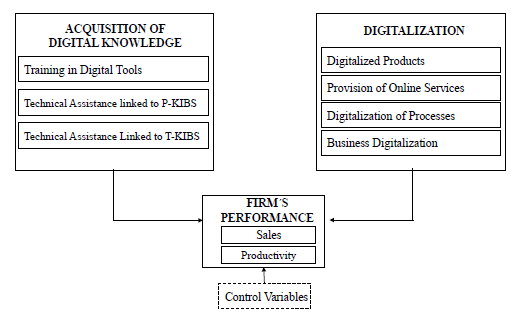
In any case, acquiring digital knowledge through training programs, informal learning methods, or collaborations with external partners is a vital prerequisite for firms to leverage digital technologies effectively. From an organizational learning perspective, these activities constitute an exploratory process designed to generate and integrate new knowledge, thereby supporting future performance improvements (Argote et al., 2021). Therefore, based on these arguments, we propose the following hypothesis:
H1a. Training in digital tools is positively associated with the firm's sales.
H1b. Training in digital tools is positively associated with the firm's productivity.
H2a. The technical assistance related to P-KIBS is positively associated with the firm's sales.
H2b. The technical assistance related to P-KIBS is positively associated with the firm's productivity.
H3a. The technical assistance related to T-KIBS is positively associated with the firm's sales.
H3b. The technical assistance related to T-KIBS is positively associated with the firm's productivity.
2.3 Digital Knowledge and Digitalization in Firms
Digitalization involves transforming processes, operations, and offerings within companies through digital technologies to generate value, boost efficiency, and enhance effectiveness (Gebauer et al., 2021; Opazo-Basáez et al., 2023). Empirical research has demonstrated that digital knowledge allows firms to create digital products that include smart features, connectivity, or data-driven capabilities. These digital technologies often help firms stand out in competitive markets and gain a larger market share, which in turn positively affects revenues (Porter & Heppelmann, 2014). Besides functionality, digitized products often provide scalability and the ability to connect with digital platforms and ecosystems, boosting customer engagement and creating new sources of value (Vendrell-Herrero et al., 2024).
In parallel, online services allow firms to expand their offerings, customize user experiences, and lower operational costs. In addition to cost savings, earlier studies identified benefits such as increased sales and entry into new markets (Zhu et al., 2004). Xia and Zhang (2010) found that online channels have a more significant long-term effect on sales volumes. To implement online selling, organizations follow a process where they adjust their routines and use both internal and external collaboration (Sanders, 2007). From this perspective, digital knowledge not only supports efficiency but also acts as a catalyst for service innovation. As Nambisan et al. (2019) note, "digital technologies can have a generative effect on innovation" by enabling traditionally goods-producing firms to expand their innovation activities into service domains. This generativity increases firms' capacity to deliver ongoing value to customers, shifting from one-time transactions to continuous digital engagement. The gains in flexibility, responsiveness, and customer satisfaction strengthen the positive link with the firm's revenues. Additionally, firms that invest in digitalization are better prepared to adopt digitized internal processes, such as automation, data integration, and digital workflow management. These digitally enabled practices streamline operations, reduce human error, improve data accuracy, and boost responsiveness to market changes (Vial, 2019). As a result, firms become more agile and cost-effective-attributes essential for growth in volatile environments. These efficiencies ultimately lead to improved financial performance.
Beyond operational improvements, the strategic acquisition of digital knowledge supports comprehensive business digitalization. It requires developing a digitization capability that serves as the foundation upon which firms can build processes, structures, and business models that sustainably leverage digital resources. In this way, it acts as the link between acquiring digital knowledge and exploiting it to generate tangible results, fostering not only internal efficiencies but also new value propositions in products, services, and business relationships (Ritter & Pedersen, 2020). This includes developing a digital strategy, redesigning value creation and delivery mechanisms, and implementing broader organizational changes (Sebastian et al., 2017). Such transformations indicate a shift toward digital maturity, where firms not only adopt technologies but also deeply embed them into their organizational fabric and strategic vision. This comprehensive transformation- covering leadership, culture, infrastructure, and business models-connects holistic business digitalization to revenue growth. Therefore, we assert that acquiring digital knowledge is not a static event but an ongoing, dynamic process that supports firm digitalization across multiple dimensions.
By promoting the development of digital products, enabling online services, enhancing internal processes, and leading strategic change, digital knowledge acts as a key mechanism for firms to create value and boost revenues in the digital economy. To achieve sustainable results in this ongoing process, firms need to build capabilities that allow them to understand and utilize this knowledge effectively. Absorptive capacity is essential for transforming learning into organizational resources. However, this potential must be supported by a digitization capability that converts data into value by integrating technical, analytical, and regulatory skills (Ritter & Pedersen, 2020). Based on these points, we propose the following hypotheses:
H4a. The digitalized product is positively associated with the firm's sales.
H4b. The digitalized product is positively associated with the firm's productivity.
H5a. The provision of service online is positively associated with the firm's sales.
H5b. The provision of service online is positively associated with the firm's productivity.
H6a. The digitalization of processes is positively associated with the firm's sales.
H6b. The digitalization of processes is positively associated with the firm's productivity.
H7a. Business digitalization is positively associated with a firm's sales.
H7b. Business digitalization is positively associated with a firm's productivity.
Figure 1 presents the set of hypotheses formulated within the conceptual model.
3. Methodology
3. Methodology
3.1 Population and sample
The data were collected from the National Enterprises Survey in Peru (ENE, in its Spanish abbreviation) in 2019. Additionally, the ENE data have been gathered annually by the Institute of Statistics and Informatics of Peru from 2015 to 2019. The survey features a comprehensive questionnaire designed to collect information on the business environment of firms through direct, face-to-face interviews with firm managers and owners involved in decision-making. The survey population includes micro, small, medium, and large Peruvian firms, totaling 9,609 firms from all industries except education and health, excluding those in their first three years of operation. The ENE uses stratified random sampling based on location, size, industry, and other country-specific details. In line with our research goals (to assess whether acquiring digital knowledge and digitalization positively impact firms' sales and productivity), the final sample includes 2,834 firms from the service industries (Table 1). The ENE has been used in previous studies and published in relevant journals; for example, see Castro et al. (2022) and Seclen-Luna et al. (2024).
Table 1:. Sample composition related to service industries
| (CIIU Rev.4) | Micro | SMEs | Large | Total |
|---|---|---|---|---|
| % | N° | |||
| 49-51. Transports | 36.4 | 55.1 | 8.5 | 597 |
| 52. Warehousing and logistics | 25.9 | 55.6 | 18.5 | 135 |
| 53. Postal and courier activities | 25.0 | 50.0 | 25.0 | 8 |
| 55-56. Accommodation, food, and beverage activities | 46.9 | 40.2 | 12.9 | 286 |
| 58-60. Editing, film, programming, and broadcasting activities | 44.7 | 42.1 | 13.2 | 38 |
| 61. Telecommunications | 61.3 | 35.5 | 3.2 | 93 |
| 62-63. Computer programming, computer consulting, and information service activities | 33.3 | 55.6 | 11.1 | 108 |
| 64-66. Financial services, insurance, and pension fund activities. | 21.6 | 52.5 | 26.0 | 181 |
| 68. Real estate activities | 69.3 | 29.4 | 1.3 | 228 |
| 69. Legal and accounting activities | 29.9 | 64.9 | 5.2 | 77 |
| 70. Head office and management consulting activities | 38.0 | 47.8 | 14.1 | 92 |
| 71. Architectural and engineering activities; technical testing and analysis | 45.8 | 45.8 | 8.5 | 201 |
| 72. Research and development activities | 50.0 | 50.0 | 0.0 | 4 |
| 73. Advertising and market research activities | 45.9 | 49.4 | 4.7 | 85 |
| 74. Other professional, scientific, and technical activities | 29.9 | 59.7 | 10.4 | 77 |
| 77. Rental and leasing activities | 57.4 | 40.2 | 2.5 | 122 |
| 78. Employment activities | 35.7 | 39.3 | 25.0 | 28 |
| 79. Travel agency and tour operator activities | 38.3 | 55.3 | 6.4 | 47 |
| 80. Security and investigation activities | 24.2 | 41.9 | 33.9 | 62 |
| 81-82. Building service activities and administrative and office support activities | 27.2 | 48.2 | 24.7 | 162 |
| 90-94. Creative, artistic, gambling, sports, and association activities | 28.4 | 59.3 | 12.4 | 81 |
| 95. Computer repair, personal effects repair, and household goods repair | 37.5 | 50.0 | 12.5 | 8 |
| 96. Other personal service activities | 52.3 | 46.0 | 1.8 | 111 |
| Total Sample | 40.7 | 48.1 | 11.2 | 2,834 |
3.2 Measurement
This study examines firm sales and productivity as dependent variables. The independent variables are divided into two groups: i) acquisition of digital knowledge and ii) digitalization. To measure the first, we used three questions from the ENE, where respondents were asked, for example: 1) "In 2019, did workers receive training in digital tools?" 2) "In 2019, did your firm receive technical assistance for process improvement?" This measurement approach is similar to that used in previous studies, such as Seclen-Luna et al. (2022b). Additionally, to measure digitalization, four questions from the survey were included, where respondents were asked, for example: 1) "Does your firm currently sell digital products?" and 2) "In 2019, did your firm acquire technology to digitize your business?" This measurement approach is similar to that used in previous studies on digitalization, such as those by Sestino et al. (2020), among others.
Finally, as in previous studies, this research includes firm size and firm age as control variables. On the one hand, previous research has emphasized that business size is the most important determinant of whether digital technologies are adopted or not (Spinelli et al., 2013). Additionally, empirical evidence suggests that large firms possess more resources, which accelerate the adoption of technologies and innovation development, thereby impacting performance more significantly than in small firms (Lafuente & Vaillant, 2023).
On the other hand, based on the accumulation of experience and knowledge (S0rensen & Stuart, 2000), it could be argued that older firms are more likely to adopt digital technologies than younger firms; however, it can also be argued that newer firms find it easier to reach higher levels of digitalization. However, these arguments are complex because there are situations where digital technologies are visible but not seen as a strategic issue, which can lead to their active rejection (Fernandes & Burcharth, 2024). In any case, a more established and prominent firm is likely to have higher sales levels (Audretsch & Belitski, 2023). Lastly, dummy variables for each sector and region are also included to control for unobservable variables at both levels of aggregation. The variables used in this work are described in Table 2.
Table 2:. Description of variables
| Variable | Description |
|---|---|
| Dependent Variable | |
| Sales | Revenues from service provision - Sol (PEN), in logarithms. |
| Productivity | It is calculated by dividing total sales by the number of workers (including permanent workers and owners), - Sol (PEN), in logarithmic form. |
| Independent Variables | |
| Training in digital tools | A binary variable that takes the value of 1 if the firm has spent on training (workers) in digital tools, and takes the value of 0 otherwise. |
| Technical assistance linked to P-KIBS | A binary variable that takes the value of 1 if the firm has received technical assistance linked to P-KIBS, and takes the value of 0 otherwise. |
| Technical assistance linked to T-KIBS1 | A binary variable that takes the value of 1 if the firm has received technical assistance linked to T-KIBS, and takes the value of 0 otherwise. |
| Digitalized products | A binary variable that takes the value of 1 if the firm has digitalized its products, and takes the value of 0 otherwise. |
| Provision of online services | A binary variable that takes the value of 1 if the firm has provisioned online services, and takes the value of 0 otherwise. |
| Digitalization of processes | A binary variable that takes the value of 1 if the firm has invested in machinery and/or equipment to digitalize their processes; and takes the value of 0 otherwise. |
| Business digitalization | A binary variable that takes the value of 1 if the firm has its business model digitalized, and takes the value of 0 otherwise. |
| Control variables | |
| Size of the firm | Categorical variable by number of permanent workers and owners (0=Micro; 1=SMEs; 2=Large firms). |
| Age of the firm | Years since the firm was founded, up to 2019, in logarithmic terms. |
| Sector | Dummies that capture unobserved specific effects to each of the activities of the analyzed sectors (2-digit ISIC) |
| Region | Dummies that capture unobserved specific effects for each of the 25 regions of Peru |
3.3 Methods and test
The OLS regression model was applied using STATA 17 software, which is suitable for our continuous dependent variables. The descriptive statistics in Table 3 reveal no strong correlation among the independent variables, suggesting that multicollinearity is not a significant issue in the data (Myers, 1990). This insight was confirmed by the variance inflation factor (VIF) test conducted on the independent variables, which yielded an average value of 1.14, indicating a satisfactorily low level of multicollinearity (Hair et al., 2010).
Table 3:. Correlation matrix and summary statistics
| Variable | SD | 1 | 2 | 3 | 4 | 5 | 6 | 7 | ||
|---|---|---|---|---|---|---|---|---|---|---|
| 1. | Training in digital tools | 0.21 | 0.41 | 1.00 | ||||||
| 2. | Technical assistance linked to P-KIBS | 0.06 | 0.24 | 0.20 | 1.00 | |||||
| 3. | Technical assistance linked to T-KIBS | 0.01 | 0.12 | 0.11 | 0.11 | 1.00 | ||||
| 4. | Digitalized products | 0.02 | 0.14 | 0.08 | 0.06 | 0.01 | 1.00 | |||
| 5. | Provision of service online | 0.07 | 0.26 | 0.11 | 0.08 | 0.06 | 0.06 | 1.00 | ||
| 6. | Digitalization of processes | 0.07 | 0.26 | 0.18 | 0.20 | 0.13 | 0.09 | 0.11 | 1.00 | |
| 7. | Business digitalization | 0.20 | 0.40 | 0.18 | 0.15 | 0.05 | 0.10 | 0.12 | 0.21 | |
4. Result and discussion
4. Result and discussion
4.1 Descriptive analysis
On the one hand, Table 1 shows that the sample is mainly composed of transport (21.1%), accommodation, food, and beverage activities (10.1%), real estate activities (8.0%), architectural and engineering activities, technical testing and analysis (7.1%), financial services, insurance, and pension fund activities (6.4%). All these services account for 52.7% of the total sample. Additionally, the analysis by firm size indicates that SMEs are the most significant segment (48.1%), followed by micro firms (40.7%), and large firms (11.2%).
On the other hand, as shown in Table 3, Peruvian service firms generally have not adopted a clear digitalization strategy; in fact, there is a low proportion of firms that have embraced digital knowledge and digitalization. Specifically, it is clear that the percentage of firms that received technical assistance for process improvement and specialized technical information, and also implemented a digitalization strategy, was very low. However, in relative terms, the main factor influencing digital knowledge acquisition is training in digital tools, which, on average, makes up 21% of the firms' expenses. Likewise, digitalization is the primary digital strategy for 20% of service firms.
4.2 Hypothesis testing
Table 4 shows the results of the OLS regression analysis, broken down by firm size. To examine revenue by sales (columns 1, 2, 3, and 4) and productivity (columns 5, 6, 7, and 8), we estimated the effects of acquiring digital knowledge and digitalization across the total sample, micro, SMEs, and large firms. Along with the significance of the regression for each model, it is also evident that all significant coefficients of the subsamples, based on firm size, are consistently higher than those of the total sample, whether the latter are significant, except for the variable 'training in digital tools' in the sales revenue model. Finally, it is possible to observe a good fit for revenue by sales models, but only for large firms in terms of productivity. Although the values of this indicator are low compared to other productivity models, the results are consistent with those of previous studies, such as Vendrell-Herrero et al. (2023), among others.
Table 4:. OLS regression analysis for Peruvian service firms
| Sales | Productivity | |||||||
|---|---|---|---|---|---|---|---|---|
| Variables | Total Sample (1) | Micro (2) | SMEs (3) | Large (4) | Total Sample (5) | Micro (6) | SMEs (7) | Large (8) |
| Constant | 0.03 | -0.46** | 3.42** | 6.78*** | 11.76*** | 11.65*** | 11 97*** | 11.06*** |
| (0.19) | (0.14) | (0.95) | (0.63) | (0.15) | (0.21) | (0.24) | (0.28) | |
| Training in digital tools | 0.14 | 0.14* | 0.04 | 0.14* | 0.06 | 0.34 | -0.09 | 0.45** |
| (0.08) | (0.07) | (0.10) | (0.06) | (0.20) | (0.24) | (0.30) | (0.13) | |
| Technical assistance linked to | 0.20 | 0.25** | 0.15 | 0.03 | -0.58* | -1.24** | 0.02 | 0.01 |
| P-KIBS | ||||||||
| (0.10) | (0.10) | (0.16) | (0.26) | (0.28) | (0.41) | (0.12) | (0.15) | |
| Technical assistance linked to | -0.03 | -0.30 | 0.36* | 0.45 | 0.37 | 0.44 | -0.14 | 0.26 |
| T-KIBS | ||||||||
| (0.16) | (0.22) | (0.18) | (0.26) | (0.33) | (0.35) | (0.20) | (0.28) | |
| Digitalized products | 0 71*** | 0.91*** | -0.05 | 0.12 | -0.06 | -0.52 | 0.88** | -0.09 |
| (0.08) | (0.16) | (0.12) | (0.24) | (0.58) | (0.99) | (0.25) | (0.26) | |
| Provision of service online | 0.17 | 0.44** | -0.10 | 0.15 | -0.09 | -0.03 | -0.13 | 0.24 |
| (0.12) | (0.15) | (0.15) | (0.15) | (0.23) | (0.45) | (0.15) | (0.21) | |
| Digitalization of processes | 0.35** | 0.56*** | 0.18 | -0.15 | 0.16 | -0.06 | 0.28 | 0.35** |
| (0.13) | (0.12) | (0.11) | (0.12) | (0.26) | (0.44) | (0.25) | (0.10) | |
| Business digitalization | 0.22*** | 0.28* | 0.05 | -0.09 | -0.10 | 0.03 | -0.14 | -0.17 |
| (0.05) | (0.14) | (0.11) | (0.14) | (0.36) | (0.47) | (0.36) | (0.10) | |
| SMEs | 2.22*** | n.a. | n.a. | n.a. | 0.01 | n.a. | n.a. | n.a. |
| (0.08) | (0.26) | |||||||
| Large firms | 5.13*** | n.a. | n.a. | n.a. | -0.78 | n.a. | n.a. | n.a. |
| (0.08) | (0.58) | |||||||
| Firm's age | 0.14 | 0.22* | 0.03 | 0.19* | 0.23*** | 0.26** | 0.08 | 0.18 |
| (0.09) | (0.11) | (0.08) | (0.08) | (0.06) | (0.10) | (0.11) | (0.10) | |
| Productivity | 1.01*** | 1.03*** | 0.91*** | 0.98*** | n.a. | n.a. | n.a. | n.a. |
| (0.01) | (0.01) | (0.07) | (0.06) | |||||
| Sector | YES | YES | YES | YES | YES | YES | YES | YES |
| Region | YES | YES | YES | YES | YES | YES | YES | YES |
| N | 2,834 | 1,153 | 1,363 | 318 | 2,834 | 1,153 | 1,363 | 318 |
| R-squared | 0.893 | 0.896 | 0.680 | 0.819 | 0.051 | 0.087 | 0.127 | 0.625 |
| Root MSE | 0.757 | 0.741 | 0.732 | 0.728 | 1.742 | 2.002 | 1.073 | 0.817 |
First, the focus on revenue by sales in the total sample (column 1) indicates that the variables analyzed concerning the acquisition of digital knowledge do not have a statistically significant effect on sales. Therefore, no hypothesis was supported. One reason for this result is the low proportion of firms that invest in acquiring digital knowledge; therefore, it can be seen as a lack of strategic vision among firms regarding these issues and their limited absorptive capacity to benefit from KIBS. Consequently, this finding contradicts previous studies that highlight the importance of digital capabilities among workers (Kumar et al., 2016; Wechsler et al., 2018). The technical assistance related to KIBS (Ribeiro-Navarrete et al., 2021; Seclen-Luna et al., 2024) positively influences their performance.
On the other hand, the digitalization of the firm, including digitalized products (p < 0.01), digitalization of processes (p < 0.05), and business digitalization (p < 0.01), has positive effects on firms' sales, although with different magnitudes. Specifically, the coefficient for the first variable is twice that of the second, and the second is more than 50% greater than the third. These results, therefore, support hypotheses H4a, H6a, and H7a. These results are consistent with previous studies, such as Porter and Heppelmann (2014), which noted that digitalized products positively impact their revenues. Additionally, it is similar to the study by Vial (2019) because digitalized internal processes allow practices to streamline operations, reduce human error, improve data accuracy, and positively influence the firms' sales. Furthermore, these results confirm that business digitalization deeply integrates digital technologies into their organizational structure, strategic vision, and positively impacts the firm's sales (Sebastian et al., 2017). Finally, since firm size and productivity only positively impact sales, it was appropriate to examine their diverse effects. However, only more experienced companies appear to prioritize productivity over sales improvements, as the latter has a non-significant coefficient.
Second, when the analysis examines the subsamples based on firm size, clear differences emerge between these groups. On the one hand, focusing on micro firms (column 2), the variables related to acquiring digital knowledge generally have a positive, statistically significant impact on their sales, except for technological assistance associated with T-KIBS. Therefore, these findings support hypotheses H1a and H2a. This result aligns with previous studies, which show that workers' digital capabilities (Kumar et al., 2016) positively affect their sales. On the other hand, the variables examined regarding the firm's digitalization, such as digitalized products (p<0.01), online service provision (p<0.05), process digitalization (p<0.01), and overall business digitalization (p<0.01), have positive effects on the firm's sales. Consequently, we can conclude that microenterprises aim to generate sales in the short term. Therefore, these results support hypotheses H4a, H5a, H6a, and H7a. These results align with previous studies indicating that digitalized products (Porter & Heppelmann, 2014), online services (Xia & Zhang, 2010), process digitalization (Vial, 2019), and business digitalization (Sebastian et al., 2017) influence firms' sales.
The analysis of SMEs (column 3) indicates that neither acquiring digital knowledge nor digitalization has positive effects on the firm's sales, except for technological assistance related to T-KIBS. That is, SMEs outsource technical assistance to boost revenue in the short term. Therefore, this finding supports the hypothesis H3a. One explanation for this can be found in the resource-based view theory (Barney, 2001), which suggests that a firm can benefit from collaborations with external partners. This result aligns with previous studies that found T-KIBS positively influence a firm's sales in the short term, especially in the context of Latin American countries (Seclen-Luna et al., 2024). However, these results also indicate that for SMEs, digital technologies are considered important but are not seen as a strategic issue, as Fernandes and Burcharth (2024) mention. Therefore, it can be understood that SMEs are at a basic level of digital maturity, which is common in Latin American countries (Balestrini et al., 2024).
Regarding large firms (column 4), only the variables related to acquiring digital knowledge, such as training in digital tools (p < 0.05), have a positive effect on firms' sales, supporting Hypothesis H1a. Therefore, we can assert that for large firms, training workers is a strategic issue in increasing sales. This finding aligns with previous studies, which demonstrate that workers' digital capabilities positively influence their performance (Kumar et al., 2016). However, digitalization does not have a statistically significant impact on a firm's sales. Therefore, no hypothesis was supported. One possible explanation is that firms faced challenges in meeting their demand for digital talent. In fact, Novella & Rosas-Shady (2022) report that eight out of ten Peruvian firms struggled to recruit digital talent.
Third, when examining productivity across the entire sample (column 5), it is notable that neither the acquisition of digital knowledge nor digitalization shows any positive impact on the productivity of service firms. Only technical assistance related to P-KIBS (p<0.10) has a statistically significant adverse effect on their productivity. This suggests that digital skills and digitalization in Peruvian service firms are underdeveloped and not effectively linked to productivity, highlighting an area that requires improvement. Therefore, no hypothesis was supported. Comparing these results with those previously observed for sales revenue (column 1), we can conclude that the resource-based view logic is more closely related to digitalization than to the firm's productivity. However, when analyzing the subsamples based on firm size, it is possible to observe significant differences between these firms.
Regarding micro firms (column 6), the previous results still stand. Therefore, hypothesis H2b was not supported. One reason is that micro firms are vulnerable to market fluctuations (in terms of sales in the short run), and focusing on efficiency and productivity is a subsequent step. This aligns with their organizational inertia and the firm's age; additionally, because P-KIBS are based on professional services and support activities that rely on personal expertise and are less likely to transfer their knowledge to other local firms (Doloreux, et al., 2010).
The analysis of SMEs (column 7) reveals that, on the one hand, the acquisition of digital knowledge has no statistically significant positive effects on the productivity of service firms. Perhaps one explanation is that, for SMEs, digital technologies are seen as important but are not perceived as a strategic issue, as mentioned by Fernandes and Burcharth (2024). This result can be understood since SMEs are at the initial level of digital maturity, which is common in Latin American countries (Balestrini et al., 2024). On the other hand, results show that SMEs' digitalization has a statistically significant effect on a firm's productivity. Specifically, digitalized products (p < 0.10) have a positive impact on productivity. Therefore, this result supports hypothesis H4b and aligns with previous studies that have found digitalized products (Porter & Heppelmann, 2014) to have a positive effect on firm performance. It is important to note that, although SMEs do not invest in acquiring digital knowledge, they still implement digitalized products; that is, digitalization enhances productivity in SMEs.
Lastly, regarding large firms (column 8), only the variables related to acquiring digital knowledge, such as training in digital tools (p<0.05), have a positive effect on the productivity of service firms. Therefore, these results support only hypothesis H1b. This finding aligns with previous studies that show the necessity of digital skills among workers (Kumar et al., 2016) to positively influence a firm's performance. On the other hand, variables related to the digitalization of the firm, such as digitalized processes (p < 0.05), have positive effects on the productivity of service firms. Therefore, this supports hypothesis H6b. These findings align with previous research indicating that the digitalization of processes (Vial, 2019) influences firms' productivity. In summary, it appears that under the organizational learning theory, large firms combine the acquisition and development of digitalization.
Concluding
5. Conclusion and implications
The objective of this study was to evaluate the impact of acquiring digital knowledge and digitalization on the performance of Peruvian service firms. Based on OLS regression analysis of 2,834 service firms, the findings show that analyzing sub-samples by firm size reveals more details than examining the total sample. On the one hand, regarding sales, micro firms display a complementarity between acquiring digital knowledge and adopting a digitalization strategy, which positively influences their sales. At the same time, SMEs subcontract technological assistance related to T-KIBS. Additionally, large firms mainly focus on investing in training for digital tools to boost their sales.
On the other hand, when analyzing productivity, micro firms do not show positive links between acquiring digital knowledge, digitalization, and productivity. It seems they are focusing on sales rather than productivity in their initial market. Additionally, SMEs face challenges in boosting productivity in this context; however, implementing digitized products can help improve their productivity. Meanwhile, large firms demonstrate a complementary relationship between training in digital tools and process digitalization, which positively influences their productivity.
Finally, firms with more advanced absorptive capacity are better equipped to integrate digital inputs into their routines and operational processes, which reduces learning curves and improves their ability to turn acquired knowledge into increases in productivity and revenue. In smaller firms, limited formalization and scarce resources often restrict organizational learning over time. This restriction is caused not only by a lack of tangible resources but also by less accumulated experience and an underdeveloped internal environment-regarding structures, processes, and culture-that hampers the retention, transfer, and growth of gained knowledge (Argote et al., 2021).
5.1 Theoretical implications
The first contribution of this study relates to the organizational learning theory (March, 1991), as it shows that the complementarity between acquiring digital knowledge and digitalization improves firm performance in sales and productivity. This mainly applies to investments in digital tools, training, and digitalizing products and processes. This relationship is especially strong for larger firms' productivity and micro firms' sales. Therefore, this study emphasizes that combining digitalization with the acquisition of digital knowledge is more effective than doing them separately.
Second, this study helps expand the understanding of how KIBS's technical assistance influences the acquisition of digital knowledge and sales by their client firms (Rapaccini et al., 2023; Ribeiro-Navarrete et al., 2021; Seclen-Luna et al., 2024). Specifically, SMEs are linked to T-KIBS, while micro firms are linked to P-KIBS.
5.2 Managerial and policy implications
First, since several strategies for gaining digital knowledge and digitalization positively relate to sales and productivity, managers should oversee a broad range of digital capabilities and the technological portfolio. They should also develop tailored strategies based on firm size and maturity level. This is particularly important because the use of multiple digital technologies can have a stronger impact on firm performance (Seclen-Luna et al., 2025). For example, micro and small firms could focus on cost-effective training programs centered on basic digital tools and online services. Meanwhile, large firms might benefit from advanced programs that incorporate artificial intelligence, data analytics, and comprehensive digital business models. Therefore, establishing knowledge management mechanisms and leveraging knowledge assets is crucial for technological and organizational innovation (Hall & Andriani, 2003; Lafuente et al., 2010).
Additionally, empirical studies show that team processes related to knowledge management-such as team building, information seeking, and problem-solving-positively impact the internalization of technology, thereby strengthening the adoption of innovations (Bong et al., 2004).
Second, adopting digitalization may also require ad hoc policies when they are closely linked to innovation processes within the firm. In this context, creating advanced services should be encouraged to connect digital service innovation (Lafuente et al., 2018; Opazo-Basaéz et al., 2024), especially to promote digital servitization (Gebauer et al., 2021). Similarly, policy tools could incentivize partnerships among firms, universities, and public agencies to offer targeted digital training and consulting services.
The positive effects of digital training on small and large firms suggest that human-capital-based initiatives might need different approaches depending on the firm's absorptive capacity and the development of the surrounding digital ecosystem. Micro firms could benefit from simplified, subsidized training programs and shared digital service centers that reduce entry barriers. Meanwhile, large firms may require more advanced programs that incorporate data analytics, cybersecurity, and artificial intelligence into their management practices.
This aligns with the framework proposeds by Acs et al. (2022) for Latin America, Szerb et al. (2019) for Europe, and Lafuente et al. (2024) at the global scale, which highlights that the success of entrepreneurship and innovation policies depends on their ability to target local ecosystem bottlenecks rather than using one-size-fits-all solutions. Based on this perspective, national and regional governments should create tailored policies that strengthen specific aspects of the entrepreneurial and digital ecosystem, such as human capital, technological infrastructure, and institutional coordination, depending on firm type and sector (Bayon et al., 2016; Lafuente et al., 2017; Lafuente et al., 2022). Consequently, the policy approach should shift from generic digital inclusion programs to context-aware, capability-focused interventions that enhance firms' digital knowledge and help them turn digitalization into measurable performance results.
5.3 Limitations and future research
This study has limitations. First, although it provides valuable insights into the business's productivity and sales, the database used is from 2019, which is the most recent survey available on these topics for Peruvian firms. Since 2020, due to the COVID-19 pandemic, business digital transformation has sped up worldwide; therefore, the study's findings may not reflect current conditions.
Second, the measurement of digital knowledge acquisition uses three binary indicators, which may not fully reflect variations in intensity, frequency, or depth of training and technical assistance. Likewise, the binary format of the digitalization variables reduces their explanatory power. Therefore, the Peruvian business survey (ENE) or future studies should consider this limitation when designing their questionnaires. Additionally, some key moderating variables for the explored determinants were not included in the ENE 2019, such as the education level of the firm's workers, which serves as a primary proxy for the firm's technological absorption capabilities, as well as their academic specialization in STEM careers, among others. Including these in the ENE would help improve and provide better evidence related to the digital transformation of Peruvian firms.
Finally, our findings are based on the experiences of Peruvian service firms, which may raise concerns about their relevance in other sectoral, geographical, and cultural contexts. Future research could adopt a cross-country approach to consider the influence of different institutional environments and cultural differences. Additionally, the cross-sectional design of our dataset limits the ability to analyze how these relationships change over time. Therefore, it is recommended that future studies employ a longitudinal approach to explore these relationships further.
References
References
- Acs, Z. J., Lafuente, E., & Szerb, L. (2022). A note on the configuration of the digital ecosystem in Latin America. TEC Empresarial, 16(1), 1-15. https://doi.org/10.18845/te.v16i1.5926
- Argote, L., Lee, S., & Park, J. (2021). Organizational learning processes and outcomes: Major findings and future research directions. Management Science, 67(9), 5602-5629. https://doi.org/10.1287/mnsc.2020.3743
- Asheim, B.T., Boschma, R., & Cooke, P. (2011). Constructing regional advantage: Platform policies based on related variety and differentiated knowledge bases. Regional Studies, 45(7), 893-904. https://doi.org/10.1080/00343404.2010.543126
- Audretsch, D., & Belitski, M. (2023). The limits to open innovation and its impact on innovation performance. Technovation, 119, 102519. https://doi.org/10.1016/j.technovation.2022.102519
- Balestrini, M., Castillo, A., Echeverry, I., Castro Blandón, C., Torrico, B., Mafla, J., Guzmán, M., Di Giovanni, L., Rojas, D., & Guillen, D. (2024). Economía del dato para pymes: claves para impulsar los negocios en la era digital y casos de uso en Latinoamérica. BID Lab / Banco Interamericano de Desarrollo. https://doi.org/10.18235/0013165
- Barney, J.B. (2001). Resource-based theories of competitive advantage: a ten-year retrospective on the resource-based view. Journal of Management, 27(6), 643-650. https://doi.org/10.1016/S0149-2063(01)00115-5
- Bayon, M. C., Lafuente, E., & Vaillant, Y. (2016). Human capital and the decision to exploit innovative opportunity. Management Decision, 54(7), 1615-1632. https://doi.org/10.1108/MD-04-2015-0130
- Bharadwaj, A., El Sawy, O. A., Pavlou, P. A., & Venkatraman, N. (2013). Digital business strategy: Toward a next generation of insights. MIS Quarterly, 37(2), 471-482. https://doi.org/10.25300/MISQ/2013/37:2.3
- Bogers, M., Chesbrough, H., & Moedas, C. (2018). Open innovation: Research, practices, and policies. California Management Review. 60(2), 5-16. https://doi.org/10.1177/0008125617745086
- Bong, S.H., Lee, J., & Gil, Y. (2004). Effective team processes for technology internalization with special emphasis on knowledge management: successful late starter, Samsung case. International Journal of Technology Management, 27(1), 16-39. https://doi.org/10.1504/IJTM.2004.003879
- Bustinza, O. F., Opazo-Basaez, M., & Tarba, S. (2021). Exploring the interplay between smart manufacturing and KIBS firms in configuring product-service innovation performance. Technovation, 118, 102258. https://doi.org/10.1016/j.technovation.2021.102258
- Castro, R. Schmitt, V., & Aylas, E. (2022). Desempeño exportador de las KIBS desde una perspectiva de innovación, digitalización y bases de conocimiento diferenciado evidencias desde Perú. Ekonomiaz: Revista Vasca de Economía, 102, 192-217.
- Cassiman, B., & Valentini, G. (2016). Open innovation: are inbound and outbound knowledge flows really complementary? Strategic Management Journal, 37(6), 1034-1046. https://doi.org/10.1002/smj.2375
- Chatterjee, S., Moody, G., Lowry, P.B., Chakraborty, S., & Hardin, A. (2020). Information technology and organizational innovation: harmonious information technology affordance and courage-based actualization. The Journal of Strategic Information Systems, 29(1), 101596. https://doi.org/10.1016/j.jsis.2020.101596
- Chesbrough, H. (2024). Twenty years of open innovation. MIT Sloan Management Review, 65(2), 1-3. Available in: https://sloanreview.mit.edu/article/twenty-years-of-open-innovation/
- Cirera, X., Comin, D., Cruz, M., & Lee, J. (2021). The innovation paradox: Developing-country capabilities and the unrealized promise of technological catch-up. World Bank Group. http://documents.worldbank.org/curated/en/844101510122107327
- Clemente-Almendros, J.A., Nicoara-Popescu, D., & Pastor-Sanz, I. (2024). Digital transformation in SMEs: Understanding its determinants and size heterogeneity. Technology in Society, 77, 102483. https://doi.org/10.1016/j.techsoc.2024.102483
- Doloreux, D., Freel, M., & Shearmur, R. (2010). Knowledge-intensive business services: Geography and innovation. Ashgate Publishing, Ltd.
- Escribá-Carda, N., Redondo-Cano, A., & Escribá-Moreno, M. Ángeles. (2024). Firms’ digital transformation and e-human resource management. A qualitative approach. TEC Empresarial, 18(3), 103-128. https://doi.org/10.18845/te.v18i3.7289
- Fernandes, E., & Burcharth, A. (2024). Why traditional firms from the same industry reject digital transformation: Structural constraints of perception and attention. Long Range Planning, 57(2). https://doi.org/10.1016/j.lrp.2024.102426
- Gardner, H.K. (2015). Teamwork and collaboration in professional service firms: Evolution, challenges, and opportunities. In: Empson, L., Muzio, D., Broschak, J., Hinings, B. (Eds.), The Oxford Handbook of Professional Service Firms. Oxford University Press, Oxford, pp. 374-402. https://doi.org/10.1093/oxfordhb/9780199682393.013.21
- Gebauer, H., Paiola, M., Saccani, N., & Rapaccini, M. (2021). Digital servitization: crossing the perspectives of digitization and servitization. Industrial Marketing Management, 93, 382-388. https://doi.org/10.1016/j.indmarman.2020.05.011
- Hall, R., & Andriani, P. (2003). Managing knowledge associated with innovation. Journal of Business Research, 56(2), 145-52. https://doi.org/10.1016/S0148-2963(01)00287-9
- Hair, J.F., Black, W.C., Babin, B.J., Anderson, R.E., & Tatham, R.L. (2010). Multivariate data analysis, 7th Edition, Pearson.
- Hanelt, A., Bohnsack, R., Marz, D., & Antunes, C. (2021). A systematic review of the literature on digital transformation: insights and implications for strategy and organizational change. Journal of Management Studies, 58(5), 1159-1197. https://doi.org/10.1111/joms.12639
- Jensen, M., Johnson, B., Lorenz, E., & Lundvall, B.A. (2007). Forms of knowledge and modes of innovation. Research Policy, 36, 680-693. https://doi.org/10.1016/j.respol.2007.01.006
- Kumar, R.R., Stauvermann, P.J., & Samitas, A. (2016). The effects of ICT on output per worker: a study of the Chinese economy. Telecommunications Policy, 40(2-3), 102-115. https://doi.org/10.1016/j.telpol.2015.06.004
- Lafuente, E., Acs, Z. J., & Szerb, L. (2024). Analysis of the digital platform economy around the world: A network DEA model for identifying policy priorities. Journal of Small Business Management, 62(2), 847-891. https://doi.org/10.1080/00472778.2022.2100895
- Lafuente, E., Araya, M., & Leiva, J. C. (2022). Assessment of local competitiveness: A composite indicator analysis of Costa Rican counties using the ‘Benefit of the Doubt’ model. Socio-Economic Planning Sciences, 81, 100864. https://doi.org/10.1016/j.seps.2020.100864
- Lafuente, E., Bayo-Moriones, A., & García-Cestona, M. (2010). ISO-9000 certification and ownership structure: Effects upon firm performance. British Journal of Management, 21(3), 649-665. https://doi.org/10.1111/j.1467-8551.2009.00660.x
- Lafuente, E., & Sallan, J. M. (2024). Digitally powered solution delivery: The use of IoT and AI for transitioning towards a solution business model. International Journal of Production Economics, 277, 109383. https://doi.org/10.1016/j.ijpe.2024.109383
- Lafuente, E., Szerb, L., & Rideg, A. (2020). A system dynamics approach for assessing SMEs’ competitiveness. Journal of Small Business and Enterprise Development, 27(4), 555-578. https://doi.org/10.1108/JSBED-06-2019-0204
- Lafuente, E. & Vaillant, Y. (2023). Greater co-innovation and innovation efficiency through greening. Journal of Cleaner Production, 428. https://doi.org/10.1016/j.jclepro.2023.139516
- Lafuente, E., Vaillant, Y., & Leiva, J.C. (2018). Sustainable and traditional product innovation without scale and experience, but only for KIBS!. Sustainability, 10(4), 1169. https://doi.org/10.3390/su10041169
- Lafuente, E., Vaillant, Y., & Rabetino, R. (2023). Digital disruption of optimal co-innovation configurations. Technovation, 125, 102772. https://doi.org/10.1016/j.technovation.2023.102772
- Lafuente, E., Vaillant, Y., & Vendrell-Herrero, F. (2017). Territorial servitization: Exploring the virtuous circle connecting knowledge-intensive services and new manufacturing businesses. International Journal of Production Economics, 192, 19-28. https://doi.org/10.1016/j.ijpe.2016.12.006
- Lee, J., & Berente, N. (2012). Digital innovation and the division of innovative labor: digital controls in the automotive industry. Organization Science, 23(5), 1213-1522. https://doi.org/10.1287/orsc.1110.0707
- Li, L., Su, F., Zhang, W., & Mao, J. Y. (2018). Digital transformation by SME entrepreneurs: A capability perspective. Information Systems Journal, 28(6), 1129-1157. https://doi.org/10.1111/isj.12153
- Lin, H.-F., & Lee, G.-G. (2005). Impact of organizational learning and knowledge management factors on e-business adoption. Management Decision, 43(2), 171-188. https://doi.org/10.1108/00251740510581902
- Liu, Y., Dong, J., Mei, L., & Shen, R. (2023). Digital innovation and performance of manufacturing firms: an affordance perspective. Technovation, 102458. https://doi.org/10.1016/j.technovation.2022.102458
- March, J. G. (1991). Exploration and exploitation in organizational learning. Organization Science, 2(1), 71-87. https://doi.org/10.1287/orsc.2.1.71
- Miles, I. (2005). Knowledge-intensive business services: Prospects and policies. Foresight, 7(6), 39-63. https://doi.org/10.1108/14636680510630939
- Myers, R.H. (1990). Classical and modern regression with applications, 2nd ed. Duxbury Press.
- Nambisan, S., Wright, M., & Feldman, M. (2019). The digital transformation of innovation and entrepreneurship: Progress, challenges, and key themes. Research Policy, 48(8), 103773. https://doi.org/10.1016/j.respol.2019.03.018
- Novella, R., & Rosas-Shady, D. (2022). Talento digital en el Perú 2022: ¿qué demanda el mercado laboral?: resultados de una muestra de empresas líderes. https://doi.org/10.18235/0004400
- Opazo-Basáez, M., Vendrell-Herrero, F., Bustinza, O. F., Vaillant, Y., & Marić, J. (2023). Is digital transformation equally attractive to all manufacturers? Contextualizing the operational and customer benefits of smart manufacturing. International Journal of Physical Distribution & Logistics Management, 53(4), 489-511. https://doi.org/10.1108/IJPDLM-12-2021-0538
- Opazo Basáez, M., Vendrell-Herrero, F., Bustinza, O.F., & Raddats, C. (2024). Guest editorial: Digital service innovation: ontology, context and theory. Journal of Service Management, 35(2), 129-140. https://doi.org/10.1108/JOSM-03-2024-498
- Porter, M. E., & Heppelmann, J. E. (2014). How smart, connected products are transforming competition. Harvard Business Review, 92(11), 64-88.
- Rapaccini, M., Paiola, M., Cinquini, L., & Gianetti, R. (2023). Digital servitization journey in small- and medium-sized enterprises: the contribution of knowledge-intensive business firms. Journal of Business & Industrial Marketing, 38(6), 1362-1375. https://doi.org/10.1108/JBIM-01-2022-0008
- Ribeiro-Navarrete, S., Botella-Carrubi, D., Palacios-Marques, D., & Orero-Blat, M. (2021). The effect of digitalization on business performance: an applied study of KIBS. Journal of Business Research , 126, 319-326. https://doi.org/10.1016/j.jbusres.2020.12.065
- Ritter, T., & Pedersen, C. L. (2020). Digitization capability and the digitalization of business models in business-tobusiness firms: Past, present, and future. Industrial Marketing Management, 86, 180-190. https://doi.org/10.1016/j.indmarman.2019.11.019
- Rojas-Segura, J., Faith-Vargas, M., & Martínez-Villavicencio, J. (2023). Conceptualizing digital transformation using semantic decomposition. TEC Empresarial , 17(3), 63-75. https://doi.org/10.18845/te.v17i3.6850
- Sanders, N. (2007). An empirical study of the impact of e-business technologies on organizational collaboration and performance. Journal of Operations Management, 25(6), 1332-1347. https://doi.org/10.1016/j.jom.2007.01.008
- Sebastian, I. M., Ross, J. W., Beath, C. M., Mocker, M., Moloney, K. G., & Fonstad, N. O. (2017). How big old companies navigate digital transformation. MIS Quarterly Executive, 16(3), 197-213. https://aisel.aisnet.org/misqe/vol16/iss3/6
- Seclen-Luna, J. P., & Barrutia-Güenaga, J. (2018). KIBS and innovation in machine tool manufacturers. Evidence from the Basque Country. International Journal of Business Environment, 10(2), 112-131. https://doi.org/10.1504/IJBE.2018.095808
- Seclen-Luna, J.P., Castro-Vergara, R., & López-Valladares, H. (2022a). The effect of the use of digital technologies on firm’s performance in a developing country. Are there differences between creative and manufacturing industries? International Journal of Information Systems and Project Management, 10(1), 79-91. https://doi.org/10.12821/ijispm100104
- Seclen-Luna, J.P., Moya-Fernández, P., Barrutia, J., & Ferruci, L. (2022b). Innovation in micro firms builders of machine tool? Effects of T-KIBS on technological and non-technological innovations. Revista Brasileira de Gestão de Negócios, 24(1), 144-158. https://doi.org/10.7819/rbgn.v24i1.4163
- Seclen-Luna, J.P., Alvarez-Salazar, J., Cancino, C., & Schmitt, V.G.H. (2024). The effects of innovations on Peruvian companies’ sales: the mediating role of KIBS. Technovation, 129, 102877. https://doi.org/10.1016/j.technovation.2023.102877
- Seclen-Luna, J.P., Fernández-Olmos, M. & Paz-Aparicio, C. (2025). A simultaneous relationship between digitalization and servitization? An application to Spanish importer manufacturing firms. Journal of Enterprise Information Management. https://doi.org/10.1108/JEIM-04-2024-0197
- Sestino, A., Prete, M.I., Piper, L., & Guido, G. (2020). Internet of Things and Big Data as enablers for business digitalization strategies. Technovation, 98, 102173. https://doi.org/10.1016/j.technovation.2020.102173
- Sørensen, J., & Stuart, T. (2000). Aging, obsolescence, and organizational innovation. Administrative Science Quarterly, 45(1), 81-112. https://doi.org/10.2307/2666980
- Spinelli, R., Dyerson, R., & Harindranath, G. (2013). IT readiness in small firms. Journal of Small Business and Enterprise Development, 20(4), 807-823. https://doi.org/10.1108/JSBED-01-2012-0012
- Szerb, L., Lafuente, E., Horváth, K., & Páger, B. (2019). The relevance of quantity and quality entrepreneurship for regional performance: The moderating role of the entrepreneurial ecosystem. Regional Studies, 53(9), 1308-1320. https://doi.org/10.1080/00343404.2018.1510481
- Teece, D. J. (2020). Hand in glove: Open innovation and the dynamic capabilities framework. Strategic Management Review, 1(2), 233-253. https://doi.org/10.1561/111.00000010
- Vaillant, Y., Lafuente, E., Horváth, K., & Vendrell-Herrero, F. (2021). Regions on course for the fourth industrial revolution: The role of a strong indigenous T-KIBS sector. Regional Studies, 55(10-11), 1816-1828. https://doi.org/10.1080/00343404.2021.1899157
- Vaillant, Y., & Lafuente, E. (2024). Digital versus non-digital servitization for environmental and non-financial performance benefits. Journal of Cleaner Production, 450, 142078. https://doi.org/10.1016/j.jclepro.2024.142078
- Vaillant, Y., Lafuente, E., & Vendrell-Herrero, F. (2025). AI platforms as cooperation enablers favoring the development of strategic situating capabilities within solution delivery ecosystems. Journal of Product Innovation Management, in press, https://doi.org/10.1111/jpim.12807
- Vendrell-Herrero, F., Molina-Fernández, L.M., & Bustinza, O.F. (2023). Challenging the knowledge resources complementarity hypothesis: a counterexample. Knowledge Management Research & Practice, 21(3), 551-565. https://doi.org/10.1080/14778238.2021.1967215
- Vendrell-Herrero, F., Para-González, L., Mascaraque-Ramírez, C., & Freixanet, J. (2024). The order of the factors matters: How digital transformation and servitization integrate more efficiently. International Journal of Production Economics, 271, 109228. https://doi.org/10.1016/j.ijpe.2024.109228
- Vial, G. (2019). Understanding digital transformation: A review and a research agenda. Journal of Strategic Information Systems, 28(2), 118-144. https://doi.org/10.1016/j.jsis.2019.01.003
- Wang, Y.-C., Phillips, F., & Yang, C.(2021). Bridging innovation and commercialization to create value: An open innovation study. Journal of Business Research , 123, 255-266. https://doi.org/10.1016/j.jbusres.2020.09.052
- Wechsler, S., Saiz, C., Rivas, S., Vendramini, C., Almeida, L., Mundim, M., & Franco, A. (2018). Creative and critical thinking: Independent or overlapping components? Thinking Skills and Creativity, 27, 114-122. https://doi.org/10.1016/j.tsc.2017.12.003
- Xia, Y., & Zhang, G. (2010). The impact of the online channel on retailers’ performances: An empirical evaluation. Decision Sciences, 41(3), 517-546. https://doi.org/10.1111/j.1540-5915.2010.00279.x
- Zhu, K., Kraemer, K., & Xu, S. (2004). Electronic business adoption by European firms: a cross-country assessment of the facilitators and inhibitors. European Journal of Information Systems, 12(4), 251-268. https://doi.org/10.1057/palgrave.ejis.3000475