
Article
DOI:
https://doi.org/10.18845/te.v20i1.8393
Social media marketing, purchasing decisions, and consumer satisfaction in peruvian millennials
Marketing en redes sociales, decisiones de compra y satisfacción del consumidor en millennials peruanos
TEC Empresarial, Vol. 20, n°. 1, (Jan - April, 2026), 22 - 47, ISSN: 1659-3359
AUTHORS
Renzi Loza

Faculty of Business Sciences, Private University of Tacna, Perú.
renloza@virtual.upt.pe.

Gianni Romaní
Centro de Emprendimiento y de la Pyme, CEMP, Facultad de Economía y
Administración, Universidad Católica del Norte, Antofagasta, Chile. Centro
para el Desarrollo Integral de los Territorios- CEDIT, Chile.
gachocce@ucn.cl.
Corresponding Author: Renzi Loza
ABSTRACT
Abstract
The accelerated growth of social media is largely driven by the active participation of the millennial generation. Their high connectivity and digital habits have transformed these platforms into strategic channels for marketing and communication directed at this audience. In this context, the present study analyzes the effect of social media marketing on purchase decisions and customer satisfaction among Peruvian millennial consumers, with the aim of providing an in-depth understanding of online consumption patterns and offering valuable insights for the development of effective tailored business strategies. The results of the structural equation modeling (SEM), applied to a sample of 437 Peruvian millennials, reveal a positive effect of social media marketing on both purchase decisions and customer satisfaction. Entertainment, personalization, and service efficiency were also identified as having a significant influence on consumers' satisfaction. This study contributes to the current debate on digital marketing by enriching existing theories on millennial purchasing behavior in developing countries. The results have important implications for both the academic community and business practice. On the one hand, they inform policies directed at entrepreneurial initiatives targeting millennials; on the other, they guide companies in adapting their communication strategies to the needs of this specific market segment.
Keywords: Social media, millennial consumers, purchase decisions, customer satisfaction, digital marketing.
Resumen
El crecimiento acelerado de las redes sociales se debe en gran parte a la activa participación de la generación millennial. Su alta conectividad y hábitos digitales han convertido estas plataformas en canales estratégicos para el marketing y la comunicación dirigida a este tipo de audiencias. En este contexto, el presente estudio se centra en analizar el efecto del marketing en redes sociales en la decisión de compra y la satisfacción del consumidor millennial peruano, con el propósito de ofrecer una comprensión en profundidad de los patrones de consumo en línea y proporcionar información valiosa para el desarrollo de estrategias comerciales efectivas y adaptadas a sus comportamientos digitales emergentes. Para ello, se envió un cuestionario a 600 jóvenes millennials de los cuales respondieron 437, los datos se analizaron utilizando un modelo de ecuaciones estructurales. Los hallazgos revelaron un efecto positivo del marketing en redes sociales en la decisión de compra y la satisfacción de este grupo demográfico. Se identificaron diversas dimensiones, como el entretenimiento, la personalización y la eficiencia del servicio, que ejercen un impacto notable en los consumidores. El estudio contribuye al debate actual sobre marketing digital, enriqueciendo las teorías existentes sobre el comportamiento de compra de los consumidores millennials en países en desarrollo. Los resultados tienen importantes implicaciones tanto para la comunidad académica, como para las empresas y las marcas. Por un lado, orienta políticas hacia emprendimientos dirigidos específicamente a jóvenes millennials, y, por otro, permite a las empresas adaptar sus estrategias de comunicación a las necesidades de este segmento particular de mercado.
Palabras clave: Redes sociales, consumidor millennial, decisión de compra, satisfacción del consumidor, marketing digital.
Introduction
1. Introduction
Social media has become a fundamental channel for global commerce, reaching 5.22 billion active users in 2025, representing more than 60% of the world’s population (Petrosyan, 2025). These platforms exert a significant influence on the consumption habits of millennials, who account for approximately 26% of the global population (Wandhe, 2024). This segment is characterized by high activity levels, strong digital connectivity, and greater empowerment and access to information, compelling firms to adapt their marketing strategies to interact more effectively with a digitally savvy audience (Kumar, 2025).
Accordingly, social media has consolidated its position as one of the most effective tools within digital marketing, where the presence of brand ambassadors has become a decisive factor influencing millennials’ purchase decisions (Suleman et al., 2022). This shift has transformed traditional marketing models, positioning social media marketing as an efficient tool to enhance communication, disseminate knowledge, gather insights about community needs, and strengthen relationships with target audiences (Alanazi, 2023).
In developed countries, the relationship between social media marketing and purchase decisions has been widely examined and documented, revealing a direct and significant relationship between both variables (Amrutha, 2025; Deepthi et al., 2025; Kumar, 2025; Lestari et al., 2025; Rakhmawati, 2023). However, limited evidence exists regarding how this relationship interacts with consumer satisfaction. Incorporating this variable is essential, as it enables a broader understanding of not only the act of purchase but also the extent to which consumer experiences-particularly among millennials-align with their expectations, directly influencing loyalty, repurchase behavior, and word-of-mouth recommendations.
In emerging economies such as Peru-characterized by rapid digitalization and more than 24 million active social media users (Paiva et al., 2022)-empirical evidence on the relationship between social media marketing, purchase decisions, and consumer satisfaction remains scarce. This gap is particularly relevant given that cultural patterns, digital trust, and consumption behaviors in developing economies differ substantially from those in developed contexts (Leung et al., 2021). In Peru, the widespread adoption of mobile technologies and the high digital activity of millennials create a consumption environment that remains underexplored (Vargas et al., 2024).
Therefore, this study seeks to analyze the effect of social media marketing on purchase decisions and consumer satisfaction among Peruvian millennials, through a structural model that integrates both dependent variables. This approach enables the measurement of the actual effects of social media on young consumers’ behavior, contributing to both theory and practice in digital marketing across Latin America, where research remains limited (Amrutha, 2025; Deepthi et al., 2025; Lestari et al., 2025; Alanazi, 2023).
From the perspective of network theory, opinions are not formed solely on an individual basis but emerge through the influences circulating within social networks, which provide diverse perspectives that shape brand perception and preference (Montecinos, 2007; Stephen, 2016). This becomes especially relevant since social media plays a crucial role in purchase decision-making, particularly among millennials, by providing information, testimonials, and recommendations from other users (Pedreschi & Nieto, 2021).
Moreover, according to the theory of planned behavior, consumer decisions are grounded in the evaluation of behavioral consequences, social expectations, and available resources-elements essential to achieving commercial objectives and closely linked to customer loyalty and consumer rights (Stranieri et al., 2023; Leung et al., 2021; Felix et al., 2017).
In this regard, the present study also contributes to the specialized marketing literature by integrating network theory and the theory of planned behavior into a model that quantifies the influence of social media marketing on these two variables. This approach is innovative as it combines the dynamics of digital social networks with intentionality and planned purchasing behavior, offering a more comprehensive understanding of the digital consumer.
Recent studies highlight that millennials value transparency and control over their personal data-factors that significantly influence their satisfaction and loyalty toward personalized advertising (Hasrama et al., 2024). Nevertheless, the use of data and technology to deliver individualized content, known as personalized digital advertising, raises growing concerns about privacy and the management of personal information (Restuccia & Double, 2018).
In addition, the relationship between social media content and repurchase intention shows that marketing and interactivity on these platforms act as mediating variables between content and purchase decisions. This reflects a transition from traditional channels to online shopping environments influenced by evolving lifestyles (Zhen et al., 2023; Martha et al., 2023). Complementarily, digital environments have transformed the post-purchase experience by enabling immediate and public feedback, which can enhance satisfaction when the experience is positive or amplify dissatisfaction otherwise (Mendoza-Moreira & Moliner-Velázquez, 2022; Lalaleo-Analuisa et al., 2021).
Along the same lines, online word-of-mouth (WoM) has become a decisive factor in e-commerce, influencing consumer trust and purchase decisions when opinions are favorable. However, perceived social risks associated with sharing opinions may limit its diffusion, representing a challenge for digital marketing strategies (Jain et al., 2022). Consequently, social media marketing is understood as a strategy that leverages these platforms to promote products or brands through engaging, relevant content, aiming to enhance visibility, attract users, and strengthen relationships with target audiences (Shafiq et al., 2023).
To address these phenomena, an empirical study was conducted using a structured questionnaire administered to university students in the city of Tacna, southern Peru. In this study, social media marketing was treated as an exogenous variable, while purchase decision and consumer satisfaction were treated as endogenous variables. The collected data were analyzed through Structural Equation Modeling (Ruiz et al., 2010).
The study is particularly relevant in the context of emerging countries like Peru, where empirical evidence is limited and digitalization, together with the intensive use of social media among young people, is rapidly accelerating. Understanding how these platforms influence millennials’ purchase decisions and satisfaction is therefore essential for both digital marketing practice and the development of contextually grounded academic knowledge.
This research advances understanding and supports the formulation of digital strategies tailored to the specific needs of the Peruvian market. It also contributes to contemporary debates on digital marketing, enriching existing theories by exploring the influence of social media on millennial consumer behavior and satisfaction in developing countries. As Stephen (2016) notes, consumer digital culture, responses to digital advertising, the effects of digital environments, mobile device use, and online word-of-mouth (WoM) represent the core dimensions shaping consumer behavior in the digital era.
Finally, the article is structured as follows: first, the theoretical framework outlining the conceptual foundations; followed by the materials and methods section detailing the research design and modeling process; next, the presentation and discussion of results; and finally, conclusions, implications, limitations, and recommendations for future research.
2. Theoretical background and hypotheses
2.1 Social Media Marketing
The phenomenon of online shopping has grown steadily due to the accelerated development of the Internet and digital technologies, which have transformed the ways products and services are acquired across various markets. In this context, the intensive use of social networks by different consumer groups has enhanced the effectiveness of digital marketing strategies, turning social media marketing into an essential tool for achieving business objectives and strengthening the brand-consumer relationship (Christianity & Hansopaheluwakan, 2023). In the digital era, this practice has become one of the most effective ways to build connection, trust, and brand loyalty (Marín & López, 2020).
The digitalization process has substantially transformed how consumers process information, make decisions, and establish relationships with brands, creating an environment in which the individual and the social constantly intertwine. Understanding this new landscape requires an integrative perspective that combines the Theory of Planned Behavior (Ajzen, 1991) and Network Theory (Granovetter, 1985; Burt, 1992), as both provide complementary insights into the dynamics of digital consumption. The former explains the psychological mechanisms shaping behavioral intention-attitudes, social norms, and perceived control-while the latter emphasizes the relational structures that enable diffusion, validation, and social influence within connected communities (Granovetter, 1985; Watts & Strogatz, 1998).
Building on this theoretical convergence, social media marketing can be understood as an interactive system where individual intentions and collective interactions intertwine to generate symbolic and behavioral value. According to Sehar et al. (2019) , this form of marketing is structured around five dimensions-entertainment, personalization, interaction, word of mouth, and trend-which reflect how consumer psychological processes and the social dynamics of digital platforms jointly shape purchasing behavior and emotional attachment to brands.
The entertainment dimension focuses on providing engaging, emotionally stimulating content that fosters positive attitudes toward the brand and motivates the intention to interact with or purchase (Krishnadas & Renganathan, 2022). From the perspective of the Theory of Planned Behavior, this emotional response reinforces an individual's predisposition toward action. At the same time, Network Theory explains how repetition, comments, and reactions on platforms amplify message reach, transforming individual emotion into a collective, socially validated experience (Christianity & Hansopaheluwakan, 2023).
Personalization is another point of integration between the two perspectives. Psychologically, tailoring messages to users’ specific preferences and needs increases perceptions of control, relevance, and satisfaction, thereby strengthening behavioral intention (Dwivedi et al., 2021). From a network perspective, digital segmentation creates affinity-based communities or microgroups in which users share common interests, reinforcing the legitimacy and credibility of messages (Votta et al., 2024). Thus, personalization not only enhances individual self-efficacy but also fosters social cohesion and a sense of belonging within the network.
Regarding interaction, the direct relationship between brand and consumer strengthens engagement and reciprocity. From the Theory of Planned Behavior, two-way communication improves the attitudes and subjective norms that underlie behavioral intention (Ajzen, 1991). Meanwhile, Network Theory shows how such exchanges generate social capital and trust, facilitating long-term relationships and symbolic co-creation between users and firms (Campines, 2023; Leung et al., 2021). Digital interaction therefore transforms the consumption relationship into a participatory experience, where the user becomes an active agent of the brand discourse.
Digital word-of-mouth exemplifies the dynamic interplay between psychological and structural factors with particular clarity. Positive attitudes and perceived social norms stimulate individuals’ intentions to share experiences, while network density and connectivity shape both the speed and the reach of information diffusion (Stephen, 2016). The credibility of such messages depends on the degree of trust among network nodes, which helps explain why recommendations from closely connected users exert greater persuasive influence (Montecinos, 2007). Nevertheless, perceived social risk may inhibit participation, underscoring the need for brands to cultivate communication environments characterized by safety and transparency (Jain et al., 2022).
Finally, the trend dimension illustrates how individual decisions evolve into collective phenomena within interconnected environments. Fads and viral topics act as normative signals that guide planned behaviors, while the network’s structure determines the speed at which these behaviors spread and consolidate (Brito et al., 2022; Martha et al., 2023). In this dimension, individual rationality and social dynamics converge, producing collective behavioral patterns that redefine brand visibility, reputation, and competitiveness in the digital marketplace.
In this study, the five dimensions proposed by Sehar et al. (2019) will be adopted to define the Social Media Marketing construct.
2.2 Purchase Decision
The purchase decision is the process by which consumers evaluate alternatives and select a product or service, integrating rational, emotional, and social factors (Khoiri & Marbun, 2023). In digital environments, this process is strongly influenced by social commerce and network interactions, which enhance trust and increase the likelihood of purchase-particularly among millennial consumers (Kistan & Yavisha, 2023).
According to Román et al. (2022) , the purchase decision unfolds through five fundamental stages: need recognition, information search, alternative evaluation, purchase decision, and post-purchase behavior. These stages help explain the complexity of contemporary consumer behavior, which is characterized by a nonlinear, multidimensional process.
In the first stage, need recognition, the consumer identifies a problem or deficiency that generates internal tension and motivates the search for solutions (Román et al., 2022). In digital contexts, constant exposure to social media content accelerates this process by triggering new perceived or aspirational needs. Interaction and social support within virtual communities strengthen trust and motivate purchase intentions (Kistan & Yavisha, 2023), while expectations of future market conditions also influence initial evaluations (Jia et al., 2023).
During the information search and evaluation of alternatives, consumers compare options by weighing attributes such as price, quality, product features, and social recommendations (Román et al., 2022; Jordán-Vaca et al., 2018). At this point, the role of influencers or brand ambassadors becomes crucial, as they act as credible reference sources who disseminate persuasive messages and shape value perceptions, directly influencing purchasing decisions (Hainnuraqma et al., 2024; Cea et al., 2019). This phenomenon is supported by network theory, which explains how shared opinions shape brand reputation and preference (Montecinos, 2007; Stephen, 2016).
In the decision stage, consumers combine rational and emotional elements. Factors such as product availability, promotional offers, browsing experience, and platform trust determine the final choice (Román et al., 2022). E-commerce provides a favorable environment for fast, secure, and personalized transactions (Cano et al., 2022).
Finally, post-purchase behavior involves evaluating the experience and the degree of satisfaction, which, in turn, affects future decisions regarding repurchase, recommendations, or brand abandonment (Román et al., 2022). Among millennials, this stage is characterized by a reflective, critical approach to advertising information, while also considering the social, environmental, and ethical impacts of their consumption decisions (Moreno-Fontivero et al., 2022). Thus, the purchase decision becomes a continuous learning process, in which prior experiences and digital interactions reshape consumer behavior patterns.
In this study, the five stages proposed by Román et al. (2022) are adopted as the dimensions of the Purchase Decision construct.
2.3 Consumer Satisfaction
Consumer satisfaction is conceived as a general emotional response derived from the comparison between prior expectations and the perceived performance of a product or service (El Moussaoui et al., 2022). This construct reflects the extent to which the purchase experience meets or exceeds customer expectations, influencing loyalty, word-of-mouth recommendation, and repurchase intention (Dhillon et al., 2021).
According to Lacaci (2017) , consumer satisfaction in digital environments is structured around five key dimensions: website efficiency, delivery fulfillment, system availability, responsiveness, and compensation. These dimensions integrate functional, technological, and relational aspects that determine the perceived quality of the online experience.
Website efficiency is associated with ease of navigation, clarity of the purchasing process, and loading speed-factors that foster user trust and comfort. Recent research highlights that aesthetics, usability, and information quality are direct determinants of satisfaction, especially when interactive technologies such as virtual reality or artificial intelligence are incorporated (Tang et al., 2023; Doğan-Südaş et al., 2023).
Delivery fulfillment-the company’s ability to meet promised deadlines and conditions -serves as a critical component of customer satisfaction. Delays or logistical errors undermine trust, whereas transparent and efficient management strengthens customer loyalty (Boonchunone et al., 2023).
System availability ensures that consumers can access the service at any time, reflecting professionalism and corporate commitment (Siyal et al., 2021). Responsiveness, understood as the speed and effectiveness with which inquiries or complaints are addressed, constitutes another essential pillar. An empathetic, timely response can reverse negative experiences and turn a dissatisfied customer into a brand advocate (Varela-Neira et al., 2023).
Finally, compensation refers to the company’s willingness to redress inconveniences-through refunds, discounts, or replacements-contributing to enhanced trust and corporate reputation (Agag et al., 2023).
Other studies complement this approach by noting that satisfaction also depends on factors such as search motivation, visual attention to products, and digital interaction, which can trigger impulsive decisions, particularly among millennials (Jang, 2023; Martínez-González et al., 2021). At the organizational level, high consumer satisfaction translates into greater loyalty, improved competitive performance, and an enhanced ability to deliver differentiated and innovative experiences (Dhillon et al., 2021).
Therefore, within the framework of this research, the five-dimensional model proposed by Lacaci (2017) is adopted as the theoretical basis for operationalizing the construct of Consumer Satisfaction, given its explanatory power in digital marketing and e-commerce contexts.
2.4 Social Media Marketing and Its Effect on Purchase Decisions and Consumer Satisfaction: A literature Review
The COVID-19 pandemic profoundly transformed product needs, consumption patterns, and purchasing behaviors, while also reshaping post-purchase satisfaction levels (Brandtner et al., 2021). This process accelerated the digitalization of shopping, driven by mobility restrictions that led consumers to rely heavily on online channels to meet their demands (Sosa & Duque-Oliva, 2022). Within this new digital environment, social networks emerged as decisive spaces for commercial interaction, where individual consumption attitudes and social influence dynamics intertwine-an ideal context for analysis through the lenses of the Theory of Planned Behavior (TPB) and Network Theory.
According to Sehar et al. (2019) , social networks and microblogs function as strategic channels that not only attract users but also create affinity-based communities, strengthening bonds of trust and belonging (Zailskaite-Jakste & Kuvykaite, 2012). This phenomenon is particularly evident among millennials-those born between the late 1980s and early 1990s-who possess significant purchasing power and a strong inclination toward digital shopping due to their intense engagement in virtual social environments (Safronova, 2024; Ching, 2022). As Román et al. (2022) note, these platforms operate not only as sources of information but also as persuasive mechanisms that shape attitudes, norms, and perceptions of control, surpassing even the influence of traditional channels.
Within this framework, social media marketing emerges as a key instrument for understanding how individual attitudes translate into purchasing behaviors mediated by social influence. Safira et al. (2024) highlight that, among Generation Y, continuous exposure to digital content reinforces consumption intentions by integrating emotional, cognitive, and relational factors. According to Lacaci (2017) , frequent interactions with digital providers and trust in online platforms foster positive attitudes toward e-commerce. This trust, in addition to sustaining behavioral intention, is amplified through network mechanisms, where social validation enhances perceptions of safety and credibility (Abiola et al., 2025).
Consumer satisfaction appears as a key outcome of this interaction between cognition and social structure. When experiences exceed expectations, favorable attitudes are consolidated, driving new purchasing decisions; conversely, dissatisfaction generates resistance or abandonment (Antonides & Hovestadt, 2021; Garcés-Giraldo et al. 2022) demonstrate that millennials’ willingness to use digital platforms increases when their experience is seamless and consistent with expectations, strengthening both future consumption intentions and positive service diffusion. Similarly, Agarwal et al. (2021) emphasize that digital environments amplify satisfaction management by allowing users to share real-time feedback, creating collective influence dynamics that guide other consumers’ decisions.
In summary, social media marketing acts as a catalyst that integrates individual psychological processes-attitudes, norms, and perceived control-with the mechanisms of validation and diffusion inherent to social networks. Consequently, the formation of positive brand attitudes depends not only on personal experience but also on interaction with other users and the collective recognition that emerges from those connections (Ramos & Ramos, 2025). The credibility and usefulness of shared information strengthen purchase intention and post-purchase satisfaction, consolidating the role of digital marketing as a bridge between individual cognition and social influence within contemporary consumer behavior.
Based on the foregoing, the following general hypothesis and two specific hypotheses are proposed:
H: Social media marketing has a direct and significant effect on purchase decision and consumer satisfaction among Peruvian millennials.
H1: Social media marketing has a direct and significant effect on the purchase decision of Peruvian millennial consumers.
H2: Social media marketing has a direct and significant effect on the consumer satisfaction of Peruvian millennials.
The conceptual model is presented in Figure 1 , illustrating the relationship among social media marketing, purchase decision, and consumer satisfaction among millennial consumers.
Figure 1 Proposed Theoretical Model: Social Media Marketing, Purchase Decision, and Consumer Satisfaction

Note. The figure depicts the theoretical model comprising the second-order latent construct “Social Media Marketing” (SMM)-operationalized through the first-order latent dimensions Entertainment (E), Personalization (P), Interaction (I), Word-of-Mouth (WoM), and Trend (T)-the second-order latent construct “Purchase Decision” (PD)-consisting of Need Recognition (NR), Information Search (IS), Alternative Evaluation (AE), Purchase (P), and Post-Purchase Behavior (PPB)-and the second-order latent construct “Consumer Satisfaction” (CS)-formed by Website Efficiency (WE), Delivery Fulfillment (DF), System Availability (SA), Responsiveness (R), and Compensation (C). Each dimension is assessed through specific indicators represented by questionnaire items, thereby illustrating the hierarchical structure construct → dimensions → indicators/items.
Methods
3. Materials and Methods
This research is empirical in nature, adopting an associative and explanatory strategy through the use of structural equation modeling (SEM) (Ruíz et al., 2010). The study is also classified as ex post facto, since it collects information and proposes explanatory hypotheses without manipulating the independent variable (Rigo & Donolo, 2020).
3.1 Sample
The survey was conducted between November and December 2022 among university students in Tacna, Peru. A total of 600 millennial students were invited to participate, of whom 437 effectively responded, yielding a response rate of 72.8%. Data collection was carried out through email invitations and online dissemination, using a Google Forms questionnaire.
Of the total participants, 52.6% were female and 47.4% male. Regarding age distribution, 89.7% were between 20 and 25 years old, 8.2% between 26 and 30, and 2.1% between 31 and 35. In terms of marital status, 91.5% were single, 4.1% married, 3% cohabiting, and 0.2% widowed. Concerning employment status, 56.8% were exclusively students, 21.5% were employees, and 21.7% were self-employed.
3.2 Tools
Three instruments were employed: the Social Media Marketing Scale (Sehar et al., 2019), the Consumer Satisfaction Scale (Lacaci, 2017), and the Purchase Decision Scale (Román et al., 2022). The questionnaires were adapted and validated for the Peruvian context by the research team, using a five-point Likert scale: 1 = Strongly disagree, 2 = Disagree, 3 = Neither agree nor disagree, 4 = Agree, and 5 = Strongly agree (see Annexes 1, 2, and 3).
The Social Media Marketing (SMM) scale consisted of 16 items and demonstrated strong internal consistency in this study (α = 0.92). The Purchase Decision (PD) scale included 20 items and also showed high internal consistency (α = 0.91). Similarly, the Consumer Satisfaction (CS) scale contained 21 items, with equally strong reliability (α = 0.91).
The construct of the exogenous variable Social Media Marketing was divided into five dimensions (latent variables): Entertainment (E) (items 1-4), Personalization (P) (items 5-9), Interaction (I) (items 10-12), Word of Mouth (WoM) (items 13-14), and Trend (T) (items 15-16), all measured using the Likert scale (see Table 1).
The construct of the endogenous variable Purchase Decision comprised five dimensions (latent variables): Need Recognition (NR) (items 1-4), Information Search (IS) (items 5-8), Alternative Evaluation (AE) (items 9-12), Purchase Moment (PM) (items 13-16), and Post-Purchase Behavior (PPB) (items 17-20), also assessed with the Likert scale (see Table 1).
Finally, the construct of the endogenous variable Consumer Satisfaction included five dimensions (latent variables): Website Efficiency (WE) (items 1-4), Delivery Compliance (DC) (items 5-9), System Availability (SA) (items 10-12), Responsiveness (R) (items 13-17), and Compensation (C) (items 18-21), all measured using the Likert scale (see Table 1).
Table 1 Measurement of variables
| Variable | Dimensions | Questionnaire items or (Annex 1, 2 and 3) | Instrument |
|---|---|---|---|
| Social Media Marketing (SMM) (Independent or exogenous) | Entertainment (E) | 1,2,3,4 | Social Media Marketing Scale |
| Personalization (P) | 5,6,7,8,9 | ||
| Interaction (I) | 10, 11, 12 | ||
| Word of mouth (WoM) | 13, 14 | ||
| Trend (T) | 15,16 | ||
| Purchase decision (PD) (Dependent or endogenous) | Need Recognition (NR) | 1,2,3,4 | Purchase Decision Scale |
| Information Search (IS) | 5,6,7,8 | ||
| Alternatives Evaluation (AE) | 9,10,11,12 | ||
| Purchase Moment (PM) | 13, 14, 15, 16 | ||
| Post-Purchase Behavior (PPB) | 17, 18, 19, 20 | ||
| Consumer satisfaction (CS) (Dependent or endogenous) | Website Efficiency (WE) | 1,2,3,4 | Consumer Satisfaction Scale |
| Delivery Fulfillment (DF) | 5,6,7,8,9 | ||
| System Availability (SA) | 10, 11, 12 | ||
| Responsiveness (R) | 13, 14, 15, 16 | ||
| Compensation (C) | 17, 18, 19, 20, 21 |
Note.- Prepared with data taken from The Influence of Social Media's Marketing Efforts on Brand Equity and Consumer Response, by Sehar et al. (2019) , IUP Journal of Marketing Management, p.30 ; Consumer loyalty and satisfaction on online retail platforms, by Lacaci (2017) , Polytechnic University of Catalonia ; and, The Influence of Digital Marketing on the Purchasing Decision of Etafashion Consumers, by Román et al. (2022) , Digital Publisher CEIT, pp. 146-157 .
3.3 Procedure
For data collection, an online questionnaire was implemented, which explained the purpose of the study and emphasized the voluntary and anonymous nature of participation. At the beginning of the survey, an informed consent form was included with two options: “I agree to participate” and “I do not agree to participate.” The questionnaire was disseminated through social media platforms targeting students enrolled in accredited universities in Tacna, Peru. Once the data collection phase was completed, a data-cleaning process was carried out before conducting the corresponding analyses.
3.4 Data Analysis
Data analysis was conducted using SPSS v.26 and IBM SPSS AMOS v.24, assessing the reliability and validity of the variables (Lewis, 2017). Subsequently, a model was specified considering endogenous, exogenous, latent, and observed variables, based on the theoretical framework (Kline, 2016). Several fit indices were employed for the structural equation model, including CMIN/DF, RMR, RMSEA, NFI, and CFI (Kennel & Valliant, 2019). Parsimony fit indices were also evaluated, as these provide a more rigorous assessment of the model’s goodness of fit (Medrano & Muñoz-Navarro, 2017). The findings derived from these analyses are presented below.
Results
4. Results
4.1 Evaluation of the construct reliability of the variables
Table 2 presents the reliability assessment of the variable constructs and their dimensions using Cronbach’s Alpha coefficient. The results indicate that all constructs exceed the minimum acceptable threshold of 0.70: Social Media Marketing (0.92), Purchase Decision (0.91), and Consumer Satisfaction (0.91). Similarly, the results for the variable constructs, evaluated through Average Variance Extracted (AVE), reached coefficients above the minimum acceptable value of 0.50.
Table 2 Reliability and validity evaluation
Table 3 presents the collinearity values for the variables and their dimensions. The Variance Inflation Factor (VIF) values averaged 2.22. These values range from 1 to 5, indicating a moderate correlation between the model's predictor variables.
Table 3 Collinearity test: variance inflation factor (VIF)
To ensure that the study data were not contaminated by early response bias, Harman’s single-factor test was conducted (Podsakoff et al., 2003; Fuller et al., 2016). The results showed that the first factor explained approximately 37% of the total variance-below the 50% threshold that would indicate common method bias-while the cumulative variance explained by the first five factors exceeded 52%, distributed across 57 factors with eigenvalues greater than 1. These results indicate the absence of a dominant factor and support the discriminant validity of the instrument, confirming that common method bias does not significantly affect the validity of the data. Therefore, the observed relationships reflect actual constructs rather than a systematic bias from the data collection method (see Annex 4).
4.2 Model Estimation
For the structural equation modeling, several fit indices were considered. The CMIN/DF should be less than 3.00 to be acceptable; the Root Mean Square Residual (RMR) should be close to 0 (Escobedo et al., 2016); the Root Mean Square Error of Approximation (RMSEA) should be ≤ 0.05 (Rappaport et al., 2020); the Normed Fit Index (NFI) should be ≥ 0.90 (Hong & Jacobucci, 2019); and the Comparative Fit Index (CFI) should also be ≥ 0.90 (Sánchez & Rotundo, 2018).
In the proposed model, Purchase Decision and Consumer Satisfaction were treated as endogenous variables explained by Social Media Marketing. After estimating the model, the following indices were obtained: CMIN/DF = 2.91, meeting the requirement of being below 3.00; RMR = 0.44, fulfilling the condition of being close to 0; RMSEA = 0.04, satisfying the requirement of being ≤ 0.05; NFI = 0.88, within the acceptable range but slightly below the 0.90 threshold; and CFI = 0.90, meeting the acceptable cutoff of ≥ 0.90. Overall, these results indicate a good level of fit between the empirical data and the proposed integrated explanatory model based on structural equations, designed to explain how social media marketing influences purchase decisions and consumer satisfaction among Peruvian millennials.
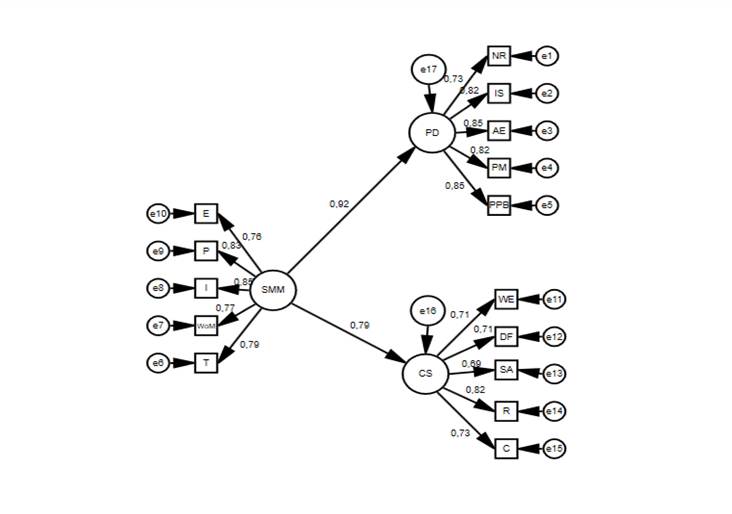
As shown in Table 4, the model reached an R-squared coefficient of 0.66, indicating that 66% of the variability in purchase decision and consumer satisfaction among Peruvian millennials is explained by social media marketing, demonstrating a high degree of explanatory power in the proposed theoretical model. The coefficients revealed that both Purchase Decision (β = 0.920, p < 0.001) and Consumer Satisfaction (β = 0.790, p < 0.001) are positively and significantly influenced by social media marketing (the exogenous variable). Purchase Decision showed the strongest standardized effect (highest β), indicating it is the most relevant predictor.
Figure 2 illustrates that social media marketing has a direct and significant effect on both purchase decision and consumer satisfaction among Peruvian millennials, with a p-value < 0.001. Specifically, 92% of purchase decision is determined by social media marketing, supporting the acceptance of Hypothesis H1. Likewise, the results show that 79% of consumer satisfaction is determined by social media marketing, confirming the acceptance of Hypothesis H2. Therefore, the overall study hypothesis is validated: “Social media marketing has a direct and significant effect on purchase decision and consumer satisfaction among Peruvian millennial consumers.”
Table 4 Coefficients of determination
| Model | Standardized Beta Coefficients | t | Next. |
|---|---|---|---|
| (Constant) | 6.978 | .000 | |
| Purchase decision | .920 | 19.036 | .000 |
| Consumer satisfaction | .790 | 1.503 | .000 |
| Independent or exogenous variable: Social Media Marketing |
DISCUSSION
5. Discussion
The main objective of this study was to analyze the effect of social media marketing on the purchase decision and consumer satisfaction of Peruvian millennials, proposing as a general hypothesis that social media marketing has a direct and significant effect on both variables. The results obtained through structural equation modeling confirm this hypothesis, showing direct and significant effects of digital social media marketing on purchase decision (β = 0.920, p < 0.001) and consumer satisfaction (β = 0.790, p < 0.001). The following section discusses these findings in relation to the specific hypotheses and the theoretical frameworks reviewed.
First, Hypothesis H1, which posits a direct and significant effect of social media marketing on the purchase decision of Peruvian millennial consumers, was strongly supported by the data. The causal coefficient of 0.92 with statistical significance (p < 0.001) indicates that social media marketing plays a decisive role in purchase decision-making for this segment. This finding aligns with Román et al. (2022) , who describe the purchase decision as a process influenced by the information and recommendations consumers obtain in digital environments. Likewise, Network Theory, as discussed by Montecinos (2007) and Stephen (2016) , explains that opinions and testimonials shared on social media shape brand perception and preference, strengthening trust and motivating purchase intentions-particularly among millennials characterized by high connectivity and active information-seeking behavior (Pedreschi & Nieto, 2021).
In addition, the presence of brand ambassadors and bidirectional interaction on social media-highlighted by Suleman et al. (2022) and Sehar et al. (2019) -helps build authentic connections that facilitate decision-making. Consequently, the strong influence observed on purchase decision (92% explanatory power) supports the need for companies to adapt their strategies to leverage the persuasive power of these platforms, as recommended by Kumar (2025) . Thus, digital social media marketing not only informs but also persuades and guides the consumer throughout the decision-making process, consistent with the Theory of Planned Behavior (Stranieri et al., 2023).
Regarding Hypothesis H2, the results show a causal coefficient of 0.79 (p < 0.001), confirming that social media marketing has a direct and significant effect on millennial consumer satisfaction. This effect can be explained by factors such as digital platform efficiency, delivery reliability, system availability, responsiveness, and compensation mechanisms-dimensions that align with the user experience and quality constructs described by Tang et al. (2023) and Doğan-Südaş et al. (2023) . This evidence is consistent with Lacaci’s (2017) satisfaction theory, which emphasizes the importance of these elements in optimizing the digital purchasing experience through personalized, user-centered strategies.
Similarly, personalization and transparency in data management-highlighted by Hasrama et al. (2024) and Restuccia and Double (2018) -are crucial for building trust and enhancing the consumer experience, leading to greater satisfaction and loyalty. Moreover, the immediate and public feedback enabled by social networks, as noted by Mendoza-Moreira and Moliner-Velázquez (2022) , amplifies satisfaction when experiences are positive, reinforcing the brand-consumer relationship.
These findings demonstrate that social media marketing not only influences purchase decisions but also contributes to fostering a favorable post-purchase experience-a key factor in loyalty and positive word-of-mouth, as indicated by Garcés-Giraldo et al. (2022) . Therefore, the satisfaction of Peruvian millennial consumers is closely linked to the quality of digital interaction and service provided, aspects that should be prioritized in digital marketing strategies.
Finally, the proposed structural model, with a determination coefficient of 66%, indicates that social media marketing explains a substantial proportion of the variance in purchase decision and consumer satisfaction among millennials. This explanatory level is consistent with previous studies emphasizing the centrality of social media as a channel for communication, influence, and commerce (Sehar et al., 2019; Zailskaite-Jakste & Kuvykaite, 2012).
The findings of this research strengthen the integration of the Theory of Planned Behavior and Network Theory, demonstrating that social media marketing simultaneously influences both individual cognitive processes and social validation dynamics. The results confirm the general hypothesis and show that this form of marketing constitutes a decisive factor influencing both purchase decision and consumer satisfaction among Peruvian millennials, establishing itself as a strategic axis for designing personalized, trustworthy, and socially meaningful digital experiences.
Overall, these results provide empirical evidence that reinforces the theoretical foundations reviewed and highlight the importance of integrated, user-centered digital strategies that generate trust, enhance interaction, and foster sustainable value experiences. In doing so, this study contributes to a deeper understanding of digital consumer behavior in the Peruvian context, offering both theoretical and managerial implications for contemporary marketing management.
This theoretical-empirical integration not only validates the assumptions of the proposed model but also opens new avenues for analyzing the influence of social networks on the development of digital trust and loyalty. Consequently, the results of this research provide a solid foundation for formulating more effective business strategies and for developing future studies aimed at understanding the evolving dynamics of consumption in emerging digital environments.
Concluding
6. Conclusions, Implications, And Future Research
This study has demonstrated that social media marketing exerts a direct and significant effect on both purchase decision-making and consumer satisfaction among Peruvian millennials. By analyzing the latent variables within the second-order constructs, it was observed that dimensions such as personalization, interaction, and user-generated content exert a particularly strong influence on purchase decisions, whereas digital experience efficiency and responsiveness are decisive factors in consumer satisfaction. This approach provides a deeper understanding of how each component contributes to purchase behavior and positive brand perception.
From a theoretical standpoint, this study contributes to the marketing literature by extending prior research (Abiola et al., 2025; Amrutha, 2025; Garcés-Giraldo et al., 2022; Kumar, 2025), which primarily focused on the relationship between social media marketing and purchase decisions. In contrast, the present study incorporates consumer satisfaction as an additional key variable. This inclusion is substantively relevant, as it transcends a merely behavioral analysis of the act of purchase to examine the degree of alignment between consumption experiences and expectations-particularly within the millennial segment-which directly affects loyalty, repurchase intention, and word-of-mouth recommendations.
Furthermore, this research enriches specialized knowledge by integrating network theory and the theory of planned behavior into a model that quantifies the influence of social media marketing on both constructs. This approach is innovative in that it combines the dynamics of digital social networks with planned behavioral intentions and purchasing behaviors, offering a more comprehensive understanding of the digital consumer.
Additionally, the study validates and expands upon the conceptual frameworks proposed by Stephen (2016) , Sehar et al. (2019) , Lacaci (2017) , and Román et al. (2022) , showing that social interaction and trust within digital environments are essential factors in shaping consumer attitudes and purchase behaviors. These dynamics do not operate in isolation but rather intertwine and mutually reinforce one another, leading to more complex decision-making processes among digital consumers. In this sense, the research highlights the need to adapt classical marketing and consumer behavior models by explicitly incorporating the social media dimension intrinsic to the digital ecosystem-thereby establishing a solid foundation for future scholarly inquiry in the field.
In terms of practical implications, the findings suggest that companies and brands in Peru and other emerging markets with high digital penetration should develop personalized digital marketing strategies based on data analytics, aimed at delivering relevant content that strengthens emotional connection and brand loyalty. It is essential to foster direct, two-way interactions with consumers on social platforms, facilitating real-time feedback, query resolution, and issue management-actions that build trust and enhance customer satisfaction.
Integrating user-generated content as a central component of digital strategies leverages digital word-of-mouth, increasing brand authenticity, credibility, and social influence. To achieve this, marketing teams must be trained in the strategic use of analytical tools and performance metrics to monitor campaign impact and dynamically adjust tactics according to local trends and technological adoption.
Moreover, transparency and control over personal data are critical-especially for millennials and younger consumers concerned with privacy-as they directly impact loyalty and satisfaction. Finally, from an academic perspective, universities are encouraged to incorporate specialized programs in digital marketing and social media management, emphasizing competencies in data analytics, digital communication, interactive experience design, and privacy management to prepare professionals capable of developing strategies tailored to local contexts and digital consumer expectations.
Among the study’s limitations, its exclusive focus on millennials constrains the generalizability of results to other age groups or socioeconomic segments. Additionally, the sample is limited to the city of Tacna; thus, future research should expand the geographic scope to validate the model’s consistency across different regional and cultural contexts. Future studies are also encouraged to include moderating variables such as gender and socioeconomic status to identify variations in how social media influences purchase decisions and satisfaction. It would likewise be valuable to examine other generational segments-such as Generation Z or older adults-to compare behavioral patterns and design more segmented digital marketing strategies. Furthermore, future research should analyze the differential impact of specific platforms-such as Instagram, TikTok, and YouTube-on consumer experience and behavior, considering the unique characteristics of each network.
Finally, exploring the effects of personalized advertising and privacy perception will deepen understanding of how these factors shape consumer trust and satisfaction, while longitudinal studies could provide evidence on the temporal evolution of social media marketing’s impact on purchase decisions and satisfaction within a constantly changing digital environment.
Appendix
7. Appendices
Annex 1.Social Media Marketing Scale
Annex1 = Strongly disagree, 2 = Disagree, 3 = Neither agree nor disagree, 4 = Agree; and, 5 = Strongly agree
Annex 2.Purchase Decision Scale
1 = Strongly disagree, 2 = Disagree, 3 = Neither agree nor disagree, 4 = Agree; and, 5 = Strongly agree
Annex 3.Consumer Satisfaction Scale
1 = Strongly disagree, 2 = Disagree, 3 = Neither agree nor disagree, 4 = Agree; and, 5 = Strongly agree
Annex 4.Harman's Single Factor Test.
References